




Final bid to get Saiful's witness statement dismissed
The Federal Court today dismissed Anwar Ibrahim's appeal to obtain the witness statement of Mohd Saiful Bukhari Azlan, which was recorded by the police, in connection with the opposition leader’s sodomy trial.
The Federal Court today dismissed Anwar Ibrahim's appeal to obtain the witness statement of Mohd Saiful Bukhari Azlan, which was recorded by the police, in connection with the opposition leader’s sodomy trial.
Today's decision comes after the apex court had earlier accepted a “two-page broad reasons of the Court of Appeal”, instead of the full judgment, as the basis for hearing the application.
In its unanimous decision, the court led by Chief Judge of Malaya Arifin Zakaria ruled that the High Court ruling was not within the definition of “decision” based on section 3 of the Courts of Judicature Act.
"It does not dispose of the rights of the appellant. Hence, the application before us is dismissed."
Arifin in his 19-page judgment agreed with the Court of Appeal judges that it was not a final order and that the matter could be raised during the High Court trial.
The other judges sitting with Justice Arifin were Justices James Foong and Md Raus Sharif.
Today's decision exhausts the attempts by the Permatang Pauh MP
 to get the witness statement of Mohd Saiful (
above
), made under section 112 of the Criminal Procedure Code.
to get the witness statement of Mohd Saiful (
above
), made under section 112 of the Criminal Procedure Code.
On May 11, High Court judge Justice Mohamad Zabidin Mohd Diah dismissed lead counsel Karpal Singh's application for a copy of Mohd Saiful's witness statement.
The reasons provided by the Federal Court in rejecting the appeal today were similar to those given in Anwar’s previous interlocutory applications before the court.
The sodomy charge against Anwar now faces a “ historic contradiction ”, after Mohd Saiful, the complainant and star witness, claimed on June 26, 2008, that the incident at the Desa Damansara condominium was “non-consensual”.
Despite this, the Permatang Pauh MP has been charged with “consensual carnal intercourse” under Section 377b of the Penal Code.
Last Thursday, Kuala Lumpur Hospital forensic pathologist Dr Siew Sheue Feng told the High Court that Saiful had told the doctors the alleged sodomy incident was done “ without force ”.
Considering possibility of impeaching Saiful
The May 11 High Court decision rejecting Anwar's application for Mohd Saiful's witness statement was upheld by the Court of Appeal, which only provided broad reasons for its decision, rather than the detailed written grounds of judgment that under normal circumstances could run in excess of 20 pages.
The defence wants Mohd Saiful's witness statement as it is looking into the possibility of impeaching his credibility for giving contradictory testimony in court.
Anwar's (
right
) lawyers had argued that if Mohd Saiful's testimony was in
 question, the charge against the opposition leader must necessarily fail.
Going by Mohd Saiful's testimony in court with what had been related by Dr Siew duing the forensic pathologist's testimony last Thursday, there have been contradictions.
Commenting on today's Federal Court decision, Karpal said it would have far-reaching implications as it would encourage judges to write brief judgments.
“If that is the scenario, lawyers need not provide lengthy submissions in court. Judges must give a reasoned conclusion, which is backed by authorities, in arriving at an acceptable decision,” he told reporters.
Broad reasons 'clear and comprehensive'
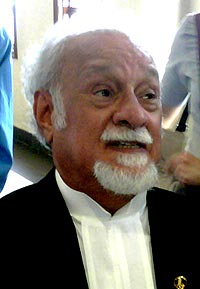
Justice Arifin, who is the third most senior judicial officer in the country, noted that Karpal ( below ) had applied for the detailed grounds of judgment and not the broad reasons as the defence felt it would be prejudicial for the appellants to prepare a memorandum of appeal.
“Grounds or reasons for a judgment are required so that parties, particularly the unsuccessful one, would know why the judge arrived at the decision the way it was. It can be obvious in cases where the facts are not in dispute and the law is well established.
“In such a case, all that is needed is the conclusion and reasons in support of the same. This is not to say that in all cases, judgments should be brief and concise. ”
Justice Arifin said the court accepted the “broad reasons” as the grounds when the facts were not disputed.
 If the facts were disputed, the judge had to discuss and analyse them, and where the law was in doubt, he should argue it out before arriving at a decision.
The Chief Judge of Malaya said the “broad reasons” given by the Court of Appeal in its two-page judgment were “clear and comprehensive”.
“Hence, this could be adopted as part of the reasoned judgment for this court to make a decision. However, this does not mean we discourage judges from writing long judgments.
“A judgment must contain the conclusion and the judge’s reason to support the decision. It should not be too brief and concise,” he said.
Furthermore, Justice Arifin said, the Court of Appeal decision in this case had cited the proper authorities in arriving at the decision.
“They made their decision and gave reasons for adopting the decision. The Court of Appeal was right and had discharged the duty properly,” the judge ruled.
“In fact, our learned Chief Justice (Zaki Azmi) has been advocating that judges should write short and concise judgments. We entirely agree with him. This is what the Court of Appeal had done in this case,” the Chief Judge of Malaya said.
Against the backdrop of today's decision, lawyers fear that future judgments from the Court of Appeal and the Federal Court could see a deluge of “broad reasons” being adopted, and brief one- or two-page judgments becoming the norm.


Report this comment
Are you sure you want to delete this comment?
This action cannot be undone.