




Sodomy II: Apex court sets 'unusual' precedent?
The Federal Court departed from normal practice today and accepted a two-page "broad reasons" decision of the Court of Appeal to hear Opposition Leader Anwar Ibrahim's appeal against the lower court's dismissal of his plea for the witness statement of Mohd Saiful Bukhari Azlan.
The Federal Court departed from normal practice today and accepted a two-page "broad reasons" decision of the Court of Appeal to hear Opposition Leader Anwar Ibrahim's appeal against the lower court's dismissal of his plea for the witness statement of Mohd Saiful Bukhari Azlan.
Normally, the nation's highest court would rely on the detailed grounds of judgment before deciding to hear an appeal.
However, in an unusual development, the Federal Court agreed to accept the two-page decision titled "broad reasons", handed down by a three-member bench of the Court of Appeal on June 25, as the basis for the grounds of the lower court's decision in rejecting Anwar's appeal.
Anwar, who is charged with sodomising Saiful at a condominium in Bukit
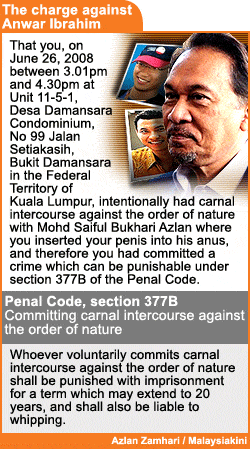 Damansara on June 26, 2008, had appealed to the Court of Appeal against the decision of the High Court, before which he is being tried, in rejecting his request for Saiful's witness statement made under section 112 of the Criminal Procedure Code.
Lawyers fear today's Federal Court decision may become a precedent for the acceptance of such "brief reasons" for court decisions to be constituted as grounds of judgment.
Anwar's lead counsel Karpal Singh had at the outset said they were prepared to go on with today's appeal, but were hampered by the lack or absence of the Appeal Court's grounds of judgment.
"What we have, as stated in our appeal records, are not the 'Grounds of Appeal' but 'Broad Reasons' for the decision, which they handed out on that day.
"Without the detailed Grounds of Appeal, which the appellant is entitled to under the law, the appellant is prejudiced in putting up a proper petition of appeal," the senior lawyer submitted.
Chief Judge of Malaya Arifin Zakaria, who heads the three-member Federal Court panel, asked whether Karpal was seeking an adjournment, to which Karpal said he was prepared to go on despite the handicap, for the apex court could ask the appellate court to submit the proper grounds of judgment, not just the broad reasons.
"I am not asking for a postponement, but am worried that my client may be prejudiced by such limited reasons. The appellant is entitled to the proper grounds and not the brief broad reasons," he said.
 Solicitor-general II Mohd Yusof Zainal Abiden submitted that the broad reasons could be considered as part of the grounds of judgment.
After a short break, Justice Arifin ruled that the court agreed with the prosecution's submission and accepted the "broad reasons" of the Court of Appeal to be the grounds of judgment for its decision.
"We will now hear the merits of the appeal," Justice Arifin said. Sitting with him in the unanimous decision was Justices James Foong and Md Raus Sharif.
Consensual and non-consensual
Karpal went on to submit that there was a contradiction of sorts with what Anwar was charged with and the testimony that had been adduced in court.
"Anwar is charged with consensual carnal intercourse under section 377B of the Penal Code. However, the evidence adduced, including that from Saiful's ( above ) testimony, is that the incident was non-consensual, under section 377C.
"Hence, we are applying to get Saiful's section 112 of the Criminal Procedure Code witness statement. We want to have a look at the statement as there are contradictions."
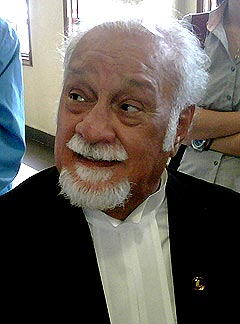 Karpal (
right
) had raised the issue with the trial judge in the High Court, Justice Mohamad Zabidin Mohd Diah, on grounds the court is faced with
historic contradiction
between the charge against an accused and the testimony of the main witness.
Karpal (
right
) had raised the issue with the trial judge in the High Court, Justice Mohamad Zabidin Mohd Diah, on grounds the court is faced with
historic contradiction
between the charge against an accused and the testimony of the main witness.
The senior lawyer wanted access to Saiful's statement, as well as the statements of other witnesses, with the view of possibly having Saiful charged with perjury for making conflicting statements in court.
However, Justice Zabidin dismissed the application, ruling that although there were material contradictions in Saiful's police report and testimony, the witness's statement was not in conflict with the incident of sodomy.
This decision was upheld by the Court of Appeal, which ruled on June 25 that it had no jurisdiction to entertain appeals on interlocutory matters decided in the course of a trial, by virtue of the amendment to Section 3 of the Courts of Judicature Act (CJA), because such a ruling was considered not a final order.
Judgment is deferred
Karpal submitted today that the appellate court was wrong in ruling the High Court's rejection of the witness statements sought by Anwar's counsel as "an interlocutory appeal", arguing that it was considered a final order and hence appealable.
"This is within the parameters of a decision under section 3 of the CJA," he said.
Karpal added that while there was no doubt the public prosecutor had every right to charge an individual under any section, the prosecution had in this case led evidence of non-consensual intercourse against the order of nature, under section 377C of the Penal Code, despite Anwar being charged under section 377B.
Yusof submitted that a proper interpretation of section 3 of the CJA meant that the application could not be entertained as it was an interlocutory application and did not dispose of the rights of the accused.
"This is not a final order which disposes of Anwar's rights. It is a ruling made during a course of a trial. If it was done at the end of prosecution's case or end of the defence case, where a decision had been made, then it would be appealable," he said.
Justice Arifin then deferred decision on the matter, saying the court had to make an in-depth judgment on the interpretation of section 3 of CJA.
Outside the court, Karpal said today's decision of the Federal Court to accept the "broad reasons" as a grounds of judgment was a bad precedent.
"It will now encourage judges to write brief decisions and give broad reasons and it will be difficult for appellants to appeal. This can cause miscarriages of justice," he added.


Report this comment
Are you sure you want to delete this comment?
This action cannot be undone.