




Food inflation: Why grocery bills are higher
SPECIAL REPORT The November 2010 inflation figure may only have indicated a modest rise in prices of 1.7 percent compared to the same month in 2009, but on the ground the pinch is tighter.
A deeper look into official statistics may explain why the average Joe has been force to tighten the belt beyond what is expected from the marginal overall price hike.
SPECIAL REPORT The November 2010 inflation figure may only have indicated a modest rise in prices of 1.7 percent compared to the same month in 2009, but on the ground the pinch is tighter.
A deeper look into official statistics may explain why the average Joe has been force to tighten the belt beyond what is expected from the marginal overall price hike.
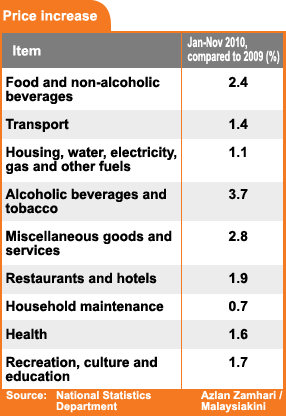 The largest contributor to the inflation rise, said the National Statistics Department (NSD), is the increase in price of food and non-alcoholic beverages.
More importantly, this mainly consists of food eaten at home, putting much pressure on grocery bills for working families, especially when a significant 40 percent of them earn less than RM1,500 per month.
Families are also facing hikes in utility bills (up 1.1 percent according to official data), transportation costs (up 1.4 percent), healthcare charges (up 1.6 percent) and education fees (up 1.7 percent).
“Among the sub-groups (of food at home) which showed significant increases during the period (of January to November 2010) were sugar, jam, honey, chocolate and confectionary (10.2 percent), vegetables (8.1 percent), meat (2.9 percent), fruit (1.7 percent), fish and seafood (1.6 percent) and rice, bread and other cereals (0.9 percent),” said the NSD.
On the ground ,though, observations indicate that wallets are far lighter than suggested by such data.
The Federati
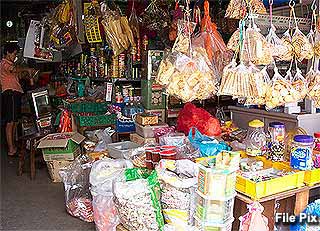 on of Sundry Goods Merchants Association of Malaysia represents 40,000-odd sundry stores.
Its president Lean Hing Chuan estimates that at least half of the goods they stock, mostly food, have increased in price by up to 20 percent over the past few months.
Worst, Lean said the price of items like onions went up several times last year, from about RM1 per kg to up RM4 per kg.
Price monitors at the Consumer Research and Resource Centre (CRRC), too, show price hikes greater than reported by the NSD, whose data only covers the period up to November 2010.
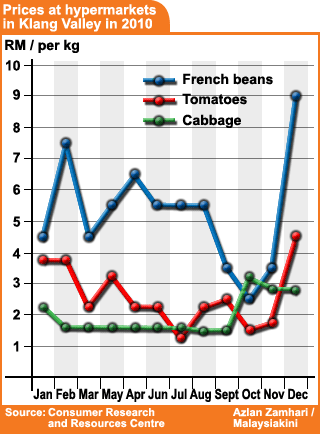
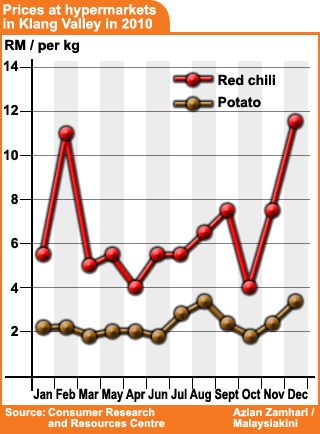 The prices of red chillies sold in Klang Valley hypermarkets, for example more than doubled to RM11.50 per kg in December 2010, compared to RM5.50 in January last year.
The CRRC, which is part of the Federation of Malaysian Consumer Association (Fomca), also found that the price of garlic had increased by 62 percent from RM6.50 per kg in January 2010 to RM11.00 per kg by the end of the year.
Fomca president Paul Selvaraj explained that the sharp increase was due to the shortage of supply from exporter China, where crops were affected by volatile weather conditions.
“This is something we cannot avoid and it is affecting the whole world,” he said.
On Jan 5, the UN Food and Agriculture Organisation announced that global food prices have climbed to historical heights.
Its price index - a basket tracking the wholesale cost of commodities such bas wheat, dairy products and meat - jumped to 214.7 points, above its previous peak of 213.5 in June 2008.
Food imports
This is bad news for once-agricultural Malaysia, which now imports much of its food supply and which is unable to conclude the long debate over its food security.
“Our statistics show that about 50 percent of Malaysia’s food requirements are met by imports, which means that we are highly affected by rising commodity prices,” said Ratings Agency Malaysia chief economist Yeah Kim Leng.
He added that this also affects the price of meat as most of feedstock is imported.
While it is difficult to pinpoint which factors that have caused the most impact, local conditions cannot be ruled out in the phenomenal escalation of food prices.
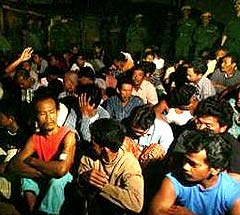 The authorities have stepped up raids to round up foreign workers at the Selayang wholesale market in Selangor, causing prices to soar up to 100 percent, said Kuala Lumpur Vegetable Wholesaler Association president Chong Tek Keong.
The market, with 448 stalls, supplies most of the vegetables, fruit and seafood needs of the Klang Valley, and the shortage of workers has left its operators in a dire situation.
"After a dialogue on Jan 11, the Kuala Lumpur CID chief agreed not to arrest documented foreign workers . This will solve the shortage of workers," said Chong.
He expects prices to stabilise by Chinese New Year early next month, although it may rise again due to local shortages in food supply due to the rainy season. This will have to be supplemented with imports.
Consumer
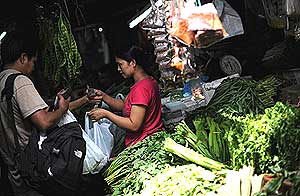 Association Penang president SM Idris questioned the cited impact from the raids in Selayang, saying this was hardly likely to have forced up prices all the way in Penang.
He blamed the shoddy distribution lines for vegetables from Cameron Highlands, which travel to the Klang Valley before packed for the northern states.
“In between, you have three or four middlemen who raise the price at each point,” he said.
 Fortunately, the price hike will not affect rice as there is sufficient international supply.
Federation of Malaysian Rice Wholesalers president Ng Chee Len said any jump in price due to the Chinese New Year will only be temporary.
While the subsidy of RM1.80 per litre of cooking oil remains in place, shortages continue to pressure prices, said Lean.
Hoarding, he claimed, has exacerbated the situation but the shortage is also due to “irresponsible producers” who are exporting subsidised goods abroad to almost double their profits.
"The price of cooking oil in Singapore, Thailand and Indonesia is RM4 per litre, while it has exceeded RM6 in China. This is much higher than our local price of RM2.50," he said.
‘Textbook analysis’
The price hikes have also found their way to restaurants, with traders blaming subsidy cuts for increased production costs.
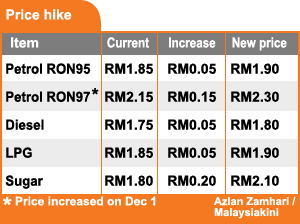 In July, the first round of subsidy cuts brought up prices of RON95 petrol to 1.85 per litre, diesel to 1.75 per litre, sugar to 1.75 per kg and natural gas used in cooking by RM1 to RM1.40 per tank, depending on volume purchased.
This was followed by the 4-in-1 hike last December, raising RON95, diesel and prices by another five sen while the sugar price jumped another 20 sen to RM2.10 per kg.
When proposing the subsidy cuts, the Performance and Management Delivery Unit said that - excluding sugar price hikes - it expects the price of items like roti canai and teh tarik to go up by only 1 sen.
However, Yeah said this was a “textbook analysis” as traders are unlikely to raise prices by just 1sen - the lowest would be by 10 sen, as is the case for beverages sold at hawker stalls.
An analysis by CAP found that the price of roti canai is disproportionate to the increased cost of flour and sugar.
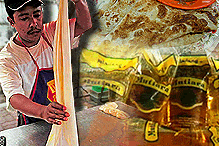 “We found that 1kg of flour can produce about 12-15
roti canai
. With the cost of labour, sugar, oil, curry and gas included, it should only cost about 60 sen each, so selling it for more than RM1 is unreasonable. The price hike is not proportionate,” said Idris.
“We found that 1kg of flour can produce about 12-15
roti canai
. With the cost of labour, sugar, oil, curry and gas included, it should only cost about 60 sen each, so selling it for more than RM1 is unreasonable. The price hike is not proportionate,” said Idris.
Yeah, though, said this is “natural pricing behaviour” as traders will seek to maximise profits.
“So the only way for the government to control this is to ensure greater competition.
Traders will then have to think twice before raising prices,” he added.
Tomorrow: Should subsidies still be rolled back?


Are you sure you want to delete this comment?
This action cannot be undone.