




'Not possible for Teoh to squat on ledge and jump'
It would not have been possible for Teoh Beng Hock to squat on the window ledge and jump forward, said an expert witness testifying before the Royal Commission of Inquiry (RCI) investigating his death.
It would not have been possible for Teoh Beng Hock to squat on the window ledge and jump forward, said an expert witness testifying before the Royal Commission of Inquiry (RCI) investigating his death.
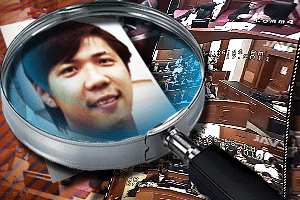 Universiti Teknologi Malaysia's associate professor in mechanical engineering, Sallehuddin Muhamad, concluded this in his report after reconstructing Teoh's fall in nine possible ways.
"Squatting on the window edge and then jumping forward is not possible due to the size of the open window. The head will hit the window panel if he jumps from this position," Sallehuddin said in his report.
During the proceedings, Sallehuddin's theory was heavily scrutinised by the Bar Council and the MACC.
The professor, when asked by MACC lawyer Muhammad Shafee Abdullah if he was satisfied with the findings, said:
"I'm not satisfied because to me to change a human body to an elliptical shape is not acceptable... for me to assume that a human body is elliptical in shape is not 100 percent correct but for the moment I have to accept it as this is the closest ," admitted Sallehuddin.
In the report submitted to commission this morning, Sallehuddin suggested two possible positions of Teoh's fall:
(a) Without the air resistance effect
- pushed horizontally forward at 1m/s (Case 2)
- pushed downwards at a speed of 3m/s and a 20-degree angle (Case 7)
(b) With the aerodynamic effect
- Sit on the window edge and free-fall to the ground at initial angle of 4.75 degrees.
"Squatting on the window edge and then jumping forward is not possible due to the size of the open window. The head will hit the window panel if he jumps from this position," he added after the second suggestion.
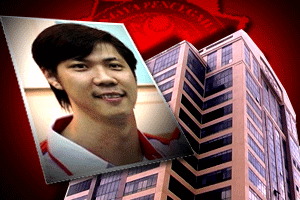 "Situation (a) is homicide, while situation (b) is suicide. To fall from situation (b), the deceased must be sitting on the window edge for a very short time before free-fall as the sharp edge of the window frame will be uncomfortable for him," the report stated.
Sallehuddin, who specialises in aircraft accident investigations, was engaged by the RCI's private investigator Michael Leslie Squires after the commission called for a reconstruction of the fall via computer animation in February.
He told the panel today that he visited the scene of the incident in March, accompanied by several officers from the Chemistry Department and police officers.
"It is not possible to open the window to the farthest extent without difficulty. A few of us had to push it all the way," said Sallehuddin.
He explained that the window from which Teoh had fallen measured slightly more than 96 feet from the fifth floor landing and "if one is to open the window, the person must bend over".
"I asked my assistant to sit on the window ledge to simulate the fall but we didn't try to jump... it is very uncomfortable to squat on the ledge for long," he testified.
The inquiry took a 30-minute break after the professor had introduced himself and submitted his report to the panel.
However, the panel after the break decided to reserve Sallehuddin's testimony for later in the day and to first question Teoh's friend, Woo Chuan Sing, and colleague Mandy Ooi.
After lunch the inquiry continued with Sallehuddin on the stand.
Bar Council lawyer Christopher Leong evaluated the possibilities proposed by Sallehuddin in-depth and suggested the study was not of any "practical consequences" as it did not take into account of factors such as the mass of the deceased and air flow during the fall.
"The analysis can still be used a guideline to determine the fall... But I wouldn't say it is 100 percent (accurate) because it doesn't consider air flow, weather conditions and position of the body," said Sallehuddin.
Leong suggested ideally a "life-size mannequin of proper texture and equal mass" would be best to experiment with, to which Sallehuddin concurred.
"The police officer came the with me on that day (to Plaza Masalam) and brought a mannequin with him. But I didn't want to perform the experiment with that mannequin as it was plastic and it would shatter upon fall," he explained.
Leong told the panel they had been in contact with Rodney Cross, a forensics physicist from Sydney, Australia, who proposed that to derive accurate deductions, the experiment had to be conducted using the right mannequin.
 The lawyer informed the panel that Cross is willing to provide his expertise but RCI chairperson James Foong (
left
) said that the commission must complete its investigation by next week.
The lawyer informed the panel that Cross is willing to provide his expertise but RCI chairperson James Foong (
left
) said that the commission must complete its investigation by next week.
Instead, he asked Leong to check with Cross if he would be able to provide evidence by next Tuesday and a more substantial theory as well as the cost, before the commission can decide on the matter.
Teoh was found dead on the fifth floor landing of Plaza Masalam in Shah Alam on July 16, 2009, after being questioned overnight as a witness by the Selangor Malaysian Anti-Corruption Commission (MACC).
The MACC was investigating his employer Seri Kembangan assemblyperson Ean Yong Hian Wah over alleged irregularities in disbursement of state funds, but could not find evidence of this.
Below is the full summary of Sallehuddin's findings:
Conclusion
A. Most probable position before the fall:
Based on the fall analysis, the most probable ways the body fell to the ground are:
(a) Without the air resistance effect
(i) pushed horizontally forward at 1m/s (Case 2)
(ii) pushed downwards at a speed of 3m/s and 20 degrees angle (Case 7)
(b) With the aerodynamic effect
Sit on the window edge and free-fall to the ground at initial angle of 4.75 degrees.
(c) Squatting on the window edge and jumping forward is not possible due to the opening size of the window. The deceased's head will hit the window panel if he jumps in this position.
Situation (a) (i) and (ii) are homicide , while (b) is suicide. To fall from situation (b), the deceased must be sitting on the window edge for a very short time before free-fall as the sharp edge of the window frame will be uncomfortable for him.
B. Marking on the shoes
Markings on his shoes (labelled A) were due to wear and tear as there are no markings on the outside wall of the 14th floor during my inspection.
However, markings (labelled B) may occur when the shoes made contact with the sharp edges of the window during situation (b).
Unanswered questions
The window handle lost from the window lock. According to the maintenance personnel, the handle was installed on the window prior to the incident. Did the handle break due to:
(a) The deceased grabbing the handle to prevent himself from falling, but the handle breaking due to the weight of the body?
(b) The handle catching part of the body/clothing and breaking due to its weight?
Situation (a) is homicide and situation (b) is suicide.
'Anuar broke his promise'
On another matter, Kota Alam Shah assemblyperson and lawyer M Manoharan said he spoke to Teoh last when received a call from the latter when he went to the MACC on July 15, 2009 to accompany Teoh.
"I was at the reception area but was not allowed to be together with Teoh. I was told to wait and I waited for about an hour," he said.
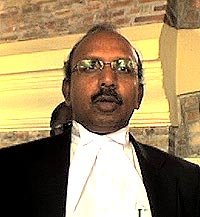 Manoharan (
left
) said that MACC investigation officer Mohd Anuar Ismail informed him that he could stay with his client, while his statement was being recorded by the graft-busters.
Manoharan (
left
) said that MACC investigation officer Mohd Anuar Ismail informed him that he could stay with his client, while his statement was being recorded by the graft-busters.
"But Anuar played me out... I could not be with Teoh... we gave in and cooperated all the way from the beginning... but at the crucial moment, I was refused (entry)," complained Manoharan.
"(If I wasn't allowed in) I shouldn't have been let to come all the way in the first place," he told the panel.
MACC's counsel Shafee then asked Manoharan if he agreed that in law, suspects had no right to counsel immediately, to which the latter responded that he did.
Pressed by Shafee, Manoharan concurred that there are no instances where a lawyer was allowed to be with witnesses while their statement was being recorded.
"But there is no law to refuse lawyers to be present also," he said adding that lawyers were usually threatened by cops that they would become witnesses if they were present when statements were taken from suspects.
"That's what the authorities do and they say if we become witnesses we can no longer represent our clients," he said.
Meanwhile, Teoh's sister Lee Lan, who was slotted to testify on Thursday, will be asked to explain her comments that there were suspicions the RCI was in cahoots with the MACC.
Shafee raised the issue with the commission over her statement to the media and that it was in contempt, as she had criticised the commission for postponing the inquiry last Thursday.
The inquiry resumes tomorrow.


Report this comment
Are you sure you want to delete this comment?
This action cannot be undone.