




Acid attacks symptom of a society in disarray
COMMENT There is a dire need to address worrying issues affecting Malaysian society today.
News of a wanton acid splashing spree by certain individuals on innocent victims completely unknown to the culprits, within the Klang Valley mostly, have riveted the attention of the Malaysian public to the point where these incidences have become the focal point of gossip, small talk and much speculation.
COMMENT There is a dire need to address worrying issues affecting Malaysian society today.
News of a wanton acid splashing spree by certain individuals on innocent victims completely unknown to the culprits, within the Klang Valley mostly, have riveted the attention of the Malaysian public to the point where these incidences have become the focal point of gossip, small talk and much speculation.
While the focus of much of this communication between people is on the motive behind these brazen attacks, it might be also important for us to perhaps size up the worrying gejala sosial or social ills that now plague the country.
However, splashing acid to maim, injure or even kill goes beyond the scope of a mere social ill. But since this malaise has been copied by a couple of other errant youths as a means of calling attention to their bold and vicious deeds, it does amount to another form of social malaise affecting the nation today.
In the light of these incidents, much-vaunted outrage has been sparked, most of which has been directed to the men in blue. The slow and hapless response and reaction by the police force is a certain dent in the pride of their quest for greater professionalism within their ranks.
The confidence and trust by Malaysians of all walks of life in the police have steadily been eroding in recent times, not only in the case of acid splashing. The inept attitude of the police, their approach towards policing, and the view by youths that being a policeman is a cushy job, have caused a marked deterioration in the force, becoming more of a semblance of policing.
If social ills today within Malaysian society have started to grow rapidly, it will be quite right, though not exact, to lay the blame on the authorities and the police as custodians of law and order.
Every sphere of social ill in this country has started to witness a marked increase, though this fact is often downplayed by the authorities or distorted by the use of statistics.
 While the police confess that incidences of rape cases are on the rise, the contention by the All Women’s Action Society Malaysia is that it is not only on the rise but that “a rape occurs every 15 minutes in Malaysia,” contrary to what was earlier purportedly stated by other sources.
A shocking revelation even from federal police statistics on rape cases in the country from 2006 to 2010 was that 73 percent of the reported 16,159 victims during this period were girls under the age of 18. What about the number of rape cases that go unreported?
Arresting the growing trend
Since Malaysia has a population of 28 million people at the last
 census, it can ill afford to allow social ills to go unchecked. If left unchecked, we face the bleak prospect of being a nation made up of more and more sick people very soon. But the media, NGOs and concerned individuals have from time to time been spearheading moves and directing the attention of the authorities to arrest the growing trend in social ills.
Ever since the boh sia and lepak episode was highlighted in the 90s, more social ills have started to creep into Malaysian society. We are now witnessing, in line with our bid to be a high-income, developed nation by 2020, probably a high spike in the number of deviant persons with deviant behaviour.
 Earlier on if it was the case of
Mat Rempits
that the authorities were harried into rehabilitating, the saga has created a spin off in the form of
Mat Sikals
evolving. These are cyclists who emulate the daring, death-defying feats of
Mat Rempits
but on a much smaller scale.
Earlier on if it was the case of
Mat Rempits
that the authorities were harried into rehabilitating, the saga has created a spin off in the form of
Mat Sikals
evolving. These are cyclists who emulate the daring, death-defying feats of
Mat Rempits
but on a much smaller scale.
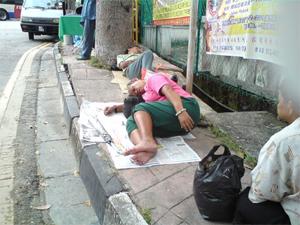
If these scenarios are not a cause for concern, witness the increase in the number of homeless, destitute people sleeping under the starry skies of the city of Kuala Lumpur along five-foot ways and pavements oblivious to the stares from curious onlookers.
Children have also become even more vulnerable to wrongdoing and harm. Last year was a low point in children’s safety and well-being, with police recording 257 cases of physical abuse against boys and girls.
The number, compared to 203 in 2009, is the highest recorded over the last five years. Besides these facts, a staggering majority of the abusers were supposedly responsible adults such as guardians, babysitters or the fathers themselves.
If this is not bad enough, the authorities seem to “encourage” the dumping of unwanted babies by stating openly that there are plans on the drawing board to operate more baby hatches as they seem to be gaining in popularity. Is this the best solution? Other individuals and organisations are describing this measure as merely offering “symptomatic relief” and not tackling the problem at the root.
Further, if you were just to wander around the major towns and cities of the country, you will find a significant number of mentally and emotionally ill people. This is because unofficial estimates put the number of mentally ill at around 10 percent of the population which translates to close to 3 million Malaysians in need of some form of psychiatric or psychological care and counsel.
 Added to this are the growing numbers of the beggar population that have become a menace to society. Not only local beggars, but nowadays we have expatriate beggars from China, the Philippines and Burma vying for a share of Malaysians’ generosity not just in urban areas but also in the rural areas of the peninsula, Sabah and Sarawak.
Best to seek lasting measures
While efforts to clamp down on these beggars are laudable, it is perhaps better to seek lasting measures rather than have to see them return to the streets to beg once they have been taken off the streets and sent for rehabilitation. This issue needs to be addressed so as to discourage other weak-willed individuals from resorting to this form of option to earn a living.
Aside from rehabilitating beggars, the measures by the authorities to turn around the lives of drug addicts have so far shown a very dismal performance. This is simply the reason why drug abuse is still Public Enemy No1 and has been so for the last three or four decades. Efforts to eradicate and eliminate this destructive behaviour especially among youths needs to undergo a major revamp in line with the current situation.
Time and space does not permit in this forum to jot down the full list of woes that afflict Malaysian society today. But most of us have some form of awareness that Malaysia is now a and where the down-and-out are growing rapidly every year as we head towards the status of fully-developed nation by 2020.
While anyone will welcome the push to become an advanced and developed country, let's ensure the price we pay is fair and worth it. Otherwise much of the benefits and gains of evelopment may be lost in the form of having to nurse the sick and infirm and to put up with eople that are a threat or a public nuisance.
The right thing to do will be to strive for a society that is whole and is able to integrate with ne another and be able to meet the challenges of the future with confidence and assurance. Only such a “prepared society” will prevail and triumph over adversity and challenges, difficulties, problems and crises.
But as Malaysia stands today, the disarray that has begun to foment is enough to assure right-thinking individuals that the future might not augur well for even more Malaysians as the list of casualties across society continues to grow.
CHRISTOPHER FERNANDEZ has been teaching and writing throughout Asia since 1984.


Are you sure you want to delete this comment?
This action cannot be undone.