




Hindraf Makkal Shakti takes dispute to court
Hindu Rights Action Force pro-tem secretary P Ramesh is seeking judicial review of the government's refusal to register Hindraf Makkal Shakti as a non-governmental organisation.
Hindu Rights Action Force pro-tem secretary P Ramesh is seeking judicial review of the government's refusal to register Hindraf Makkal Shakti as a non-governmental organisation.
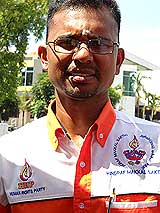 Ramesh (
left
), along with Hindraf leaders P Uthayakumar and M Manoharan, were present when the application was filed at the Kuala Lumpur High Court registry this morning.
Ramesh (
left
), along with Hindraf leaders P Uthayakumar and M Manoharan, were present when the application was filed at the Kuala Lumpur High Court registry this morning.
The application named Prime Minister Najib Abdul Razak, Home Minister Hishammuddin Hussein, Registrar of Societies Malaysia (ROS) and ROS Federal Territory as respondents.
Ramesh is seeking an order of certiorari (an order to set aside) any decision of the respondents to reject his application.
He is also seeking a writ of mandamus (an order to compel) the respondents to register Hindraf Makkal Sakthi with the ROS within seven days of the court decision, based on the provision of Article 8 (on equality) in the federal constitution.
Alternatively, Ramesh is seeking other relief deemed fit by the court and for the costs of the application to be borne by the respondents.
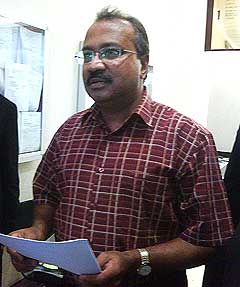 Uthayakumar (
right
) said it is unprecedented anywhere in the world for an NGO not to be allowed to be registered.
Uthayakumar (
right
) said it is unprecedented anywhere in the world for an NGO not to be allowed to be registered.
Manoharan pointed out that the ROS had allowed Perkasa to be registered despite the Malay-rights pressure group time and time again affecting and upsetting the security of the nation with seditious statements.
“Why is it that Perkasa has been registered but not Hindraf Makkal Shakti when we can see that they (Perkasa) have made many questionable statements that have upset the society?” asked Manoharan, who with Uthayakumar, was one of the five leaders of the original Hindraf.
In the application filed by Manoharan's legal firm, Ramesh said Uthayakumar's law firm, Kumar Hashimah & Co, had on Oct 2, 2009, applied for the registration of Hindraf Makkal Shakti as a NGO.
A second letter dated March 18, 2011, was written with the same purpose and was received by the respondents on March 23.
Manoharan's law firm sent another letter dated April 11, asking the ROS and the others to approve the application based on the right to freedom of association as per Article 10(1) of the federal constitution, which is read together with Article 8.
In that letter, the applicants stated that failure to respond would result in legal action being instituted to seek an order certiorari and writ of mandamus .
‘Selective approval’ questioned
Ramesh said the respondents had acted mala fide (with bad intention) in not allowing Hindraf Makkal Shakti's registration and this was prevalent as the ROS had approved and allowed the registration of 46,870 other NGOs.
Such “selective approval” had been given for pro-government NGOs such as Perkasa, Pekida, Malaysian Makkal Shakti Party and the Parti Kesejahteraan Insan Tanah Air, which were approved by the respondents within two to four weeks.
He claimed that bad intention was also prevalent as the respondents failed to or negligently decided not to reply to all the letters from the applicants, even when all the documentation for the application were said to be complete.
Ramesh argued that the BN/Umno government does not want Hindraf Makkal Shakti to fight for the rights of the marginalised Indian Malaysian community, and cited several instances of action against the group.
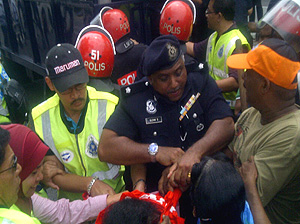 He said he was
physically assaulted
during a peaceful gathering on April 13 - in relation to the Kampung DBI issue in Ipoh, Perak - which led to him being admitted to Ipoh Hospital.
He said he was
physically assaulted
during a peaceful gathering on April 13 - in relation to the Kampung DBI issue in Ipoh, Perak - which led to him being admitted to Ipoh Hospital.
On Feb 27, during a peaceful gathering to protest the inclusion of ‘Interlok’ as a Form Five Malay literature textbook, several senior members of Hindraf Makkal Shakti and 54 others were arrested and assaulted because they were deemed to be part of an illegal organisation.
There were also arrests of the members for their involvement in a peaceful march in Kuala Lumpur against Umno's racism and ‘Interlok’, with Uthayakumar being one of those detained.
Ramesh said such actions were illegal as these were the direct result of the respondents not wanting to allow Hindraf Makkal Shakti to be established as a legal entity.
He added that under the right to freedom of association and principle of equality, he has legitimate expectations to seeing the respondents register the group.


Are you sure you want to delete this comment?
This action cannot be undone.