




MP resurrects controversial RM1.8bil KTMB deal
PAS central committee member and Kuala Selangor MP Dzulkefly Ahmad resurrected today the controversy over Keretapi Tanah Melayu Berhad's (KTMB) RM1.8 billion purchase of Electric Multiple Units (EMU) from Zhuzhou Electric Locomotive Co (ZELC) of China.
PAS central committee member and Kuala Selangor MP Dzulkefly Ahmad resurrected today the controversy over Keretapi Tanah Melayu Berhad's (KTMB) RM1.8 billion purchase of Electric Multiple Units (EMU) from Zhuzhou Electric Locomotive Co (ZELC) of China.
 Recounting the government’s
clearance of the deal
from any alleged irregularities in July last year, Dzulkefly (
right
) said he and his consultants should by now be allowed to scrutinise the specifications documents that had served as the basis for the negotiations to purchase the 38 sets of EMU trains from ZELC.
Recounting the government’s
clearance of the deal
from any alleged irregularities in July last year, Dzulkefly (
right
) said he and his consultants should by now be allowed to scrutinise the specifications documents that had served as the basis for the negotiations to purchase the 38 sets of EMU trains from ZELC.
“Given that there is no element of irregularity as stated by the (then) transport minister, I believe there would be no problem for me to review the said specification documents and compare them with the EMU specification documents used for the previous tender that are in my possession,” said Dzulkefly in a statement.
Dzulkefly first raised the claim of leakages in the purchase of the 38 EMU trains in Parliament in late June 2010, claiming that it had taken less than two months for the price of each EMU to balloon by more than three times after direct negotiations between KTMB and ZELC.
As a result of the direct negotiations, he claimed further, the government will be paying RM48 million each for the 38 units of six-car EMUs, as opposed to RM14 million for each of the units earlier agreed when eight sets of three-car EMUs were booked by KTMB.
Dzulkefly also claimed that the government would end up being shortchanged by up to RM500 million over the purchase.
Parliament’s public accounts committee (PAC) had referred the case to the Malaysian Anti-Corruption Commission (MACC) before the then-transport minister Ong Tee Keat made his remarks clearing the deal.
 According to Ong (
left
), the 2008 KTM tender was cancelled and not awarded, in light of new demands and needs highlighted by the National Key Result Areas (NKRA) for Urban PublicTransportation that surpassed those contained in the tender.
According to Ong (
left
), the 2008 KTM tender was cancelled and not awarded, in light of new demands and needs highlighted by the National Key Result Areas (NKRA) for Urban PublicTransportation that surpassed those contained in the tender.
The quantity under the procurement was, furthermore, for 38 sets of six-car trains. Any price comparison must always be based on the technical specifications or run the risk of comparing apples with oranges, said Ong.
The direct negotiation for the procurement was not directed and endorsed by the Transport Ministry but by the Finance Ministry, he added.
In his statement today, however, Dzulkefly expressed dissatisfaction with the still unanswered questions over the whole deal.
Why, for instance, was the government’s criteria that led it to engage in direct negotiations with ZELC over the purchase of 38 EMU units? he asked.
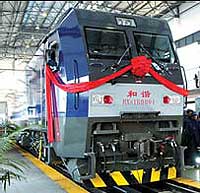 Dzulkelfy also queried why the direct negotiations with ZELC did not follow the specifications of the original tender before that was cancelled on April 27, 2010 and only modify the relevant clauses to accommodate the different demands from eight sets of three-car EMUs to 38 sets of six-car trains.
On the MACC probe, Dzulkefly asked whether the anti-graft body had investigated the method of payment for the EMU deal, given that it was not made directly to ZELC in mainland China but through ZELC in Hong Kong, which is not as tightly monitored by the authorities in Beijing.
“Did the anti-graft authorities in China think the offer (by the Malaysian government) to ZELC as strange?” he said.
He reiterated his claim that all three companies in China producing EMUs with the same specifications set by KTMB have set roughly the same price of RM40 million for each of unit of EMUs.
“I believe that the prices offered by ZELC includes an “element of commission”, or ‘kickbacks’ for local agents.
“If it is true that there is no element of irregularity, I would like the cost breakdown of the main parts used in the EMUs that we bought. This would allow me to see whether there had been inappropriate price increase,” said Dzulkefly.
Related stories
'RM100 for students not from 2012 Budget'
RM100 schooling aid can also be claimed later, says DG


