




Orang Asli, Malays ancestors of East Asians
Research in archaeology and genetics could very well prove that the ancient Orang Asli living in the Sunda Shelf were the ancestors of the rest of East Asians.
Research in archaeology and genetics could very well prove that the ancient Orang Asli living in the Sunda Shelf were the ancestors of the rest of East Asians.
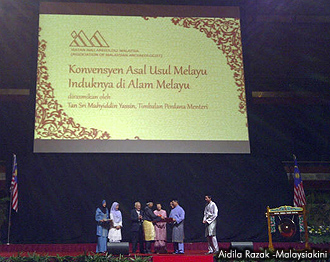 Stating this in a video presentation at a conference on the origin of the Malay race in Kuala Lumpur today, conference deputy chairperson Zaharah Sulaiman showed how the Sunda Shelf inhabitants survived the Toba super-volcanic eruption 75,000 years ago.
Zaharah said that having emigrated from Africa to the Sunda Shelf (which is Southeast Asia today), the inhabitants were among the 10,000-odd humans who survived the Toba eruption.
They survived as they were residing in a part of the Sunda shelf not blanketed by volcanic ash.
"They were the torch bearers who pioneered man's journey into the modern era," the video presentation states.
The group was, however, forced to move to India, China, Japan, North America and the rest of the world starting from 16,000 years ago due to global warming, which caused a series of floods that broke the Sunda Shelf into islands.
This debunks the theory that Malays originate from Yunan, or the “express train” theory, which states that they originate from Taiwanese rice growers who emigrated to the archipelago and obliterated the original population.
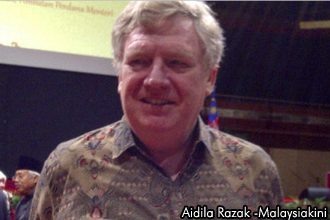 Supporting this in his presentation at PWTC today was Oxford genetic anthropology expert Stephen Oppenheimer (
right
), who showed genetic evidence that Malays and the Orang Asli originate from Southeast Asia.
Supporting this in his presentation at PWTC today was Oxford genetic anthropology expert Stephen Oppenheimer (
right
), who showed genetic evidence that Malays and the Orang Asli originate from Southeast Asia.
This is either from island Southest Asia, namely Indonesia and the Philippines, or mainland Southeast Asia that is Vietnam, Cambodia, Thailand and the Indochinese region.
He said that his research, involving testing the DNA of the Semang, Senoi, other Orang Asli and Malays, shows that 44 percent had ancestors who lived in the region well before 25,000 years.
Another 36 percent had ancestors who lived in the region from 5,000 to 25,000 years ago, while only 6 percent have their origins traced to the Taiwanese rice growers who emigrated 5,000 years ago.
He said that there is also archeological evidence of a flake industry to Taiwan.
Malay pride
Also supporting the theory that the Southeast Asians had emigrated into the world to found different civilisations was Universiti Sains Malaysia scientist Zafarina Zainuddin.
She said that her study is based on DNA derived from groups who have been living in the same place and can trace a pure Malay lineage for at least three generations.
“If he is, say, Kelantanese from Machang, he can trace his roots there for three generations. If he is unsure of his lineage or knows of mixture with Indian lineage for example, we exclude him,” she said.
She said that the research, which began in 2007 thanks to a RM1.4 million Higher Education Ministry grant, proves that Malays are the oldest community in Southeast Asia.
“They can be traced back to 60,000 years, similar to the Orang Asli,” she said.
“This is why I propose the “out of the Malay archipelago” theory... (of migration) starting from the Southeast Asian islands to Thailand, Indochina, mainland China and to North China,” she said.
She added that she hopes that the finding that “Malays have genetics which originate from the Malay land” reignites the “Malay spirit... so that people will be proud to be Malays”.
The conference was earlier officially opened by Deputy Prime Minister Muhyiddin Yassin.
Editor's note: Malaysiakini had on Jan 21 made corrections to the above article (originally headlined 'Proto Malay origins of human race') upon clarification from a researcher quoted.
Related stories
Prof Khoo: I didn't say we can't accept legends


Report this comment
Are you sure you want to delete this comment?
This action cannot be undone.