




Vision 2020 remains a pipe dream
COMMENT When contradictions in the Rukunegara became obvious, it was back to the drawing board for the next big charter that could draw the people. This was not a vision that was envisaged by the BN. It was perhaps the tireless work of a think-tank and people like the late Noordin Sopiee who crafted this fresh vision.
COMMENT When contradictions in the Rukunegara became obvious, it was back to the drawing board for the next big charter that could draw the people. This was not a vision that was envisaged by the BN. It was perhaps the tireless work of a think-tank and people like the late Noordin Sopiee who crafted this fresh vision.
Like the Rukunegara before, it was then handed over to the BN government, which through the prime minister Dr Mahathir Mohamad launched it. Mahathir presented it as a working paper at the inaugural meeting of the Malaysian Business Council on Feb 28, 1991.
Now, 20 years on, we have an opportunity to review if this charter has done any better than the earlier Rukunegara.
Those born at the time of the launching will now be in their 20s. The goal of the vision was for the nation to become a fully developed nation.
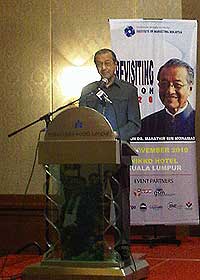 That is, a united nation with a confident Malaysian society, infused by strong moral and ethical values, living in a society that is democratic, liberal and tolerant, caring, economically just and equitable, progressive and prosperous and in full possession of an economy that is competitive, dynamic robust and resilient. There are enough "Key Performance Indicators" (KPIs) mentioned to evaluate Vision 2020.
The paper then went onto enumerate nine central strategic challenges that have confronted the nation since independence, confessing obliquely that the earlier charter was a failure. This was obvious as the first challenge enumerates the need for establishing a united Malaysian nation with a common and shared destiny.
The words used were well crafted - "a nation at peace with itself, territorially and ethnically integrated, living in harmony in full and fair partnership made up of one 'Bangsa Malaysia' with political loyalty and dedication to the nation".
The second talked about creating a psychologically liberated, secure and developed Malaysian society with faith and confidence in itself, with a whole lot of words to prop the nation's self-image so as to be respected by the peoples of other nations.
The third related to fostering and developing a mature democratic society, consensual, community-orientated that can be a model for other developing countries. The fourth enumerates the need for a fully moral and ethical society, with citizens strong in religious and spiritual values.
The fifth highlights the need for establishing a mature, liberal and tolerant society in which Malaysians of all colours, cultures and religious beliefs have a sense of belonging to one nation. The seventh talks about a caring society, while the eighth stresses the need for an economically just society that leads onto the ninth, to create a prosperous society with an economy fully competitive, robust and resilient.
The paper nevertheless stresses that the first strategic challenge, namely the establishment of a united Malaysian nation, is likely to be the most fundamental and basic challenge. Twenty years later, this challenge remains. And its failure has been fundamental to the failure of Vision 2020.
We are now a more polarised society
In fact, we now live in a more polarised society than in the early 1990s. You can crunch the economic figures and make indicators look great, employ international public relations companies to paint a glorious picture, but the reality on the ground is otherwise.
Again, Vision 2020 is another example where a broad and inclusive paradigm that was the basis for Vision 2020 crafted by a think-tank was handed over for implementation to an ethnic-based coalition party that did not have the capacity to internalise the vision and act on the strategic challenges.
This was beyond their ambit of goals and power and would call for policies that were inclusive and empowering, which was impossible for each of these ethnic parties to consider. From their narrow race-based paradigm this was a leap to failure.
It is said that a vision without action is at best day-dreaming while action without a vision leads to nightmares. Today, Vision 2020 remains a pipe dream and we can imagine the nightmares facing our society.
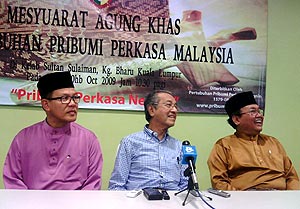 Let us look at the champion who propagated this vision. Even Mahathir is an embarrassment with his involvement in Perkasa and the racist statements now attributed to him. For Mahathir, this was yet another policy speech that sounded so brilliant that it created a ‘halo' around him as a visionary leader.
It soon became another slogan for ministers and BN psycho pants to repeat like a 'mantra'. It is as though, by repeated utterances, the vision will suddenly spring to reality.
Anyone who lives by a personal vision statement will understand that it is only through internalising the vision that one can evolve actions that can help as a powerful tool for change. A person with a vision is immediately alerted by his conscience when he or she acts incongruently.
The same goes for vision statements of organisations. A vision statement provides the strategic direction for all to act in a synergistic manner and through developing policies, processes and procedures in keeping with the vision for the organisation to both honour its vision and deliver on its promises.
Vision that's remained a political sologan
Vision 2020 has remained a purely political slogan. Apart from lip service, this has meant nothing to the civil service and the delivery mechanism of the government. One has just to evaluate the events from 1991 to 2001 to understand this.
The Biro Tata Negara (BTN) would have been revamped or removed as this was one department that was not congruent with the aims of Vision 2020. Corruption increased and draconian laws such as the Internal Security Act and the Official Secrets Act, etc, undercut the goals of Vision 2020.
 This was also because the prime mover of Vision 2020 himself did not engage seriously in making the vision a reality. These goals were in no way a part of the democratic framework within Umno or the BN, whose leaders manipulated democracy to ensure that they retained and remained in power. So there never was any sense of ownership.
Vision 2020 developed from an all-inclusive paradigm that would have given birth to a mindset that transcends race as a critical factor. Sadly, it was launched by people with no commitment to such a mindset, hence their inability to internalise the same and value it deeply to inspire the strategic changes that were being enunciated.
It was reduced to mere political sloganeering and everyone in BN and the administration excelled at this. Those who had hopes and expectations that this could make a difference soon felt that their trust was once again betrayed. Those who have lived though the last 20 years will realise how their expectations were once again manipulated by the BN.
Collectively trapped within ethnic mind-sets
The BN itself remains an imperfect model, where one component party is perceived as more powerful than the others. It is not able to exemplify the ideals stated in its vision. The other component parties still lack the will and courage to take a stand.
So, they are all collectively trapped within their narrow ethnic mindsets, incapable of steering the priorities outlined in Vision 2020. Thus, beyond a pipe dream, serious challenges have come to manifest in our society, challenges that stare at us like nightmares.
"You cannot make a good omelette out of bad eggs," says the chef. This has to be correct. To expect ethnic-based parties to transcend ethnicity is to ask for the impossible. They can only do so if they are collectively committed to a value based approach, namely the quest for justice, equality and fairness.
We must get our basic principles right. Race is not a value and when you make a norm out of race, you promote selective justice and undercut values. To pull together, you need a commitment to values and while these are expressed in the Rukunegara and Vision 2020, we have in both instances clear examples of the inability of race-based parties to deliver.
The formula is wrong because it is based on reactions. The mindset arising there is incapable of generating an inclusive spirit that will be critical for solving the problems of a diverse society.
Race is not a value. Religion, language and colour are issues of identity. These have immense emotional powers, which is why politicians the world over prey on such issues, manipulate these to secure popularity and power. When such issues are elevated as a norm, then we see powerful forces being exploited.
Even Islam becomes dwarfed by race, as exemplified by politicians who champion race, religion and royalty. What we then see is ‘race-based Islam', the exploitation of Islam by narrow-minded Muslims to promote race issues.
Islam is more majestic and encompassing and its call for justice for all of humanity is fundamental.
This is what a race-based mindset creates and this is applicable to all the component parties of the BN and their respective agendas. Couple this with calls for 'stability', or now 'moderation', and what you get is the subtle promotion of the status quo, with fear being a motivating force.
Issues will be continually swept under the carpet and injustice and unfairness will continue. Corruption rears its head under such circumstances, fortified by nepotism and cronyism. We have more than 25 years of experience and ample data in this regard that we have to confront and be honest about.
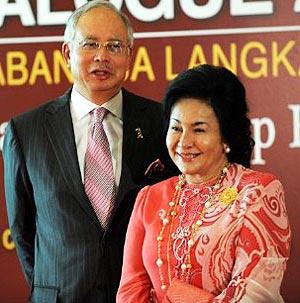
Prime Minister Najib Abdul Razak wants us to have faith in him. How can we support a formula that is guaranteed to fail? His first transformation agenda has to be within BN itself.
Unless Najib can transform BN to champion values and causes stressed under the Rukunegara and Vision 2020 and make his party democratic, liberal, tolerant to develop a sense of common and shared destiny made up of Bangsa Malaysia, is there any other example to emulate?
Umno itself is not a great example of democracy, so what has it got to offer but race polemics, like its other component members.
 It is easy to preach, but the challenge lies in the practice and creation of a just society. Najib and the BN do not possess the political will to stand up for ‘1Malaysia'. He expects us to have faith in what is going to be yet more slogans and programmes guaranteed to fail.
In retrospect, his predecessors have failed as well. What illuminating difference has Najib shown, except for the shopping spree and doctorate awards for his wife, for faith or accolades in his leadership? He is there by virtue of his antecedents and does not have the grassroots political acumen to make a difference.
At best, BN has responded to the opposition's clamour and done away with some of the draconian laws, only to replace them same with what has been perceived as equally unjust. The changes that are evident are because of a vibrant opposition and the lack of a two-thirds majority for the ruling coalition.
In his working paper, Mahathir says that Malaysia has one of the best educational systems in the Third World. As of now, we are progressing and will soon have the world's best education system.
We have national schools, national-type schools, smart schools, international schools galore, Mara residential schools... all of which have become ethnic ghettoes providing a wide range of different syllabi.
Education, which is one of the best social instruments for inspiring multi-ethnic bonding and giving birth to Bangsa Malaysia, has itself become a victim of race. You have matriculation courses, basic science, vernacular schools, STPM, A-level, schools that teach mathematics and science in Bahasa Malaysia and others that teach in English, urban schools and rural schools.
The garland of education is in the hands of incompetent people, so what can they deliver but polarised minds, like the education minister who is still ‘Malay first' but will shout Vision 2020 and has no conception whatsoever of either 1Malaysia or Bangsa Malaysia.
I have lived with Rukunegara and NEP for more than 40 years; over 20 years under Vision 2020, nearly four years under Islam hadhari and now for nearly three years under 1Malaysia. I am convinced that the BN cannot deliver because it has the wrong formula. BN has not evolved as a party that can transcend race.
Just as a caterpillar metamorphoses into a butterfly and we witness a transformation, nothing of this nature has happened within the BN. They have remained ethnic butterflies, hopping here and there.
What we are going to get in the future is more of what we have received because BN will never be able to deliver. This is not complicated science and its programmes so far, under all the four slogans, reveal no spectacular achievement, even in the realm of national unity. So why do we need to give BN yet another five years?
One has already accepted that one has been stupid and I can live with that reality. However, when you do this a third and a fourth time, then I shall leave you to complete the description because there is no more time for continued failures.
For the sake of my children, I have to repose faith in another combination that could work things out differently.
When you have politicians who are scared to declare their assets; unable to declare publicly how scholarships are awarded; when there is a lack of transparency, then one knows that by supporting such leadership, one is just throwing away the future of all Malaysians.
When one sees rampant corruption and mismanagement, monopolies and crony companies, one asks what will the future hold?
Anyone but the BN may be only option available and this again is an exercise in faith. At least in those states where the opposition is now in power, they have shown the capacity to make a difference.
Why not give them an opportunity because this may be better than going back to the mess we are now in? Why not give them an opportunity to create the Bangsa Malaysia that we dreamt of under Vision 2020?
This is the only choice we have and it will be good for BN to be in the opposition bench and do some real soul-searching.
Part 1: Rukunegara - a testament of hope long lost
Part 2: Vision 2020 remains a pipe dream
Part 3: The failure of Abdullah's Islam Hadhari
Part 4: 1Malaysia - continued fragmentation
K HARIDAS is an NGO activist involved with "change management, education and issues of conscience".


