




Anwar's successor and the non-Malay PM
COMMENT At the Foreign Correspondents Club of Malaysia dinner for guest speaker Anwar Ibrahim the other day, the opposition leader was asked who would be his replacement as Pakatan Rakyat leader should anything happen to him.
The question was one of those good but complex ones that can stymie even the most nimble of politicians.
The query had a sound basis because Anwar will be 65 soon. Though in good health, his longevity cannot be assumed...
COMMENT At the Foreign Correspondents Club of Malaysia dinner for guest speaker Anwar Ibrahim the other day, the opposition leader was asked who would be his replacement as Pakatan Rakyat leader should anything happen to him.
The question was one of those good but complex ones that can stymie even the most nimble of politicians.
The query had a sound basis because Anwar will be 65 soon. Though in good health, his longevity cannot be assumed.
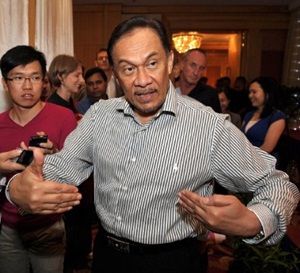 It was unanswerable because Pakatan is a work in progress. It would not be the going concern it is today without Anwar's ability to weld Pakatan's divergent components, theocratically-inclined PAS and secularism-steeped DAP, in a pact aimed at replacing BN at the seat of federal power.
Absent Anwar, Pakatan would stutter from ideological incoherence and would likely stall because of the seemingly unbridgeable chasm that separates theocrat from secularist.
With him at the helm, Pakatan's trajectory towards Putrajaya is both compelling and believable enough to dispel legitimate doubts over the ideological cohesion of the opposition coalition.
The plain answer to the question about a successor which Anwar skirted is that there is not now an individual who could credibly replace him simply because there is not yet in the Pakatan cohort a leader of comparably adhesive qualities and with Anwar's connection to a world-historical issue: Islam's compatibility with democracy.
Few would contest the point that this issue is the early 21st century's paramount political one, just as the battle between fascism and democracy, and then communism and democracy, were the pivotal issues of the early and later parts of the twentieth.
Religious pluralism
There is an indirect link between the question of who can replace Anwar as Pakatan supremo and the issue of whether a non-Malay could be prime minister of Malaysia, the latter concern thrusting up in the national consciousness by the scaremongering of Dr Mahathir Mohamad and the Malay right wing who paint the rise of Pakatan as perilous to Malay political dominance.
It is not so much that Anwar is irreplaceable as Pakatan supremo; it's just that there has yet to emerge within its ranks a leader with his gift - the special ability to diffuse around him the belief that the urgent needs of Malaysia's democratic restoration must prevail against all obstacles of rationality posed by allies with divergent ideologies.
It is the nature of this gift that its fulfillment will foster emulation. Several would be the collateral benefits therefrom.
The most significant would be the point that Islam would be seen to be compatible with democracy. Islamist critics of Anwar have upbraided him for promoting religious pluralism.
His invariable response is to cite the maqasid al-syariah, a 12th century postulates of the jurist Al-Shatibi which hold that the preservation of life, protection of property, establishment of justice, and the maintenance of peace and harmony are the higher goals of Islamic law.
In the rhetorical formulations of Anwar before international and domestic forums in recent years, the maqasid al-syariah sounds like a precursor of the ideals of the Enlightenment, not the French variety that attacked religion but the English version that did not attack religion, promoted liberty and self-study, and valued common sense.
More significant and instructive about the political thinking of Anwar was his lauding, at the FCCM dinner, of the merits of ‘Democracy in America', the classic work of the French diplomat and historian Alexis de Tocqueville, who wrote the book in 1835 after a nine-month tour of America during which he learned about democracy from the experience of ordinary people.
Anwar said he always recommended the book to the younger set of leaders in his party, PKR, for their edification. Tocqueville's central point was that democracy would sweep the world, though it has taken nearly two centuries for that to happen to most countries of the world.
The reason the French noble said that democratic revolution would be inevitable in the world was the system's conferment of equality on the people.
He said equality was preferred by people because it was immediately available; if people were equal - or could be made equal - then they would appreciate it immediately.
There are several other points Tocqueville made in his seminal book, but the one about the ordinary people's preference for equality was, he observed, strongly held.
If Anwar's and his followers' understanding of Tocqueville's emphasis on equality is well founded, it would follow that a non-Malay leader of requisite calibre can become PM of Malaysia.
Suharto's downfall
It is democracy's emphasis on the equality of all that would militate against traditions which promote class, ethnic, religious or gender superiority.
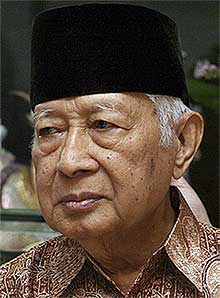 One recalls that in the waning years of dictator Suharto's rule in Indonesia, there was wide speculation on who would succeed him.
It was suggested that a successor would have to be Javanese and Muslim, thereby ruling out able presidential presumptives like Benny Murdani, who was Javanese but not Muslim.
Fourteen years on from the liberalisations that began with Suharto's downfall in 1998 and are continuing under current president Susilo Bambang Yudhoyono, the prospects of a contender, Jusuf Kalla, becoming president are not discounted on the grounds that he is not Javanese. Jusuf is Bugis.
With time and adequate experience of emollient democratic rule, restrictions of race, religion, and gender, unless embedded in the constitution (and if so, these won't last), would wither in the face of democracy's inexorable egalitarian ethos.
That is why the Pakatan goal of Malaysia's democratic restoration, marshaled by Anwar, is vital to the country's well-being.
TERENCE NETTO has been a journalist for close on four decades. He likes the occupation because it puts him in contact with the eminent without being under the necessity to admire them. It is the ideal occupation for a temperament that finds power fascinating and its exercise abhorrent.


Are you sure you want to delete this comment?
This action cannot be undone.