




Who watches the racemen?
Everybody is a book of blood; wherever we're opened, we're red. - Clive Barker, Books of Blood, Vol 1-3
COMMENT Amidst all this talk of corruption in high Umno places, at least there are some who believe that certain questions remain unasked by the two opposing forces at play in the racial games of Malaysia.
Lawyer Malik Imtiaz Sarwar's 'Answering the unasked questions' only hints at possible answers to the questions he poses, but it is a good take off point to begin the conversation.
Anyone interested in real change and who hasn't imbibed too deeply of the Pakatan Kool Aid or grown tired of inhaling from the BN crack pipe should read it and if it's not too much of a bother, seriously consider why these questions remain unasked by their preferred political parties and why as voters they prefer silence to answers...
Everybody is a book of blood; wherever we're opened, we're red. - Clive Barker, Books of Blood, Vol 1-3
COMMENT Amidst all this talk of corruption in high Umno places, at least there are some who believe that certain questions remain unasked by the two opposing forces at play in the racial games of Malaysia.
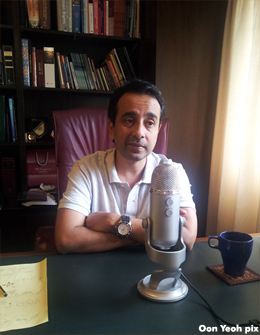 Lawyer Malik Imtiaz Sarwar's (
left
)
'Answering the unasked questions'
only hints at possible answers to the questions he poses, but it is a good take off point to begin the conversation.
Lawyer Malik Imtiaz Sarwar's (
left
)
'Answering the unasked questions'
only hints at possible answers to the questions he poses, but it is a good take off point to begin the conversation.
Anyone interested in real change and who hasn't imbibed too deeply of the Pakatan Kool Aid or grown tired of inhaling from the BN crack pipe should read it and if it's not too much of a bother, seriously consider why these questions remain unasked by their preferred political parties and why as voters they prefer silence to answers.
This is neither a response nor rebuttal to Imtiaz's piece but rather my own preoccupations (it's about time, since I have been pontificating on everyone else's in my Malaysiakini pieces) on the issues he raises or at least on the issues I think he does.
The big question of the way how ‘meritocracy' is handled with regard to the sensitivities of the dominant Malay ethnic group takes centre stage and forms the major unasked question. Now I have written about Malay matters and the fracturing of the Malay community in an attempt to frame my own questions as far as the race and political debate goes.
As I argued before, addressing the very real fears of the Malay community of marginalisation when it comes to meritocracy or any other issue is problematic for a variety of reasons. The phenomenon of constitutionally-created Malays changes the Malay demographic and introduces its own set of internal tensions which naturally becomes conflated with the communal Malay fears of the ‘other'.
In other words, not only are the Malays competing with the non-Malay communities, they are also struggling with ‘foreign' non-native elements within their own community.
Now the rallying cry of "We are all Malays" and revisionist reclassification of native ethnic groups as bumiputera may seem like a logical tactical move by the powers-that-be, but the reality is the only real division within the Malay community are those that still consider themselves aligned to the Umnoputra and those who have been disenfranchised.
The latter are looking for an alternative which does not necessarily mean an alternative to Umno dogma but rather an expectation that they would benefit from it without the corruption that plagues the current Umno regime.
Throwing religion into the mix
Added the issue of religion into the mix and the question becomes a lot more complicated.
These days, the folks spearheading the ugly side of Islam on behalf of Umno are the so-called wannabe Malays. The Ridhuan Tees, but more importantly (as far as the internal tensions I referred to) a certain vocal slice of the Indian Muslim community, is the public face of the vindictive nature of Umno when it comes to using Islam as a political weapon against legitimate dissent.
This does not go unnoticed by the disenfranchised section of the Malay electorate. The undisguised contempt by the disenfranchised when Kimma (Malaysian Indian Muslim Congress) was formally welcomed into the Umno fold (as non-voting members) is evidence of who they think really has the most influence in the party.
So, Islam and whatever rights ‘owed' to the Malay community can never be questioned, which is why meritocracy is equated with the Red Scare and Singapore is the ultimate bogeyman when it comes to the fears of marginalisation of the Malay community. Anwar Ibrahim and his cohorts are race traitors who would leave the Malays at the mercy of the Chinese without the crutches Umno provides to defend themselves.
The question of why the Malays are in this position is never asked (by the powers-that-be and it would suit them if nobody asked the question) but rather the blame is always shifted to the other. Imtiaz may rightly point out to the fact that proportionately Malays make up most of the poor, but this is cold comfort to the other communities.
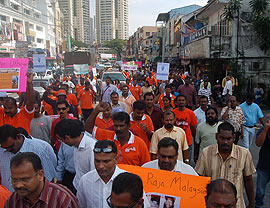 So far only Hindraf has honestly played the Malaysian race game without the camouflage of multiculturalism, which is why they have not made many friends on either side of the political divide. Not only have they shrieked their lungs out at the systemic discrimination that Umno perpetuates but also at the discrimination which is endemic in the Chinese-dominated private sector. This, of course, has resulted in them being labeled as either ‘racists' or ‘victims', sometimes both.
But it would be disingenuous to go the Frank McCourt route and claim that there's nothing more miserable than Indian Hindu poverty however much it feels that way, just as it would be disingenuous to equate the discrimination in the private sector as anywhere near as destructive in the long term as the state-sanctioned discrimination experienced by the non-Malays.
And the reality of the majority Malay poor and disenfranchised makes a mockery of the dominant privilege idea perpetuated by critical race theory types. However, as long as one party is playing the race game openly and the other covertly, status quo agitators like Hindraf will be needed to keep the latter side honest.
The predominance of Malays in public service or should I say ‘Umno service', not to mention in the security apparatus of this country, is something that I doubt Pakatan Rakyat would want to address anytime soon. Indeed all indications is that the alternative front views this voting demographic as a reliable vote bank and like BN is not above bestowing them ‘goodies' to assure them that their positions are secure if the alternative front ever comes into power.
Besides giving rise to the incompetent cronycrats, the various civil and security services is a symbol of Malay dominance of the land. Courses like the BTN (Biro Tatanegara) are there to feed into the communal fears of the Malay community.
It is because of the extremely effective Umno propaganda that the Malay community needs its crutches coupled with the concept of Ketuanan Melayu that makes the concept of Ketuanan Rakyat a pipe dream.
Not to mention that Pakatan has been literally all talk and no do when it comes to showing an alternative way to the entrenched racial games at play. However, change is only possible if voters are sincere in changing the big picture and not merely the frame.
Decentralising power
In my opinion, there is no way to depoliticise the implementation of affirmative action policies or any discussion of Article 153 of the Malaysian constitution.
Affirmative action policies are by their nature political and even if we are to go by the class-based route, we are constantly reminded that it is not a zero-sum endeavour. And any interpretation other than Umno's of Article 153 would mean we would have to redefine the very concept of what it means to be Malaysian.
Understand now that I am totally up for Malaysians having this discussion even though it may offend the sensibilities of various communities because trite as this sounds, it is the only way we as a nation can move forward. I am very well aware that people are hesitant to have this discussion because the threat of violence is always present.
I believe the mendacious implementation of so-called affirmative action policies is an indictment against the excess of Big Government. I think that this era needs to end whoever comes into power. Decentralisation, or whatever you want to call, should go hand in hand with whatever class-based approach is considered.
What the water concessionaire Syabas fiasco demonstrates and the various problems faced by Pakatan is that new ideas are a threat to Umno hegemony and federal power will be used to see that such ideas never come to fruition.
I believe that if small diverse communities can discover equilibrium amongst themselves, this could affect the larger Malaysian perspective. As the late Indian filmmaker Satyajit Ray eloquently puts it, "The only solutions that are ever worth anything are the solutions that people find themselves."
Of course, I'm just throwing this out there and there are numerous arguments for and against the curtailing of federal power and this should be in no way construed as a polemic against federal power. However, as long as race is an issue, I believe that the less power in the hands of a federal bureaucracy the better for people interested in finding solutions out of the race box.
At the end of the day, we give power to the people we vote for, but if we do not expect them to ask the tough questions that could take us somewhere, we should not be surprised by their easy answers that take us nowhere.
S THAYAPARAN is Commander (rtd) of the Royal Malaysian Navy.


Are you sure you want to delete this comment?
This action cannot be undone.