




'Revoking special projects may end in bankruptcy'
The Penang Municipal Council (MPPP) has expressed regret that a former staff member has questioned its decisions on hill projects based on existing laws and guidelines when he had been actively and directly involved in it.
The Penang Municipal Council (MPPP) has expressed regret that a former staff member has questioned its decisions on hill projects based on existing laws and guidelines when he had been actively and directly involved in it.
MPPP president Patahiyah Ismail said she was surprised by former MPPP town planner Khoo Boo Soon’s public appearance on Aug 3, and his statement that ‘special projects’ can be revoked for public interest.
She said Khoo cannot run away from his own responsibility and refusal to admit the active role played by him during his former employment in the MPPP.
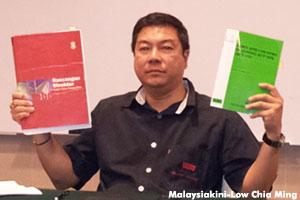 She added that Khoo (
right
) - as former acting director of Town Planning Department from 2009 to 2010 - had even recommended for approval of planning permission for special projects.
She added that Khoo (
right
) - as former acting director of Town Planning Department from 2009 to 2010 - had even recommended for approval of planning permission for special projects.
“One of these special projects recommended by Khoo is a paper he presented to the MPPP One-Stop-Centre Committee (OSC) on Dec 1, 2009, with a height above 250 feet in Telok Kumbar,” said Patahiyah.
“Khoo did not raise any objections to the OSC, who then approved the planning permission for this special project above 250 feet as recommended by himself,” she added.
 Patahiyah (
left
) had also previously revealed that the previous administration under BN had approved 37 hill projects, but the BN has refuted the allegations by asking that the minutes of the meetings on hill projects be declassified.
Patahiyah (
left
) had also previously revealed that the previous administration under BN had approved 37 hill projects, but the BN has refuted the allegations by asking that the minutes of the meetings on hill projects be declassified.
State executive councillor Chow Kon yeow then exposed minutes of meetings that showed the attendance of state BN chief Teng Chang Yeow in the approval of such projects.
Still, according to Khoo, MPPP has the power under section 25 of the Town and Country Planning Act 1976 (TCPA) to revoke planning permission granted under section 22(3).
However, an order revoking a planning permission requires compensation to be paid under section 25(7) of the TCPA which can “burden MPPP with hundreds of millions of ringgit,” said Patahiyah.
Generally, a planning permission granted under section 22(3) unless extended, shall lapse after 12 months.
Since the extension of planning permission is allowed under TCPA, the State Structure Plan 2020 gazetted on June 28, 2007, allows a planning permission to be extended five times or five years, she added.
This compares with previous practice of 12 times or for some other local authorities, she stressed.
Huge financial implications
In the midst of mounting criticisms that the MPPP has approved hill projects above 250 feet, the council has argued that they fell under the category of “special projects” mentioned under the State Structure Plan 2020, which was gazetted in 2007.
Prior to 2007, zoning and density was governed under the 1996 Zoning and Development Control Plan for projects where planning permission were granted previously or plots of land which are zoned as ‘residential’.
These plots of land zoned as residential still existed and were still recognised after 2007 as the State Structure Plan did not rezone them. These residential zones included areas with heights above 250 feet.
“Refusal to give planning permission for these residential zones would result in MPPP requiring to make compulsory acquisition under section 37 of TCPA,” she said.
“To avoid MPPP being exposed to risk of hefty compensation losses, the Penang State Planning Committee in 2009 recognised these 1996 Zoning and Development Control Plan and allowed MPPP to follow strict hillslope procedures before issuing planning permission,” she added.
Patahiyah said applicants for planning permission shall under the State Structure Plan 2020 expect their planning permission to be extended if they have not complied with all the planning requirements, including MPPP guidelines and the 1996 Zoning and Development Control Plan.
New conditions imposed must be reasonable, can be complied with and must at least be agreed by both the local planning authority and the applicant for planning permission, she added.
This criteria, she stressed, was spelt out clearly in a 1999 Federal Court decision between MPPP and Syarikat Bekerjasama-sama Gabungan Sungai Gelugor Dengan Tanggungan(SB).
MPPP lost when it was challenged for trying to impose new conditions on the extension of planning permission, she explained.
“There are huge financial implications if MPPP were to revoke planning permission granted, especially those with building plans given approval by reason of public interest,” she said.
“Apart from public monies being involved, MPPP still has to consider the public interest of third parties - the purchasers who had bought the parcel units,” she added.
“Therefore there should be weightage and balance between the two public interests,” she added.
Patahiyah also refuted that the planning permission granted to the former Shih Tung Primary School was revoked, saying that the application for extension was rejected on Nov 3, 2004 and the developer has not pursued the matter for compensation.
However there are 19 planning permissions granted by MPPP after 2008 and if they were to be revoked, the developers might pursue the matter which is “too reckless and risky to gamble” as it may result in financial bankruptcy for MPPP, she said.


Are you sure you want to delete this comment?
This action cannot be undone.