




Karpal: Sedition charge is discrimination by the AG
Veteran lawyer Karpal Singh told the Kuala Lumpur High Court that there was “selective prosecution” on the part of the attorney-general in charging him with sedition against the sultan of Perak.
Veteran lawyer Karpal Singh told the Kuala Lumpur High Court that there was “selective prosecution” on the part of the attorney-general in charging him with sedition against the sultan of Perak.
The 72-year-old lawyer said this in itself constitutes a form of discrimination over his rights to equality before the law as guaranteed by the federal constitution under Article 8.
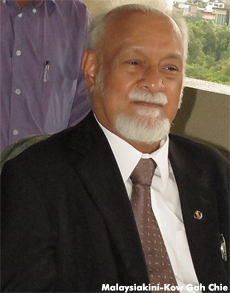 Karpal said the decision to charge him was based on the many police reports lodged against him mostly by Umno members over the press conference which he held following the Perak constitutional crisis of 2009.
He said following the pressure by them and the government, the AG had decided to lay the charge on him.
“As a lawyer, I know the parameters which would be constituted as sedition as I have represented (the late) Fan Yew Teng in the past who was charged with a similar offence. What I said at the press conference does not constitute as sedition. It was the last thing in my mind to say something seditious. My persecution is discrimination on the part of the attorney-general, and this is in contravention of the federal constitution on the rights to equality.”
“Under the amendment to the federal constitution, the rulers can be criticised for their actions and this does not constitute as sedition,” he said.
'What Mahathir said in Parliament was also seditious'
Karpal said the Sultan of Perak, being a former Lord President who has also presided over numerous court cases, would not find what he said at the press conference as sedition.
The veteran lawyer also quoted the Parliamentary Hansard on what former prime minister Dr Mahathir Mohamad had said in tabling the 1993 amendment to limit the powers of the rulers.
He said what Mahathir and former Arau MP Shahidan Kassim had said was seditious in nature but they were not charged by the then-AG.
Sedition is an offence that is not protected even if it is uttered in the legislature.
Karpal then continued reading out what Mahathir and Shahidan had said. The veteran lawyer had tried to summon Mahathir as a witness in his defence to the sedition trial.
The Bukit Gelugor MP was testifying in his defence over the charge of uttering seditious words at his office in Jalan Pudu during the press conference he held on Feb 6, 2009 over the Perak constitutional crisis.
The charge is under Section 4(1)(b) of the Sedition Act 1948, which carries a maximum fine of RM5,000 or a jail term of three years, or both, on conviction.
'Perak assembly sitting should have been allowed'
The Perak constitutional crisis arose after three Pakatan Rakyat assemblypersons, representing Jelapang, Changkat Jering and Behrang, suddenly “disappeared” and then appeared on the side of BN, resulting in the collapse of the Pakatan government under Mohamad Nizar Jamaluddin.
The BN then took over the Perak government, with Dr Zambry Abdul Kadir taking over as menteri besar.
Replying to further questions from Gobind, Karpal said Article 33 of the Perak Constitution should have been followed in that the state legislature should have been called into session as the notice had already been made.
“The proper way is to call the legislature into session, and a vote of no-confidence taken. However, the ruler had acted to quiz the three assemblypersons, two from PKR and one from the DAP, to inquire on their allegiance,” he said.
““I’m not questioning the prerogative of the sultan but the manner of his conduct in inquiring the allegiance of the assemblypersons,” he told the court, which he felt was not proper
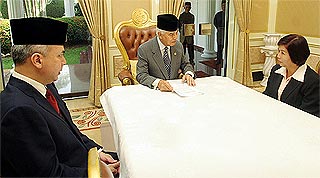 The three assemblypersons, Hee Yit Foong (Jelapang,
seated on right
), Mohd Osman Jailu (Changkat Jering) and Jamaluddin Md Rafzi (Jelapang) were summoned to the palace and asked for their allegiance, resulting in the fall of the Pakatan government.
The three assemblypersons, Hee Yit Foong (Jelapang,
seated on right
), Mohd Osman Jailu (Changkat Jering) and Jamaluddin Md Rafzi (Jelapang) were summoned to the palace and asked for their allegiance, resulting in the fall of the Pakatan government.
Karpal said the Perak sultan could, under Article 16 (6), appoint on his discretion a new menteri besar after an election is held but not under this circumstance (asking for their allegiance), as the issue had to be resolved through the state legislative assembly.
As a lawyer and MP, the DAP chairperson said, he felt he should tell the public what should be done.
“When I said legal action can be taken against a sultan, what I meant was to file a judicial review to question his actions in court, as this is allowed under the 1993 amendment,” he said.
Besides Gobind, also present were Ramkarpal Singh and former UN special rapporteur Param Cumaraswamy, who are also acting for Karpal. The prosecution is led by DPP Noorin Badaruddin.
The trial also attracted international observers from the Inter Parliamentary Union namely Mark Trowell as well as the Bar Council and Lawasia, which were represented by Baljit Singh Sidhu.
The trial before Justice Azman Abdullah will resume on Jan 22 and 25.


Are you sure you want to delete this comment?
This action cannot be undone.