




National Harmony Act in 'middle stage' of study
The Attorney-General's Chambers is in the "middle" stage of drafting the National Harmony Act which will replace the Sedition Act 1948.
The Attorney-General's Chambers is in the "middle" stage of drafting the National Harmony Act which will replace the Sedition Act 1948.
"Drafting a law is not like having cancer where you have stage one, two, three and four when you kick the bucket.
"I cannot tell you which stage we are in... but I can say that we are somewhere around the middle," attorney-general Abdul Gani Patail told reporters today.
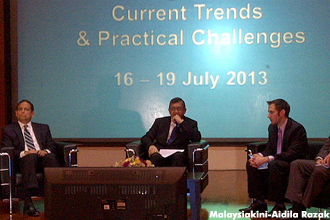 On a separate matter, Abdul Gani (
centre in photo
) said his chambers is likely to recommend changes in up to five laws which presently deal with cyber-crimes to keep abreast with changes in technology.
On a separate matter, Abdul Gani (
centre in photo
) said his chambers is likely to recommend changes in up to five laws which presently deal with cyber-crimes to keep abreast with changes in technology.
The amendments, likely to be to the Computer Crimes Act, Multimedia and Communications Act, Evidence Act, Penal Code and Criminal Procedure Code, will likely be ready to be tabled to Parliament “before the end of the year”.
“We will have to go into discussions with stakeholders including businesses, etc,” he said.
However, he added that the amendments will be largely to assist agencies in enforcing the law and not to raise penalties.
“I think our penalties are quite severe and we do have other liabilities.
“It is basically about how to be more effective as we now hear that enforcement agencies cannot obtain this or that (for investigations),” he said.
However, he stressed that any amendment will not infringe on “fundamental liberties and freedoms” or rights guaranteed by the federal constitution.
Nor will it allow enforcement officer to infringe on any existing law to nab a suspected cyber-criminal, he noted.
“We cannot be peeping on everything under the sun. Law enforcement agencies must learn that, and the public, too.
“You can’t go around hacking... and coming up to say ‘I am a whistleblower’,” he said.
Abdul Gani added that the Attorney-General’s Chambers is also in “the last leg” of studies on the Budapest Convention on Cybercrime and will make recommendations to the government on whether to accede to it by the end of the year.
US reps: Convention could mean better data access
Earlier, at a seminar involving the United States Department of Justice for the AGC on the matter, US representatives explained that acceding to the convention could mean better access to international data for Malaysian enforcement agencies.
 The US Department of Justice’s Anthony V Teelucksingh (
right
) said that an example of this is if the Malaysia police requires information in a server located in the US for the purpose of criminal investigation.
The US Department of Justice’s Anthony V Teelucksingh (
right
) said that an example of this is if the Malaysia police requires information in a server located in the US for the purpose of criminal investigation.
This could also include data held in popular email provider Gmail’s servers which the US can order to be kept for a period of 90 days upon notice and/or surrendered.
However, he said that his department has rejected requests from international counterparts in instances where the department believes infringes on the US constitutions’ guarantee of the freedom of speech.


Are you sure you want to delete this comment?
This action cannot be undone.