




Fuel pricing system unfair to dealers, says PKR
The current fuel pricing mechanism is unfair to petrol dealers, who are suffer losses when fuel prices drop at the beginning of each month, says PKR vice-president Rafizi Ramli.
Most dealers are small or medium-sized, making nett profit of between RM5,000 and RM10,000 a month, Rafizi said, but they will suffer losses of between RM10,000 and RM15,000 a month from the time the fuel prices dropped on Jan 1.
The current fuel pricing mechanism is unfair to petrol dealers, who suffer losses when fuel prices drop at the beginning of each month, says PKR vice-president Rafizi Ramli.
Most dealers are small or medium-sized, making a nett profit of between RM5,000 and RM10,000 a month, Rafizi said, But they will suffer losses of between RM10,000 and RM15,000 a month the moment fuel prices dropped on Jan 1.
 “Who is going to do such a business.
"If I know my nett income at the end of the month is only RM5,000 to RM10,000, and on the first day of every month in the current crude oil prices, I will suffer RM10,000 to RM15,000 losses, might as well surrender the whole thing and become a reporter. You can earn more,” Rafizi quipped at a press conference today.
Rafizi warned that if this continued, petrol dealers would have to surrender their business to oil companies, and this could cause a disruption of fuel supply due to many fuel stations changing hands over a short span of time.
It would also make it unprofitable to operate fuel stations in remote areas where there are fewer customers, he said, as the dealer’s income depends on the commission for each litre of petrol sold - 12 sen per litre for petrol and 7 sen per litre for diesel.
No proper study
He accused the Ministry of Domestic Trade and Consumerism of not conducting a proper study before implementing the managed float system since December last year.
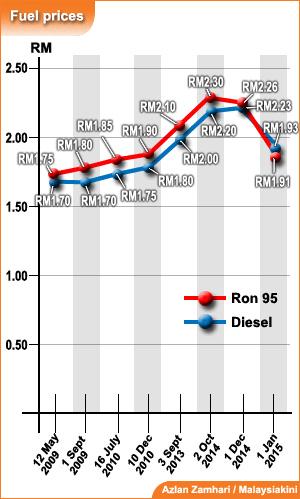
Under this system, government subsidies for RON95 petrol and diesel have been removed, and fuel prices are decided by the ministry each month based on the average market prices for the fuel over the past month.
Crude oil prices have been falling for months and are currently at its lowest levels since 2009, due to a supply glut on the world market.
Rafizi said these dealers also do not have control over their inventories, which are managed entirely by oil companies. The dealers are also required by law to maintain at least three days’ stock of fuel supply.
As a result, Rafizi ( left ) said the dealers have to keep large sums of cash on hand to purchase the stock from the oil companies.
This amounted to 50,000 to 70,000 litres in fuel stock for small and medium fuel stations at any given time, he said, which is worth between RM100,000 to RM150,000.
He said there are also allegations that oil companies have forced their dealers to stock up on fuel at a higher price just prior to the price drops, and the dealers cannot decline and wait to purchase stock after the price drop.
This is because they are bound by agreement to abide by the oil companies’ inventory management decisions, he said.
“I sympathise with them (the fuel dealers) because many don’t understand their situation. People think that they profit when fuel prices rose to RM2.30 (per litre).
“In actuality, they don’t get a single cent but instead suffer losses because their commission is only 12 cents on volume. The higher the price, the more people would save on fuel.
“When the price drops, they suffer from inventory losses like this. So for the past one year, they have lost both ways,” he said.
Between the government indifference to their plight and public misunderstanding of their predicament, Rafizi claimed that petrol dealers are “among the most victimised groups in Malaysia”.
He also emphasised that the managed float system is also not beneficial to consumers, as the monthly price reviews are not keeping up with the pace of the falling global market prices.
He said he will propose a better pricing mechanism at a future press conference.


Are you sure you want to delete this comment?
This action cannot be undone.