




Famed Swak fish swimming towards extinction
Sarawak's famous terubok ( Tenualosa toli ) will become extinct within three years if its spawning grounds are not protected, warned Agriculture and Agro-Based Industries Ministry parliamentary secretary Rohani Karim.
Sarawak's famous terubok ( Tenualosa toli ) will become extinct within three years if its spawning grounds are not protected, warned Agriculture and Agro-Based Industries Ministry parliamentary secretary Rohani Karim.
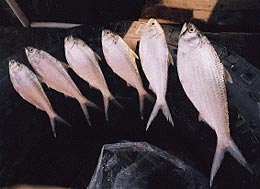 A major cause is that the spawning grounds of the fish, at river estuaries, is being disturbed by sand excavation activities.
Rohani said there is need for legal provisions to enable action to be taken under Section 29(1) Wildlife Protection Ordinance 1998 now widely used to conserve the turtle population.
She said the waters of Peninsular Malaysia used to teem with terubok but that the numbers have dwindled.
"We have to stop catching the fish during the spawning season to ensure it breeds in a natural setting. It will not adapt even if it is reared in fish-breeding stations," said Rohani.
Dramatic decline
This species formerly occurred in large numbers in the river estuaries of Sarawak, but this has undergone a dramatic decline.
By 1991, this species was close to extinction - despite two large UN Food and Agriculture Organisation projects to try and solve the problem - primarily due to over-fishing.
It was initially netted as a food fish but fishermen now target mainly the spawning females, because of the high price of roe.
The state government, through the Sarawak Development Institute, initiated research into terubok in 1992 in order to ensure its continued survival.
The project involved CSIRO Marine Research of Australia, and the Inland Fisheries Division of the Agriculture Department.
The terubok population is concentrated at the estuaries of Batang Sadong, Batang Lupar, Batang Saribas and Batang Lassa.
 This species is anadromous. Spawning migration takes place every year between June and November with peak migratory movement during the months of August to October.
Adult terubok move from foreshore waters to spawn at the middle reaches of Batang Lupar (Buloh Ayam region), Sri Aman Division and Batang Lassa (Teba'ang region), Mukah Division.
During the breeding season, the fishing activity is concentrated not only at the spawning grounds but also along the whole stretch of estuaries down to the coast.
The loss of breeding stock through exploitation coupled with environmental degradation and pollution of juvenile habitats and breeding grounds have contributed dramatically to the sharp declines of the terubok population in Sarawak.
Laughing matter
Instead of acknowledging important discoveries under the project, some senior backbenchers had cracked jokes. One member of Parliament had asked whether it is true the species was sequential hermaphrodite.
He was referring to project findings in 1993 where the fish was found to be male in the first year and female in the second, under its two-year life span.
This was the first recorded instance of sex change anywhere in the world in the economically important herring family ( Clupeidae ).
The next significant finding in 1994 was that the species spawns in only two of the estuaries of Sarawak (Batang Lupar and Batang Lassa) at specific grounds which are now being protected by the state government.
Further work established the movement patterns, food preferences and ecological requirements of the terubok .
Culture station
A terubok culture station was established at Lingga in1997. Research has established that it is not suitable for pond culture, but that fry could be produced for re-seeding purposes.
The Lingga culture station has since produced several million terubok fingerlings for re-seeding back into Batang Lupar - thus ensuring that the species survives until suitable management measures can be introduced.
In addition, Sarawak hosted the First International Terubok Conference in Kuching in September 2001, attended by representatives from Bangladesh, India, Myanmar, Cambodia and Kuwait and Australia.
Speakers reported widespread declines in population, with evidence mounting that stocks in several countries are close to economic and potentially biological extinction.
The conference stressed the need for urgent local management action to address stock conservation, sustainability and environmental issues where these have been identified.


Are you sure you want to delete this comment?
This action cannot be undone.