




Kuching court rules in favour of Forestry employees
The Kuching High Court has ruled in the favour of Sarawak Forestry Department employees by declaring that it is mandatory for the state government to issue them an option to join the newly-formed Sarawak Forestry Corporation (SFC) or remain in public service.
The Kuching High Court has ruled in the favour of Sarawak Forestry Department employees by declaring that it is mandatory for the state government to issue them an option to join the newly-formed Sarawak Forestry Corporation (SFC) or remain in public service.
Judge Clement Skinner on Tuesday also granted an order of certiorari to quash the government's decision not to issue the option.
 This decision was conveyed to the 1,200-strong Union of Forestry Employees Sarawak (UFES) president Abdul Wahab Hj Abdullah via a letter in April from the state Attorney-General's Chambers
Also granted was an order of mandamus to compel the government to comply with Section 16(1) of the Ordinance, which is: 'The corporation shall, on the appointed date, accept into its employment every person who immediately before that date is in the employment or service of the Forestry Department, Sarawak and who was given an option by the government and has opted to serve as an employee of the corporation.'
Public interest
There has been a lot of public interest in the matter since the state government's announcement on the corporatisation of most major functions of the Forestry Department and the plight of some 2,100 employees covering all categories from A to D.
To-date, some 200 employees of all categories have been absorbed into Sarawak Forestry Corporation Sdn Bhd (SFCSB) with a minimal number in SFC. A number of employees have been moved to other state departments. The union has claimed that at least a few hundred have also been 'terminated' or 'retrenched.'
Skinner read out his 29-page judgment before a packed court-room filled with UFES exco members, led by Abdul Wahab and union secretary Mohd Ali Yacob and other union members.
Counsel Abdul Rahman Mohd Hazmi represented the applicant while the state Attorney-General JC Fong appeared for the respondents.
Abdul Wahab, an assistant conservator of forest, was granted leave from the High Court on May 28, 2004 to make the application for the court orders and declarations after the judge struck out SFCSB as a party, saying only the government and SFC were affected by the application.
The application was made on his own behalf and as a representative of all other members of the union directed against the Sarawak government, SFC and the SFCSB as respondents for orders of certiorari, mandamus and declarations relating to the government's decision not to issue the option to employees of the department.
The State Legislative Assembly passed the Sarawak Forestry Ordinance on Oct 31, 1995 leading to the establishment of SFC with Chief Minister Abdul Taib Mahmud in his capacity as Minister of Resource Planning as its chairperson and SFC's wholly-owned subsidiary company SFCSB.
The ordinance itself came into force on gazette notification date Jan 1, 1998 , the 'appointed date'.
Abdul Wahab's application for a judicial review followed the AG Chambers' letter, informing him and UFES members that the government was not bound under the ordinance to issue such an option.
In his judgment, Skinner said: "The first respondent (Sarawak government) has not given to the applicant (Abdul Wahab) or any of the UFES members who immediately before the appointed day were employees of the Forestry Department the option in Section 16 (1) of the Ordinance.
"But there is evidence to show that the employees of the department have been seconded or assigned to serve in the third respondent (SFCSB) or have been offered employment by the third respondent."
On March 25, 2004 Abdul Wahab wrote to the government demanding that the option be issued to him and all members of UFES who were employees of the department immediately before Jan 1,1998.
When he received no reply to his letter, the union president requested his advocates to make the same demand on the government.
In April, the government replied that it was not bound under the ordinance to issue an option to them.
Under a duty
In his judgment, Skinner went into details on the merits of the application and the various submissions made by the State AG.
"With regard to the contention (by the respondents) that these (court) proceedings are an exercise in futility and that the second respondent (SFC) is no longer bound to accept the applicant and those whom he represents as employees for the reasons given, I cannot accept this as a valid argument because the court cannot allow a party to take advantage of its own breach of duty to thwart the purpose behind Section 16(1) and to defeat the legitimate expectations of the applicant and those whom he represents," he said.
The state AG had argued, among other things, that the court should not review the government's decision not to grant an option to the applicant and those whom he represents 'as this is a matter solely for the first respondent (state government) to decide.'
To this, Skinner said: "this is not a case where the applicant and those whom he represents are demanding to be transferred or of their being transferred within the state public service.
"This is a case about whether the first respondent (state government) is under a duty to give to those persons mentioned in Section 16(1) of the Ordinance, an option so that they may decide for themselves whether or not they wish to join the second respondent or remain in the state public service," he added.
Saying that certiorari and mandamus are discretionary remedies, Fong had argued that the court should refuse to exercise discretion in favour of the applicant and those whom he represents because 'they had slept on their rights for six years before coming to court.'
But the judge said: "In my judgment there is no such delay and I say so for the following reasons. In the first place, the decision which the applicant seeks to impugn is the refusal of the first respondent (state government) to give the option, which was made known to the applicant only on April 8, 2004."
"Under Order 53 r 3(6) the applicant is given 40 days from the date such decision is communicated to him to apply for relief, which he has done."
The judge added: "To me, if it can be said there has been delay, then it has been on the part of the first respondent (state government) in giving the option mentioned in Section 16(1) of the Ordinance."
"There has been no explanation offered at all by the first respondent why, despite the imperative language in Section 16(1) that the second respondent 'shall' accept into its employment all those in the employment or service of the Forestry Department on Jan 1, 1998, the first respondent did not by that date give to such persons the option so that they may decide whether to join the service of the second respondent or not, and why it did not, until April 2004, inform those affected persons of its decision not to issue the option," he said.
The judge also said that there was evidence to show that although the Ordinance might have come into force on Jan 1, 1998 the second respondent did not commence operations until June 9, 2003.
And even after that date, he added, the functions it had taken over from the Forestry Department were done only in stages, even as late as January 2004.
"Viewed in that light , there is no substance to the first respondent's complaint about the applicant having delayed in coming to court as it was not unreasonable for the applicant and those whom he represents to wait until they were told of the first respondent's decision not to give them the option, before they came to court," said Skinner.
"It must follow from what I have said that the applicant and those whom he represents are entitled to the relief they seek," he added.
However, the judge said it was unnecessary to make a declaration on the vesting and delegation of powers and functions of the second respondent to the third respondent as being illegal, ultra vires and void.
"In my judgment, the grant of such a declaration is unnecessary as the applicant's quest to be given the option does not in anyway hinge on the declaration they seek in relation to the third respondent," he added.
Unexpected decision
Commenting on the judgment today, Abdul Wahab said: "I cannot say I am too happy because there is another matter to deal with the large number of employees who have been retrenched and we're going to court again."
However, on the same note, he said that the decision was unexpected.
"... Why? We are fighting the government. We were prepared even to go to the highest court in the country and the International Court of Justice to fight our case," he added.
UFES is affiliated to the International Federation of Building and Wood-working (IFBWW) and the Malaysian Trade Union Congress (MTUC) from whom it receives a lot of encouragement.
 "Our concern is not really over. We hope it (the court's decision) is a general statement which means they ( the government) may give the option... to those who have been terminated," he said.
Abdul Wahab made it clear that the he and union members were not opposing privatisation or corporatisation or selling of the Forestry Department.
"We are only concerned with service matters, such as the Pension Act. When a person is moved from the department to a private body or entity (SFCSB) the Pension Act says they are considered as having departed from government service and they cannot come back.
"There is a great deal of ignorance on such matters. My point is the option should be to join SFC and not SFCSB," he said.
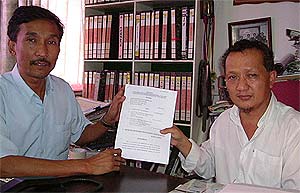
Photo: Abdul Wahab(right) holding a copy of the High Court judgement. At left is Zaidi Buang, union assistant secretary.
TONY THIEN is
malaysiakini's
Sarawak-based stringer.


Are you sure you want to delete this comment?
This action cannot be undone.