




Is Malaysia ready to adopt an inter-faith commission?
Malaysia has recorded many world firsts in terms of physical structures and individual achievements over the last two decades. But it will be a spiritual first if a draft bill on the proposed formation of a national inter-faith commission becomes law.
Malaysia has recorded many world firsts in terms of physical structures and individual achievements over the last two decades. But it will be a spiritual first if a draft bill on the proposed formation of a national inter-faith commission becomes law.
The Bar Council, through a steering committee, will hold a national conference where 40 non-governmental organisations and individuals involved in inter-faith efforts will review the draft bill.
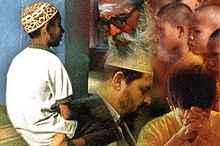 The conference is scheduled for Feb 24 and 25 in Bangi and expected to attract 250 participants from the government, faith-based organisations, religious departments and interested individuals.
Steering committee chairperson Malik Imtiaz Sarwar said the outcome of the proposal, touted as the first of its kind in the world, will be forwarded to the government for further action.
"The draft bill will see the light of day for the first time at the conference. The proposed commission is intended to be an independent body of an advisory, consultative and conciliatory nature," he said.
"Our national vision (Vision 2020) includes the challenge of establishing a matured, liberal and accepting society in which Malaysians of all colours and creed are free to practice and profess their customs, cultures and religious beliefs."
Better understanding
 He said the formation of an inter-faith commission was in line with Prime Minister Abdullah Ahmad Badawi's call for a dialogue and better understanding among various faiths.
The steering committee, he said, currently has 20 to 40 active inter-faith network and organisations interested in inter-faith efforts, including the Malaysian Consultative Council of Buddhism, Christianity, Hinduism and Sikhism (MCCBCHS).
Due to the absence of Muslim partners, the MCCBCHS is the closest that Malaysia has to an inter-faith grouping.
Describing it as exciting, Malik Imtiaz said this was not a radical idea for Malaysia because the initiative was merely responding to the call by the country's leaders to establish such a body.
The steering committee was set up following a Bar Council-organised workshop in May 2003 to collect feedback on the formation of an inter-faith council.
"That workshop saw 100 participants agreeing on a six-point statement on the need for a statutory body of a consultative or conciliatory nature.
"The draft bill, modeled after the Human Rights Commission of Malaysia (Suhakam), will be presented at the conference for further deliberation before it is endorsed," he said, adding that the Bar Council was merely facilitating the initiative.
The objective of the proposed inter-faith commission, he explained, is to have the power to make recommendations to either specific authorities or to Parliament on related issues or complaints.
Copies of draft bill have also been sent to about 50 interested individuals and bodies, he added.
Muslim groups stay away
Previous ideas and attempts to form an inter-faith body failed because Muslim groups generally felt threatened by the possibility of Islamic teachings and their authority being undermined.
According to Malik Imtiaz, the idea for a national body to oversee matters of inter-faith which would particularly be useful in a multi-racial, pluralist society was born at a seminar on freedom fo religion in early 2000.
"Muslim groups generally stayed away as they were concerned that the proposed body would undermine the existing framework and take over the functions of religious departments, although there were Muslim individuals who were present.
"The main concern was the fear of the proposed body taking over the religious authorities' adjudication function."
For example, he said, the controversy surrounding the recent Federal Territory Islamic Department (Jawi) raid has raised a lot of ambiguity as to what is wrong and right.
"Without commenting on the right or wrong of the action, a body such as the proposed commission could clear the ambiguity by making certain recommendations," said Malik Imtiaz.
"This would also cut down on court action which is mostly to seek a definition for ambiguous areas of policy implementation and interpretation of laws."
The conference is supported by Germany-based Konrad Adenauer Foundation which promotes inter-cultural and inter-religious dialogues and cooperation the world over.


Report this comment
Are you sure you want to delete this comment?
This action cannot be undone.