


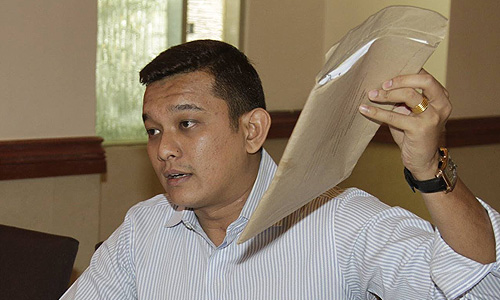

Sanjeevan wins habeas corpus bid, remand under Poca null and void
The Kuala Lumpur High Court has allowed Malaysian Crime Watch Task Force (MyWatch) chairperson R Sri Sanjeevan’s habeas corpus application, and declared his remand under the Prevention of Crime Act 1959 (Poca) null and void.
The court found that the warrant for Sanjeevan to be held at the police remand centre (PRC) at Jalan Ipoh is defective.
The High Court in Kuala Lumpur has allowed Malaysian Crime Watch Task Force (MyWatch) chairperson R Sri Sanjeevan’s habeas corpus application, and declared his remand under the Prevention of Crime Act 1959 (Poca) null and void.
The court found that the warrant for Sanjeevan to be held at the police remand centre (PRC) at Jalan Ipoh is defective.
“The procedures for detaining a person must be followed to the letter.
“As there are doubts regarding the order giving rise to several interpretations, the court allows the (habeas corpus) application and orders that Sanjeevan be released from the PRC with immediate effect,” judicial commissioner Mohamad Shariff Abu Samah ruled.
Due to outstanding charges in Seremban however, Sanjeevan’s lead counsel Gobind Singh Deo told reporters that his client would be produced in Seremban’s courts instead for a bail application.
“Now that there is a change in circumstances, I think we will write to court and ask them to consider bringing forward the file. I will ask my legal assistant to do it immediately and perhaps we will go to Seremban at three or four o’clock today and ask for him to be produced," said Gobind.
Sanjeevan had previously pleaded not guilty to charges of extortion on July 19 at the Magistrate’s Court in Seremban.
He also pleaded not guilty at the Sessions Court in Seremban on the same day, to charges of having a foreigner in his employment without the appropriate permits.
However, he was not offered bail at the time as his bail hearing was slated for Aug 1, since he was being remanded until July 31.
The remand order under Section 4(1)(a) of Poca was issued by Kuala Lumpur Magistrate Ahmad Solihim Abdul Wahid on July 11.
Gobind argued that the detention order made pursuant to the remand is invalid, because the facts contained in the order are wrong.
He said Section 4(1)(a) of Poca stipulates that the remand is for detaining a person in police custody pending further investigation.
It is not for general custody or custody in prison, he said.
However, the order for Sanjeevan’s detention is directed to an ‘officer in charge of prison’, which Gobind said treats Sanjeevan as though he has been charged with a ‘crime’ under Poca.
In addition, it refers to Sanjeevan as an ‘accused’, and the PRC where Sanjeevan was held as a ‘prison’.
The order reads, “Sri Sanjeevan a/l Ramakrishnan (hereafter referred as ‘the accused’) has been brought to this court and charged of an offence under Section 4(1)(a) of Poca and needs to have the accused detained.
“This hereby empowers and requires that you the officer receive the accused in your care together with this warrant and incarcerate him safely in prison until July 31, 2016, when you will cause him to be brought to court on the said time and date, unless you receive orders otherwise in the meantime.”
Citing legal precedence, Gobind argued that when there is doubt on whether a detention or restriction on a person’s freedom is carried out legally, the doubt must be resolved in the person’s favour.
Deputy public prosecutor (DPP) Mohammad al-Saifi Hashim countered that the magistrate is a competent authority to issue the remand order, and the notes of proceedings also state that this is a remand.
He added that although the order refers to the PRC at Jalan Ipoh as a prison, the facility is actually gazetted as a place for holding Poca detainees.
However, Gobind pointed out that the gazette referred to a ‘PRC in Batu, Kuala Lumpur’.
While Mohammad insisted that the two names refer to the same facility, Gobind said the burden of proof is on the DPP to show this.
Sanjeevan was first arrested in Nilai on June 22. He has been in police custody ever since, as he was released and immediately rearrested another eight times before he was remanded under Poca.


Are you sure you want to delete this comment?
This action cannot be undone.