




Pak Lah will prove a 'prickly' guest for Australian host
With praise for the Indonesian president's "breakthrough" visit to Australia still ringing in Prime Minister John Howard's ears, observers have warned Malaysian leader Abdullah Ahmad Badawi will prove a more prickly guest when he arrives in Canberra late today.
With praise for the Indonesian president's "breakthrough" visit to Australia still ringing in Prime Minister John Howard's ears, observers have warned Malaysian leader Abdullah Ahmad Badawi will prove a more prickly guest when he arrives in Canberra late today.
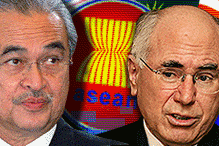 Abdullah has already shown he will not shy away from differences with the Australian government, labelling Howard's foreign policy overly US-dominated in an interview with Australia's national broadcaster last weekend.
Other sore points, such as Howard's threat of unilateral action against terrorist bases in the region and his refusal to sign the Association of Southeast Asian Nations (Asean) Treaty of Amity are expected to be raised on the trip.
The visit, only the second by a Malaysian prime minister in two decades, is intended to improve on the often acrimonious relations under Abdullah's predecessor Mahathir Mohamad.
Mahathir, who was once described as "recalcitrant" by former prime minister Paul Keating, went out of his way to exclude Australia from regional groupings and scorned its role as a US "deputy sheriff" in the region.
Foreign Minister Alexander Downer said Abdullah's visit showed political links between the countries were improving and played down the Malaysian leader's pre-trip criticisms.
"He can say what he likes, he's a prime minister of a country that is an important partner of ours," Downer told ABC radio, adding "we don't always have to agree with another country and there will always be times when with other countries we have some points of disagreement".
Main opponent
Downer identified Malaysia, along with China, as the main opponents to Australia attending the first East Asia Summit in December, blaming political "wheels within wheels" across the region.
Howard is expected to lobby Abdullah to allow Australian inclusion in the forum during the visit, after securing support this week from touring Indonesian President Susilo Bambang Yudhoyono.
Howard and Abdullah will also announce the beginning of negotiations for a free trade agreement between the countries, following similar bilateral deals between Australia and the United States, Thailand and Singapore.
Howard has said Abdullah's trip was part of Australia's policy of engaging Asia.
"Australia's future is fundamentally based on its global engagement and there is no doubt that deeper and stronger ties with the countries of Asia are a vital part of that," he said in an interview with the New Straits Times .
Howard dismissed Malaysian concerns about pre-emptive strikes, saying action by Australia would only be taken in consultation with its neighbours, a fact not specified in his remarks before national elections last October.
Howard's blunder
University of Adelaide Asian studies professor Purnendra Jain said Howard's pre-emptive comments were a blunder he needed to avoid repeating.
Jain said the Yudhoyono trip, during which Canberra and Jakarta agreed to a comprehensive security agreement, had been a success while the bitterness appeared to have dissipated from the relationship with Malaysia since Abdullah took power in 2003.
He said with Howard set to make his own trips to Japan and China later this month, Australia was undergoing a crucial phase of relationship building with Asia.
"Prime Minister Howard's cooperative attitude is a clear departure from his earlier disregard of, and indeed arrogance towards, Asia," Jain said.


Are you sure you want to delete this comment?
This action cannot be undone.