




M'sia, Australia fail to bridge key differences
Australian and Malaysian leaders failed to resolve long-standing differences over how to tackle terrorism in Southeast Asia at a meeting in Canberra today, at which Malaysia also refused to back Australia's push for inclusion in a new regional grouping.
Australian and Malaysian leaders failed to resolve long-standing differences over how to tackle terrorism in Southeast Asia at a meeting in Canberra today, at which Malaysia also refused to back Australia's push for inclusion in a new regional grouping.
In the first Australian visit by a Malaysian leader in 21 years, Abdullah Ahmad Badawi and Prime Minister John Howard announced plans to negotiate a free trade agreement but refused to concede ground on key differences regarding Canberra's role in the region.
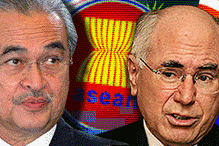 Both leaders played down tensions over Malaysia's objection to Australian participation in the inaugural East Asia summit, Canberra's refusal to sign the Association of Southeast Asian Nations' (Asean) Treaty of Amity and Cooperation and Howard's threat of unilateral action against militant bases in the region.
"Like all countries that take their relationship seriously, there will over time be differences and there will in the future be differences," Howard told reporters at a joint press conference with Abdullah.
Howard cut the press conference short after persistent questioning on thorny bilateral issues, in stark contrast with Indonesian President Susilo Bambang Yudhoyono's visit earlier this week, when both leaders appeared at ease and said relations had entered a new era.
Unlike Yudhoyono, Abdullah refused to back Australia's push to attend the East Asia forum, saying negotiations were ongoing.
"We haven't had a summit yet, we haven't finished discussions at a foreign minister level, there are many issues that need to be discussed," he said when asked whether he wanted Australia to attend.
Looking at the bigger picture
Abdullah's deputy, Najib Abdul Razak, said last month Australia should be excluded from the summit, which will be held in Kuala Lumpar in December and Australian officials have identified Malaysia and China as the main opponents to Canberra's participation.
Australia and Malaysia have a long history of tense relations, particularly under Abdullah's predecessor Dr Mahathir Mohamad, who labelled former prime minister Paul Keating a "bully" and was in turn called "recalcitrant" by the then Australian leader.
The relationship has improved since Abdullah took power in 2003 but the Malaysian leader still felt compelled to criticise Australia's foreign policy as too US-focussed ahead of his visit and question Howard's threat to take unilateral action against extremists' bases in the region.
Abdullah reacted coolly when asked if Malaysia would be willing to host Australia's proposed "flying squads" of counter-terrorist forces.
"We can certainly take care of what happens within Malaysia," he said. "If it is necessary that we seek help and assistance from other countries then we would do so."
Pressed on the issue of Australia making pre-emptive strikes in the region, Abdullah replied: "Some issues concerning which we will have a different opinion.
"But that doesn't matter really, what is important is that we look at the bigger picture."
Howard's refusal
 For his part, Howard reiterated his refusal to sign the Treaty of Amity and Coooperation, under which the 10 Asean nations, China, Russia, Japan and India have agreed not to use military aggression against one another.
"Given that it was delivered to the region by a mindset that we've really all moved on from, I didn't think it was appropriate that Australia should sign it," he said.
Trade Minister Mark Vaile said two-way trade with Malaysia reached almost 10 billion dollars (US$7.65 billion) in 2004 and a trade agreement could boost the Australian economy by 1.9 billion dollars a year.
Australia already has free trade agreements with Thailand, Singapore, the United States and New Zealand.


Report this comment
Are you sure you want to delete this comment?
This action cannot be undone.