


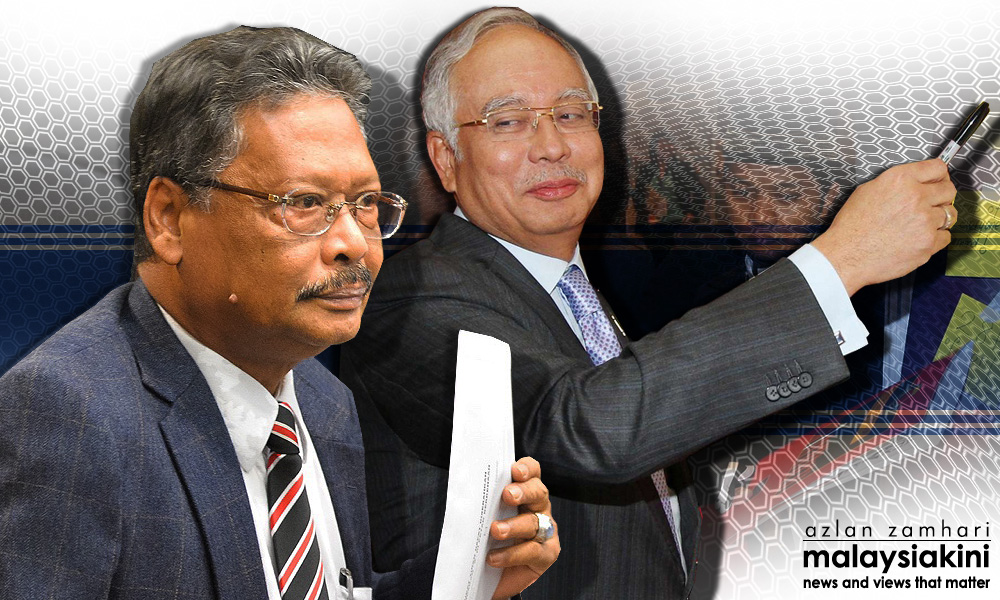

Bar submits all are equal before the law, including Najib and Apandi
All are equal before the law under the Federal Constitution and that includes Prime Minister Najib Abdul Razak and attorney-general Mohamed Apandi Ali, the Malaysian Bar told the High Court in Kuala Lumpur today.
As such, they should be held accountable under the law, it said when submitting in the judicial review application against the AG's decision to clear the prime minister over 1MDB.
Before Justice Hanipah Farikullah, the Bar further stated that 1MDB involves taxpayers' money and backed by government guarantees.
All are equal before the law under the Federal Constitution and that includes Prime Minister Najib Abdul Razak and attorney-general Mohamed Apandi Ali, the Malaysian Bar told the High Court in Kuala Lumpur today.
As such, they should be held accountable under the law, it said when submitting in the judicial review application against the AG's decision to clear the prime minister over 1MDB.
Before Justice Hanipah Farikullah, the Bar further stated that 1MDB involves taxpayers' money and backed by government guarantees.
For this reason, the Bar said it has an interest to challenge the decision made by the AG due to the magnitude of the 1MDB scandal "involving public funds which are unparalleled and unheard-of in the country".
They submitted that Najib could have acted in conflict of interest as he is also the finance minister and the chairperson of 1MDB's board of advisers.
The Bar pointed out that Apandi could also have acted in conflict when he decided to clear Najib since it was him who advised Najib not to give answers in Parliament.
It was also the case when the AG acted as an adviser to Najib and the government and at the same time performing his duties as the public prosecutor in deciding whether to institute criminal proceedings against the PM, they submitted.
"The AG also acted beyond his jurisdiction when he directed the three investigation papers submitted to the Malaysian Anti-Corruption Commission (MACC) to be closed. The AG had wrongfully encroached the MACC's statutory powers which is a matter of public concern and relevant to the administration of justice.
"There is also a question whether the AG had acted in excess of his powers in clearing the PM in the commission of an offence in relation to the RM2.6 billion, and the flow of RM42 million from SRC International Sdn Bhd into PM's personal account," they said.
Lawyers for the Malaysian Bar also asked whether Najib had returned the RM42 million in question.
Following the United States Department of Justice's forfeiture lawsuits over 1MDB, the Bar further contended that the US was not the only country investigating the matter.
"The investigations by foreign agencies in the United States, Switzerland, Singapore and Luxembourg are also unparalleled and unheard-of.
"The reported 1MDB problem is a case of massive and blatant wrongdoing and it has a terrible reflection on Malaysia," lawyers told the court.
They said for these reasons, the court should grant them leave (permission) so that a full judicial review application can be heard on merits.
The Bar's bid is the third application to challenge the AG's decision.
Prior to this, the court had separately heard submissions from lawyers representing former minister Zaid Ibrahim and former Batu Kawan Umno division vice-chief Khairuddin Abu Hassan, for a similar challenge against Apandi's decision not to charge Najib.
The Malaysian Bar was led by a team of lawyers which included Tommy Thomas, Ambiga Sreenevasan, S Ravindran and Fahri Azzat.
Not AG's job to clear Najib
Referring to Article 145(3) of the Federal Constitution, the Bar told the court that it is not the AG's job to clear Najib.
"That power rests solely on the judiciary," they said.
The lawyers also highlighted the press conference held on Jan 26 this year where Apandi cleared Najib of any wrongdoing.
"The AG has no power to say that. What he could have said was 'we do not have enough evidence to charge'," they said.
The Bar said Apandi's refusal to accede to MACC's request to activate the mutual legal assistance (MLA) to get documents from foreign jurisdiction to gather evidence was also wrong and could be seen as disrupting the investigations.
"The refusal of the AG to consider the MACC's request under the MLA was perverse and unreasonable according to the law, and should be revisited," he said.
Senior federal counsel Amarjeet Singh, who is the head of AG's Chambers' civil division, led a team which included his deputy Alice Loke, Suzana Atan and head of the appeal division, Awang Armadajaya Awang Mahmud.
They submitted that the Malaysian Bar has no locus standi (legal standing) to initiate this action because they were not adversely affected.
"There is nothing in the affidavit in support of the application for judicial review which states that the Malaysian Bar was affected," the federal counsels told the court.
They further argued that AG's action was non-justiciable in court as he exercised his discretion.
"There are some issues which are not suited for adjudication."
The court did not fix any dates to deliver its decisions in all three cases.


Are you sure you want to delete this comment?
This action cannot be undone.