




Gov't 'wasting RM400 mil' in new double-tracking contract
For years, DRB-Hicom - an automotive production and engineering conglomerate - has been struggling to complete the RM4.6 billion Ipoh-Rawang electrified double-tracking rail project. Its original completion date was 2002, but it is now pushed back to 2007.
For years, DRB-Hicom - an automotive production and engineering conglomerate - has been struggling to complete the RM4.6 billion Ipoh-Rawang electrified double-tracking rail project. Its original completion date was 2002, but it is now pushed back to 2007.
About 82 percent of the work has been done. However, DRB-Hicom wanted an additional RM700 million to finish the remaining part of the project.
The Finance Ministry was not amused and responded by terminating DRM-Hicom's contract and awarding the unfinished portion of the project to another engineering conglomerate, UEM Group Bhd.
To do the task, UEM will be paid RM1.1 billion - RM400 million more than what was demanded by DRB-Hicom. Not surprisingly, Opposition Leader Lim Kit Siang was outraged.
At a press conference today, he said the UEM contract was "a matter of grave public concern".
 The opposition leader wanted to know why the unfinished portion of the project was awarded to UEM for RM1.1 billion when DRM-Hicom had undertaken to complete it for RM700 million.
"Furthermore, what guarantee is there that there would not be further delays as well as fresh variation order claims when UEM takes over as the lead contractor for the unfinished portion of the double tracking."
According to Lim, the Finance Minister had directed DRM Hicom to vacate all its work sites along the Ipoh-Rawang stretch by this Friday.
Suspend award to UEM
The multi-billion Ipoh-Rawang double-tracking project comprises two packages - the building a 180km dual-way track, and the installation of electrification and signalling systems.
DRB-Hicom was the turnkey contractor for the construction of the dual-way track, budgeted at RM2.58 billion.
The work involved building 13 stations, renewal and realignment of the existing track, the replacing of bridges, the upgrade of level crossings, a new electrical multiple units depot and the refurbishment of the Ipoh station.
For the electrification and signalling systems, the RM1.9 billion contract was awarded to DRB-Hicom and Mitsui & Co Transport Systems.
Work has stalled over the past years due to a dispute over the RM700 million variation orders claims by DRB-Hicom, which were apparently made on the advice and instructions from several government agencies including the Transport Ministry but was not approved by the Finance Ministry.
"I call on the prime minister, Abdullah Ahmad Badawi, who is also finance minister, to suspend the award of the unfinished portion of Ipoh-Rawang double tracking contract to UEM...," demanded Lim.
He also wanted Abdullah to explain the rejection of DRB-Hicom's offer to complete the project if its RM700 million variation order claims were met.
Mired in controversy
The Malaysian portion of the double-tracking rail project - which forms part of an ambitious 5,600-kilometre trans-Asia link connecting southern China to Singapore - has been mired in controversy.
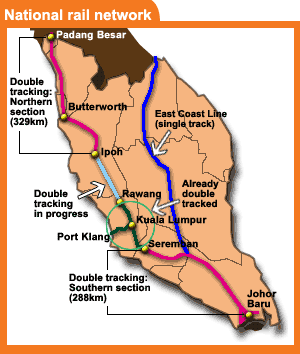 Two years ago, Abdullah shelved the two remaining sections of the project - the 336km northern Ipoh-Padang Besar stretch and the 287km southern Seremban-Johor Baru stretch - in a bid to trim a serious budget deficit.
The RM14.5 billion proposed project, one of Asia's biggest infrastructure deals, ran into a storm of protests when the government dropped a consortium of Indian and Chinese contractors in favour of the politically well-connected local consortium led by prominent tycoon Syed Mokhtar Albukhary.
Transport Minister Chan Kong Choy said early this month that parts of the suspended mega-project would be revived in the 9th Malaysia Plan, but this was reportedly shot down by Abdullah.
Meanwhile, DRB-Hicom had previously been accused of not paying some of its sub-contractors for the Ipoh-Rawang project.


Are you sure you want to delete this comment?
This action cannot be undone.