


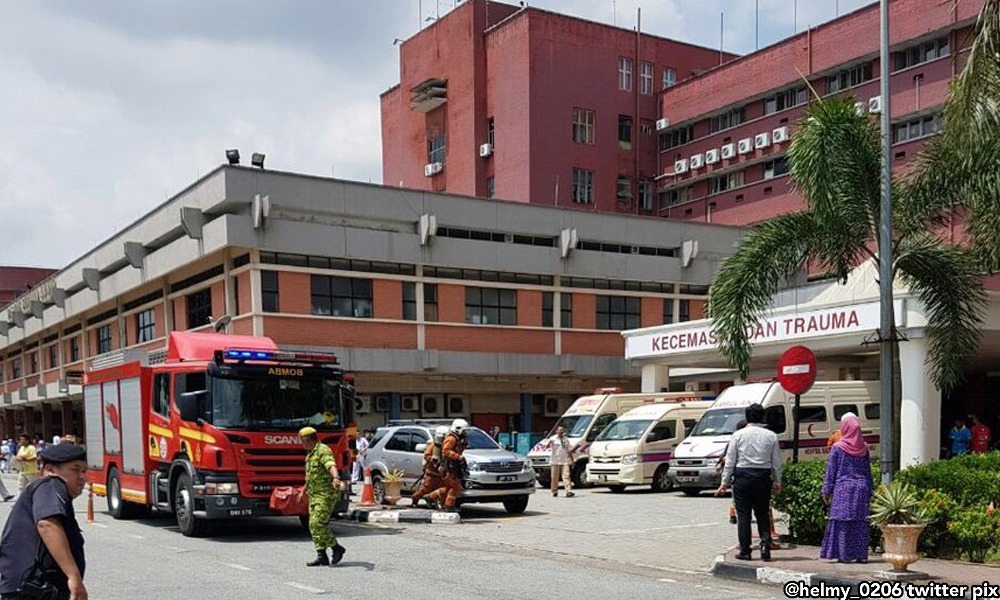

Source: Electrical sparks led to hospital fire, too
Electrical sparks is believed to have led to the Sultanah Aminah Hospital (HSA), Johor Bahru Intensive Care Unit (ICU) fire on Tuesday which killed six patients and injured 11 others.
This is similar to the short circuit in the hospital's operation theatre the following day, which forced a second evacuation and injured three nurses.
Malaysiakini understands that in the first incident, sparks were spotted from electrical wiring in the southern ICU treatment room, prompting a personnel on duty into action.
Electrical sparks is believed to have led to the Sultanah Aminah Hospital (HSA), Johor Bahru Intensive Care Unit (ICU) fire on Tuesday which killed six patients and injured 11 others.
This is similar to the short circuit in the hospital's operation theatre the following day, which forced a second evacuation and injured three nurses.
Malaysiakini understands that in the first incident, sparks were spotted from electrical wiring in the southern ICU treatment room, prompting a personnel on duty into action.
The personnel emptied one fire extinguisher while a call was placed to the Fire Department in the incident which happened before 9am, it is learnt.
However, this failed to stop the sparks from igniting into flames, prompting the staff to empty a second fire extinguisher to no avail, the portal understands.
It was earlier reported that sprinklers were triggered during the incident.
The following morning, an electric socket short circuited, which led authorities to order a full inspection of the hospital's electrical wiring.
The electric socket reportedly became wet following post-fire clean-up services.
"We will only use the block when it is certified safe after thorough inspection," Health Minister Dr S Subramaniam said yesterday.
On Tuesday, he told reporters the Fire and Rescue Department said it was safe to resume operations.
The hospital's history traces back to 1882, but the main building started construction in 1938 and opened its doors in 1942.
Building maintenance for HSA is contracted to concessionaire Medivest Sdn Bhd.
Subramaniam said hospital support service concessionaires are required to conduct regular safety inspections, while the ministry has a special task force to conduct the same.
It will now conduct a fire safety audit on all public hospitals, starting with older hospitals.
In a special report on the state of public hospitals last February, Malaysiakini reported that patients at HSA were forced to climb up stairs as the lifts were in a state of disrepair.
Hospital support services, which include building maintenance, have been outsourced since 1996.
Contracts are awarded through "negotiated tenders" and not competitive bidding, with 15-year contracts worth a total RM7.5 billion distributed between a handful of concessionaires.
In 2006, the monitoring of concessionaires was also outsourced.


Are you sure you want to delete this comment?
This action cannot be undone.