




Commission: Preventive laws undesirable
The Royal Commission to Enhance the Operation and Management of the Royal Malaysian Police has recommended a review of the Police Act 1967, Internal Security Act 1960, Dangerous Drugs Act (Special Preventive Measures) Act 1985 and Criminal Procedure Code.
The Royal Commission to Enhance the Operation and Management of the Royal Malaysian Police has recommended a review of the Police Act 1967, Internal Security Act 1960, Dangerous Drugs Act (Special Preventive Measures) Act 1985 and Criminal Procedure Code.
The 16-member commission, in its report which was released today, found that "not all preventive laws currently in force" were necessary because effective action was possible under other laws that conform to constitutional requirements.
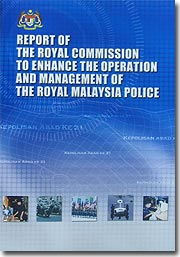 "Preventive laws are undesirable because they deny the individual his personal liberty without a right to trial in an open court as provided for in Article 5 of the Federal Constitution and in the International Bill of Rights," it said in the 607-page report.
The commission also noted the applications of section 27 of the Police Act as well as sections 8 and 73 of the ISA that are perceived to be biased against opposition politicians.
Similarly, Articles 10(2) and (3) of the Federal Constitution allow for restrictions on public assembly, but the Police Act bans the right to assemble altogether.
"This right is one of the most basic and indispensable of the fundamental freedoms necessary for the functioning of a democratic society and is provided for in the (Constitution)."
Eleventh-hour decisions
The commission said that while section 27 was open to challenge in court as unconstitutional, this has no chance of happening if the police decide to reject applications for permits at the last minute.
It found that eleventh-hour permit approvals and rejections also effectively nullified both the 48-hour appeal process to the Chief Police Officer (CPO) under section 27(7) and an avenue for judicial review.
Those granted permits were also slapped with "ridiculous and difficult to implement" conditions tantamount to an indirect refusal of permission revealing a process perceived as far from neutral and impartial.
The commission found the police to "wrongly apply a reversal of onus of proof" in permit applications and to be hiding behind the undefined ground of "prejudicial to the interest of the security of Malaysia".
The three extended provisions to section 27 - subsections A, B and C - were found to be a further erosion of constitutional freedoms, and recommended their repeal.
It noted that the Police Ordinance, which preceded the Police Act, was less restrictive and prohibitive in this aspect.
In addition, the commission proposed the removal of, among others, the power to regulate assemblies and meetings held on private premises and the 48-hour time limit for appeal.
The recommendation includes a requirement for the district police chief to state reasons for rejecting a permit application and for the CPO to do the same in an appeal.
It also requires the district police chief not to limit the rights of any person engaged in lawful advocacy, protest or dissent, and to ensure that the exercise of that right itself is not considered as prejudicial to security.
The commission further recommended that the word 'security' be defined in relation to the Special Branch.
Standard remand procedures
 On the 60-day detention period under the ISA, the commission recommended 30 days as being sufficient time for the police to conduct investigations or gather information.
The commission proposed standard remand procedures to be applied to ISA detainees including access to legal counsel.
Where legal access is denied for "good reason(s)", the commission said detainees should be given access to family members and counsel at least seven days following arrest.
The commission noted that its terms of reference, however, excludes an examination of detention under section 8.
Concerns and considerations similar to the ISA detention were made for detainees under section 3 of the Dangerous Drugs (Special Preventive Measures) Act 1985.
The Emergency (Public Order and Prevention of Crime) Ordinance 1969 and the Restricted Residence Act 1933 were also recommended to be repealed on grounds that they were outdated and no longer practical.
The partial repeal of the Prevention of Crime Act 1959 is another recommendation in light of the repeal of the above two preventive detention laws.
With regard to the application of section 117 of the CPC, the commission found the police actions circumventing the law in order to obtain serial remands as "a serious breach of human rights".
The commission said that the maximum permissible remand period is much shorter in Hong Kong, Australia and Singapore, where serial or "chain smoking" orders were not entertained.
"The practice of 'arrest first, investigate later' should be used very sparingly and only for the most necessary cases."
The recommendation is to amend section 117 to allow for a remand of a maximum of seven days for an arrest without a warrant and 24 hours with a warrant. For further remand, the police is supposed to re-apply to the magistrate every 48 hours with reasons.
Code of practice
The commission has also recommended a nine-point code of practice relating to the arrest and detention of persons.
Another recommendation resulting from the inadequacy of the CPC provisions which are "not sufficiently rigorous", is to conduct inquiries into all cases of custodial deaths through a "more expeditious, transparent and accountable" process.
Amendment of section 107(1) of the CPC has also been recommended to allow for police reports to be lodged in other ways than just at police stations.
The commission said the amendment should allow "any police officer on duty anywhere, whether in or outside the station, to accept any report made by any person".
If an oral report is made, the officer is required to write it down in his pocket book, report the receipt of the information to his superior and subsequently log the report at the station.
Similarly, section 108A has been proposed for amendment to ensure that certified documents are made available to the complainants seven days after reports are lodged.
The commission has also recommended that the Special Branch, the security intelligence unit, should be made accountable, and said the term 'security' should be defined to avoid misconceptions and prevent abuse.


Are you sure you want to delete this comment?
This action cannot be undone.