




Unprofessionalism at the core of custodial deaths, public distrust
The police's lack of professionalism in handling cases of deaths in custody has created suspicion of foul play, doubts and distrust among the dead suspect's family members, the Royal Commission to Enhance the Operation and Management of the Royal Malaysia Police has found.
The police's lack of professionalism in handling cases of deaths in custody has created suspicion of foul play, doubts and distrust among the dead suspect's family members, the Royal Commission to Enhance the Operation and Management of the Royal Malaysia Police has found.
 Shoddy investigations, insensitivity towards a grieving family, delay in notifying them of a suspect's death, denial of a post-mortem report and failure to offer an oral explanation were also cited as reasons behind a host of complaints
documented
in the 607-page report.
Shoddy investigations, insensitivity towards a grieving family, delay in notifying them of a suspect's death, denial of a post-mortem report and failure to offer an oral explanation were also cited as reasons behind a host of complaints
documented
in the 607-page report.
Citing the case of G Francis Udayappan, the commission said the police had failed to act in accordance with the law by, for example, acting promptly to facilitate an inquest, behaving insensitively towards family members or by denying their request for an independent pathologist.
Most often, said the commission, families of suspects were unaware of their whereabouts until informed about their deaths while in police custody.
It said there was a "severe lack of proper records of action" following a suspect's arrest including the logs in lockup, investigation and station diaries.
Allegations of tampering with records with regards certain dates and a general lack of transparency were also noted.
In addition, the commission said that police failed to "faithfully follow" provisions in the Lock Up Rules 1953 such as ensuring a safe journey to and from the lock-up after recording of a statement. In one case, the suspect jumped over a corridor wall and fell to his death.
Mandatory inquest
It also noted that contrary to popular perception, custodial deaths were not confined to only one race.
The commission also found that magistrates and the police failed to order for a post-mortem following custodial deaths, leading to an oversight of possible internal injuries. Only accidental deaths while in police custody are exempted by law.
Concerned with the trend of police invoking the proviso for any custodial death, it recommended that a mandatory inquest be held for any death in police custody.
The police were also found to 'escape' responsibility over a suspect by granting bail before sending him/her for a medical examination.
"When the suspect dies in hospital, the death becomes one that had not occurred while in police custody and an inquiry into the death is not mandatory," it said, adding that police should probe beyond the reasons cited by a pathologist.
Shoddy investigations into custodial deaths were also found where key eye-witnesses including cell-mates, lock-up officers on duty, arresting officers and officers who had earlier examined the suspect were left out of questioning or statements.
Case studies
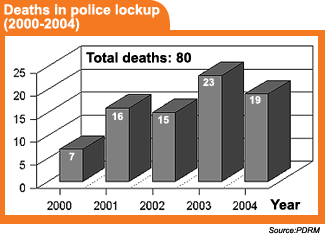 Of the total 80 deaths between 2000-2004, only six were inquired into while in 22 others the magistrate or deputy public prosecutor had decided that it was not necessary.
The report contained four case studies of custodial deaths.
In Francis' case at Brickfields police station, the commission found that a thorough DNA test was not done using samples of either his hair, hairbrush, toothbrush or other personal effects. Even his urine sample obtained upon arrest was not used as a sample.
In the case of a 25-year-old suspected drug addict detained at the Port Klang police station, bail was granted while he was still in the emergency ward, leading to allegations that police had attempted to avoid the classification of a custodial death.
The commission also condemned the police's action of granting bail on an ailing suspect's own surety as "unacceptable practice". The bail form was also allegedly tampered with.
In addition to the mix-up in the name and dates of the suspect's arrest and appearance before the magistrate's court, his identity card number on the arresting officer's report, the death certificate and later the burial permit were allegedly different.
Unanswered questions
The commission said a suspect could be declared "medically fit" to be detained in a lock-up by asking basic health questions.
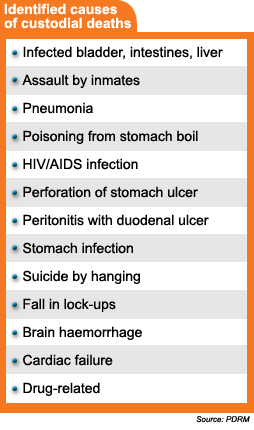 In a third case which occurred at the Kajang police station, the commission was unable to reconcile the evidence that the suspect could scale over a wall and fall to his death while in handcuffs without the two police escorts realising it.
In Kelantan, the commission found many unanswered questions pertaining to the death of a 20-year-old who allegedly hung himself in a police cell in Nilam Puri using his jeans with the support of the lock-up grille.
It found that no test was done to determine how much weight the grille could support without being bent in any way or there was any sign of being strained by any weight.
Quoting a magistrate, the commission said it was strange for a suspect to be detained fully-clothed in long pants and a long-sleeved shirt.
It also said that the pathologist should produce some features either supporting or rejecting the contention that the hanging was murder or suicide.


Report this comment
Are you sure you want to delete this comment?
This action cannot be undone.