




Kuala Muda fishermen find their sea legs after tsunami
The jetty at the little fishing village of Kampung Tepi Sungai in Kuala Muda is a hub of morning activity. Fishermen carrying rattan baskets of fish are met by middlemen or wholesalers in rubber boots, who whisper prices into their ears. This time six months ago, they were a mere week from impending disaster.
The jetty at the little fishing village of Kampung Tepi Sungai in Kuala Muda is a hub of morning activity. Fishermen carrying rattan baskets of fish are met by middlemen or wholesalers in rubber boots, who whisper prices into their ears. This time six months ago, they were a mere week from impending disaster.
The negotiation centre, or dewan berbisik (hall of whispers) as it is locally known, is a modest open-sided concrete structure with a roof. Like the bridge leading to it from the jetty, it is new.
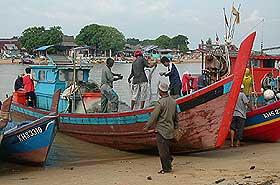 It was built as part of reconstruction efforts in the village near Sungai Petani in Kedah, the worst hit site along Malaysia's west coast when the Indian Ocean tsunami struck unexpectedly on Dec 26 last year.
The fishermen were fortunate that the waves hit after the day's fishing activities had ended. But while there were no fatalities at sea, the damage on shore still dealt a hard blow to the community of 2,000.
Boats and nets were destroyed, leaving many fishermen unable to work for months. Many had no shelter either because houses had been reduced to rubble.
But help was quickly mobilised. The Tanjung Dawai Fishermen Association took up their cause, assigning committee member Zainol Mohd Nor to co-ordinate the complex business of determining assistance required.
"Immediately after the tsunami, LKIM (Malaysian Fisheries Development Authority) created a special fund ( Dana Khas Tsunami ) to help the fishermen repair their houses and purchase equipment," he said at his house, a few steps away from the jetty.
"Initial reports by the police stated that only 172 fishermen were eligible for assistance in rebuilding their houses, a figure which many people challenged. After another meeting, LKIM set up a second fund for repairs to equipment ( Dana Baikpulih Peralatan ). This helped 269 fishermen."
Help provided
In all, 441 villagers were found to be eligible for assistance, but many more meetings had to be held to gather input from the parties concerned and to sort out relevant matters.
"We have succeeded in helping the fishermen. For example, under the special fund, only 28 people have yet to receive assistance, or about 30 percent of 172," Zainol said, showing a list of names and requests ranging from money to repair old boats to buying large fibre-glass boats.
"Insya-Allah, we will be able to meet the deadline of helping all eligible fishermen by next month, the deadline set by the deputy prime minister (Najib Abdul Razak) earlier this year."
Asked if the fishermen have been able to resume work, he replied tongue-in-cheek: "Yes, if they really want to... but some are penyegan (lazy) and refuse to go out on other boats. They have not received their new boats yet."
It has not been entirely smooth sailing in working with a large number of people throughout the process, and especially difficult to keep every person satisfied as he liaised with the authorities.
For example, women's names were found among those who requested assistance from the second fund. Some suspected this was an attempt at fraud, because women from the village rarely go out to sea.
"Those of us who liaise directly with LKIM were also accused by some fishermen as being biased or choosing to help only our friends. I, too, was accused of this," Zainol said.
"But I set them straight at a recent meeting by insisting that those bold enough to spread such rumours should swear by the Al-Quran. Nobody came forward."
Dissatisfied 'customers'
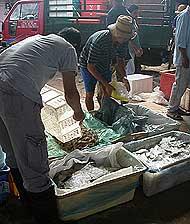 Under a tree by the jetty, some men sit and watch fishermen unloading the catch and untangling nets. Most of them are retired fishermen, although one is still in the business.
Azman Abdul claimed to have been waiting two months to receive funds through the Kedah Fishermen's Association (Nekad), which was appointed to disburse funds.
"It has been two months since I was promised assistance. The boat I ordered had to be sold because I could not pay the manufacturer the full amount. Luckily, I have personal savings and am able to go out to sea with other fishermen on their boats," he said, the disappointment evident in his voice.
He also said Nekad deducts two percent of the sum disbursed as its fee and that some boats given to the fishermen can no longer be used.
"See that boat? It was given through the village development and security committee. It was damaged after only two months," he added, pointing to a boat dragged up on shore and which had cracks in the side.
Another complaint was about unequal distribution of donations to fishermen who do not own boats ( awak-awak ), as opposed to those who do ( tekong ).
"It is very disappointing that awak-awak will not get money (from the special fund) simply because they do not own boats. This is unfair since they too, earn a living at sea and were affected by the tsunami," said fisherman and petty trader Rosli Md Nor.
He was lucky to receive a fibre-glass boat from the United Nations Development Programme (UNDP), which he leases out to others because the type of net on board is different from the one he usually uses.
"Everybody wants to use the UNDP boats. They're of good quality," he noted.
Grants better
The urgency of getting those affected back on their feet caused basic steps to be overlooked, explained Ismail Othman, who heads the village committee as well as the Kuala Muda fishermen's unit.
"For example, Nekad did not consult us before commissioning the new boats. When these arrived, we found that the design was not suitable for use in local waters.
"The boats were made by a company in Port Klang which was not familiar with the designs used in Kedah. The ice and anchor compartments were also too small. No one was willing to buy them since we were being charged RM4,600 per boat."
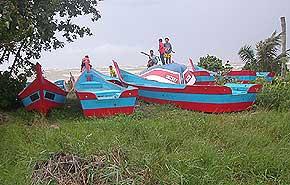 All six boats have been left on a patch of grass near the shore and the children of the village have found other uses for them.
"We don't blame Nekad or LKIM... they were only trying to help, but I suppose things could have been done better," said the chatty grandfather, whose house sports new walls and a fresh coat of paint.
He was most vocal about loans provided under the aid schemes and which require half the sum to be repaid.
"For small boats, the limit is RM 25,000, which is a generous sum. It allows us to buy sophisticated equipment, including a 60hp engine which costs RM11,000.
"Strictly speaking, a fisherman could exploit the situation by taking the full sum even if his needs were much less than that. He could then repay the loan, purchase the equipment and keep the remainder. But local people are honest."
He said that, of the 44 fishermen whose sampans were destroyed, 20 have asked for a loan not exceeding RM15,000.
For this reason, he said assistance could have easily been converted into grants rather than loans.
"A lot of money has been collected to assist the tsunami victims and Kuala Muda is the hardest hit area in the country. How else should the money be used, if not to help us?" he asked somewhat rhetorically.
ADRIANA NORDIN MANAN was in Kuala Muda last week to assess the situation in two fishing villages which had taken the brunt of the Indian Ocean tsunami.


Are you sure you want to delete this comment?
This action cannot be undone.