




Envoy: Ukraine govt, CSMU not told about derecognition
The Malaysian Medical Council (MMC) did not formally communicate its decision to Crimea State Medical University (CSMU) and the Ukraine government to de-recognise the medical degree programme, said a Ukrainian official.
The Malaysian Medical Council (MMC) did not formally communicate its decision to Crimea State Medical University (CSMU) and the Ukraine government to de-recognise the medical degree programme, said a Ukrainian official.
 The ruling, which was announced on June 16, takes effect in January next year. However, Ukrainian Ambassador to Malaysia Oleksandr D Shevchenko said the university and government were not officially informed.
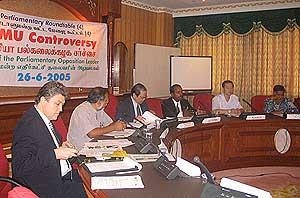 "We came to know about it from the press. I called the university, which had by then heard the news being spread among Malaysian students," he told participants at Sunday's
parliamentary roundtable
on the issue.
"We came to know about it from the press. I called the university, which had by then heard the news being spread among Malaysian students," he told participants at Sunday's
parliamentary roundtable
on the issue.
He said repeated attempts to meet Malaysian authorities have proved futile, with MMC president Dr Mohd Ismail Merican citing a busy schedule in declining an urgent meeting.
"He said the earliest he was able to meet was in August. We want to resolve the case with Malaysian officials at the earliest possible time and of course we have counter-arguments to allegations that have been cited so far."
Refuting the MMC's claims that CSMU had not replied to its queries, Shevchenko said there had been "active correspondence" between both parties.
"Whether or not the CSMU's replies were acceptable to the MMC is a different issue but the university did try to explain."
Strain on resources?
He said the MMC had requested clarification on students' living conditions, tuition fee payments and hostel facilities.
"To my knowledge, there was nothing about dissatisfaction over the standards," he said, pointing out that CSMU has so far never been de-recognised by any other country.
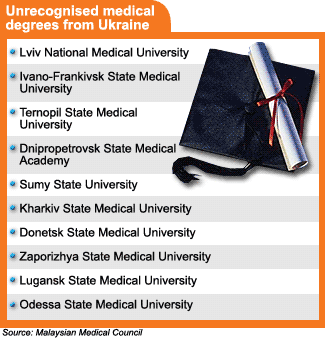
He said the Malaysian government should not issue generalised statements on the CSMU case involving 23 graduates, or use this to reject applications for recognition by 10 other Ukrainian medical universities.
"The staff-student ratio now stands at 1:10 but CSMU is targeting the required 1:6. I've explained that the strain on resources at CSMU will be greatly reduced once the MMC grants recognition to other Ukrainian universities," he said.
Interestingly, the stipend for government scholars pursuing medicine in Russia and Ukraine was increased by between 150 and 250 percent effective last February.
In rejecting claims that CSMU is admitting arts stream students, Shevchenko said it would be impossible for them to even survive the first year without basic knowledge in science subjects.
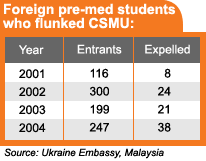 "Last year, 38 foreign students were expelled for failing to make the pre-medical grades and the average figure each year is between eight and ten percent," he said.
On allegations that CSMU was intentionally failing good students in order to reduce its intake to meet the required low staff-student ratio, he said this was not true.
"You are the second person with such a rumour. When I heard about it, I immediately checked with the CSMU rector who firmly assured me that there was no such thing and that all students were given two chances to pass the examinations."
The university administration could not be reached for comment and has yet to respond to queries that were e-mailed last week.
'Lack of transparency'
In an interview in Kuala Lumpur, Ukraine Embassy Counsellor Olexander Nechytaylo expressed concern over the lack of transparency in the decision to de-recognise CSMU medical degrees.
"There have been negative responses to numerous requests for meetings with the health director-general (Ismail), higher education minister, foreign minister and the MMC," he said.
 Clarifying the MMC's statement that the two technical panel visits to Ukraine were in 2001 and 2003, he said the second visit was in November 2004.
According to his records, then premier Dr Mahathir Mohamad had visited Ukraine in July 2003 accompanied by then Education Minister Musa Mohamad.
In late 2004, he said, the technical team gave a favourable report to Shevchenko after returning from visiting a number of Ukrainian medical universities.
"But what concerns us most now is the lack of transparency and the haste and unusual way in which the decision was made and announced.
"We are disturbed by the fact that no officials from the Ukrainian government were notified in advance during or after any of those visits and there was no indication of the MMC's unhappiness with CSMU.
 "In fact, the Malaysian ambassador had visited CSMU early this month and she was happy with the conditions, treatment of students and facilities."
Nechytaylo said the reasons cited by the MMC and the health ministry were "rather doubtful".
"Quite frankly, I don't understand the grounds on which the MMC has based its findings and the methodology used because CSMU's curriculum is designed for six years, which means a review is only due in 2007."
'Among the best'
He said the standard of Ukraine's tertiary education has been among the best in Eastern and Central Europe - CSMU, which has students from 45 countries, has trained over 26,000 doctors in various disciplines since 1966.
Asked if there have been complaints about the sale of medical degrees, he said it was impossible for this to happen in a state-run university.
"But if there is a legitimate complaint, parents should immediately inform the Malaysian authorities for action against CSMU agents here," he added.
According to CSMU's presentation to the Malaysian envoy to Ukraine early this month, a copy of which was made available to malaysiakini , the university ranked first for educational process among the country's medical universities for last year.
It claims to have 577 teachers and is licensed to enroll 300 pre-medical, 690 general medicine, 100 pediatrics and 200 dental students a year.
As at last November, there were 4,151 students in CSMU of whom 1,439 were foreigners and of this number, 1,118 or 70 percent were Malaysians.
CSMU became popular among Malaysians due to its competitive tuition fees of RM70,000 for a six-year medical programme compared to traditional destinations in the UK and Australia which levy between RM500,000 and RM800,000.


