




Tasik Chini left for dead, say local groups
Pahang's Tasik Chini has been left for dead, said local groups, as the call for its rehabilitation and the local communities dependency on the lake's resources have been forgotten.
Pahang's Tasik Chini has been left for dead, said local groups, as the call for its rehabilitation and the local communities dependency on the lake's resources have been forgotten.
What used to be a 60 hectare lake that attracted visitors both local and foreign, is now an abandoned wasteland as its stagnant and polluted water has devastated the once thriving flora and fauna.
According to environmental group Sahabat Alam Malaysia (SAM), as long as stop-gap measures such as occasional cleaning activities are preferred over systematic and holistic rehabilitation, Tasik Chini is as good as dead.
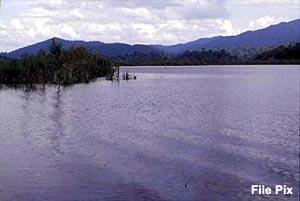 "The destruction of Tasik Chini can only be stopped and its rehabilitation effectively tackled by addressing the root problem, which is the stagnation of water as a result of the building of the dam," said SAM community development coordinator MS Anuar Mahmod.
"We need to ensure that the natural flow of Tasik Chini out to the Pahang River recurs as it originally did before the dam's construction. This cannot be done by calling for gotong royongs once in a while," he added when contacted.
Following suggestions in 1992 that the water level of Tasik Chini be raised so as to ease the passage of boats carrying tourists around the lake, a RM1 million dam was built in 1994.
Contrary to specifications provided by the consultants engaged, and for reasons known only to its builders and the state authorities, the actual height of the dam was eventually raised to 3.7 meters, considerably higher than planned.
This led to the water level rising to 2.8 meters, and 70 percent of the lake's trees and other life forms dying.
The deterioration of Tasik Chini received media and official attention in 1997 following the displeasure expressed by former premier Dr Mahathir Mohamed upon seeing its appalling condition during a visit.
The state authorities then lowered the walls from 3.7 meters to 2.3, an effort that cost RM200,000.
'Forgotten promises'
Apart from this and other intermittent efforts such as a recent study by a team from the National University of Malayia, local resident Mohd Saleh Ishak Nubi Sia said the state authorities seem to have forgotten their promises to rehabilitate Tasik Chini.
Saleh, who serves as the honorary secretary for CHISNET, an association of small farm holdings in the area, said sedimentation from dead and dying treas as well as pollution from nearby logging activities are choking the life out of the once thriving lake.
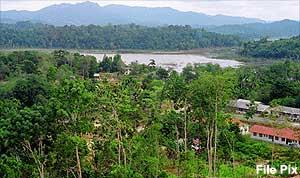 "The logging only started recently sometime this year, but water has not adequately flown out of the lake since the dam was built, as waste and other solids get trapped," he said when contacted.
"As a result, the lake has become too acidic and filled with bacteria for trees and other living organisms to survive. Even certain species of fish have become noticeably absent," he added.
The Jakun community of Orang Asli who live in the village of Kg Gumum at Tasik Chini, have for generations depended on the water, fish and plants of Tasik Chini for their livelihood and everyday needs.
According to the JBOATC, an action and welfare committee representing the 450 Orang Asli villagers of Kg Gumum, they are now "feeling the pressures of survival as their income diminishes and the area of Tasik Chini becomes increasingly polluted."
"Such conditions have disturbed and altered their culture and way of life," JBOATC said in a joint-statement with SAM and CHISNET.
National Service camp
Of particular grievance to them, said the statement, was the situation of a National Service camp on the outskirts of Tasik Chini.
"It has altered the soil structure of the area, while inadequate waste treatment pollutes the lake even further."
Subsequent to a joint monitoring mission, the three groups are calling for drastic, yet holistic steps to be taken to reverse the destruction of Tasik Chini.
Apart from ensuring that water flows freely once more to Sungai Pahang, they are also calling for the halt of all logging activities simultaneous with efforts to rehabilitate the lake.
This would include the rehabilitation of the communities of fish and ecosystem of Tasik Chini and the clearing of mud on top of the lake as well as the sedimentation found at its bottom.
They are also calling on the authorities to include all the local communities, including the Orang Asli villagers, in decisions and developments concerning Tasik Chini.
Considering the damages that have been made to the economic welfare of the Orang Asli community, they also called for the state to provide financial compensation to them until the lake is fully rehabilitated.


Are you sure you want to delete this comment?
This action cannot be undone.