


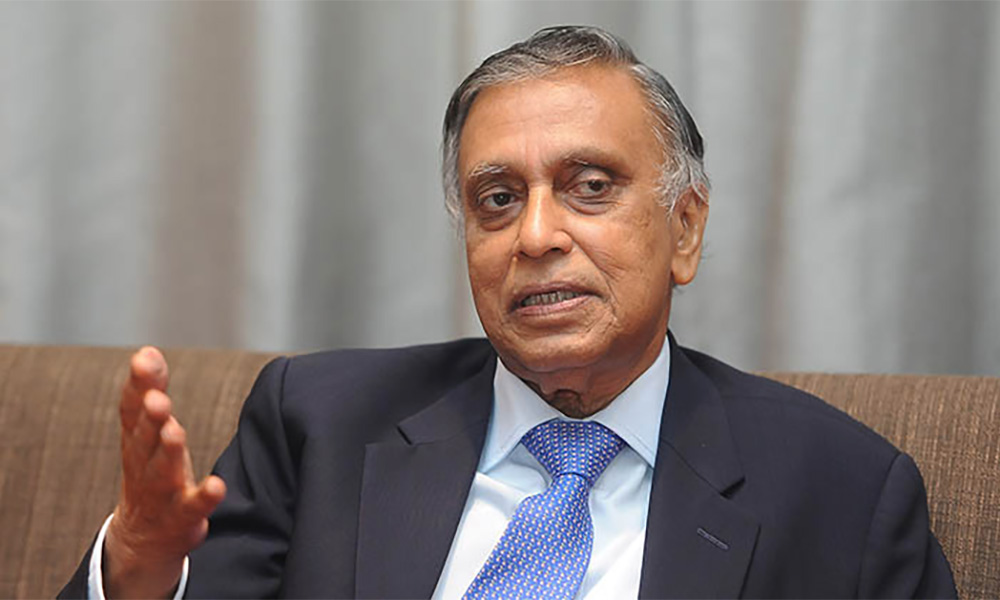

Nor Mohamed: I accepted fair share of accountability in forex losses
FOREX RCI | Former Bank Negara advisor Nor Mohamed Yakcop said he accepted his fair share of accountability over the foreign exchange (forex) losses incurred in the late 1980s and early 1990s.
Testifying before the Royal Commission of Inquiry (RCI) into the forex losses, he said he never discussed the forex transactions in the years between 1986 and 1993 with both the then finance minister Anwar Ibrahim and prime minister Dr Mahathir Mohamad.
"The forex losses occurred, there is no denying it. There is also no denying my accountability for the forex losses. I accepted my fair share of the accountability and resigned from Bank Negara," Nor Mohamed said...
FOREX RCI | Former Bank Negara advisor Nor Mohamed Yakcop said he accepted his fair share of accountability over the foreign exchange (forex) losses incurred in the late 1980s and early 1990s.
Testifying before the Royal Commission of Inquiry (RCI) into the forex losses, he said he never discussed the forex transactions in the years between 1986 and 1993 with both the then finance minister Anwar Ibrahim and prime minister Dr Mahathir Mohamad.
"The forex losses occurred, there is no denying it. There is also no denying my accountability for the forex losses. I accepted my fair share of the accountability and resigned from Bank Negara.
"At that time, it appeared to be a sad end to my 25 years of service to the nation through Bank Negara," Nor Mohamed said.
During last week's RCI hearing, former Bank Negara deputy governor Lin See Yan had confirmed that Nor Mohamed was then the chief dealer in the forex transactions and had reported directly to then governor Jaffar Hussein.
Lin said he had told Jaffar that Nor Mohamed should not be allowed to deal anymore.
This came after internal investigations that showed Bank Negara to have large open forward positions in multiple currencies.
Following the losses incurred, both Nor Mohamed and Jaffar resigned from their respective positions in Bank Negara in April 1994.
Meanwhile, Nor Mohamed confirmed that he had been responsible for Bank Negara's forex trading from 1986 until 1993.
Dealers, he said, had reported to the chief dealer but Nor Mohamed said he could not remember whether the chief dealer had reported to him or other officers.
He also said he could not remember the limit set for both the chief dealer and dealers to deal in forex trading.
"All forex trading was conducted the by chief dealer and dealers. What they did, based on my instructions, were moves to diversify reserves, normally from the US dollar to other currencies," he said.
Further explaining his role during his time in Bank Negara before his resignation in 1994, Nor Mohamed said he was tasked with implementing the external reserves management policy as determined by Bank Negara's board.
"I reported to both the governor and the external reserves committee.
"I did not report to either the finance minister or the prime minister on any issues regarding external reserves management as that was not my reporting line," he said.
Nor Mohamed also said that he was "very careful" not to execute any trade by himself although he had the authority to do so.
"It was always, without any exception, done by the staff. I did this for the purpose of transparency, so that there would always be more than one person aware of every trade," he said.
Asked later by RCI member Tajuddin Atan whether it was his decision for Bank Negara to go into active trading, Nor Mohamed pointed out that the decision was made by Bank Negara's senior management, its board, the then governor and deputy governor in 1985.
"It was not made by me. I was not (part of the) senior management.
"I was only a deputy manager, I became a manager in 1986. But my view is that it was an excellent decision," he said.
Explaining Bank Negara's move into an active mode of external reserves then, Nor Mohamed cited Jaffar, whom he said believed that those involved in the activity would be able to acquire the skills, knowledge and experience to overcome any financial crisis the nation might face in the future, which the latter termed 'market expertise".
"Indeed, the late Jaffar's foresight regarding market expertise saved the nation during the 1997/1998 Asian financial crisis.
"The skills and experience acquired enabled the nation to implement the unorthodox measures of September 1998," said Nor Mohamed.
The move, he said, had given the country the ability to frustrate foreign currency manipulators.
"Unlike Thailand, Indonesia and South Korea, Malaysia was able to overcome the financial crisis without borrowing a single sen from the International Monetary Fund, the World Bank or anyone else."
Despite his admission of being partly accountable to the forex losses, Nor Mohamed noted how he was given the opportunity in 1997 and 1998 during the Asian financial crisis to "contribute to the King and country."
Nor Mohamed had rejoined Bank Negara as an advisor in September 1998 after the implementation of the unorthodox measures.
"The important point is that the experience in the forex unit during those years proved extremely useful later in saving Malaysia from the devastating effects of the financial crisis, which otherwise would have caused losses worth hundreds of billions of ringgit for Malaysia."
Apart from this, many local companies would have become bankrupt and it was not impossible to have had large scale unemployment and poverty spreading throughout the country, he added.
Stressing that external reserve activities, including forex transactions, were based on "strategic considerations", Nor Mohamed, however, admitted that the central bank had misread the turn of the market.
Bank Negara, he said, had naturally believed that the Bank of England would win its fight against US financier George Soros. The central bank, too, had confidence in its central banker and thus bought the pound sterling.
"Unfortunately, the Bank of England lost. Similarly, our best intelligence was that the Maastricht Treaty would be ratified in the referendum in Denmark in 1992 but unfortunately, it was rejected.
"We learnt a bitter lesson from these incidents. That lesson proved crucial in helping us formulate policies to defend the country against the currency attacks in the 1997/1998 Asian financial crisis, saving the nation hundreds of billions of ringgit that would otherwise have been lost," said Nor Mohamed.


Are you sure you want to delete this comment?
This action cannot be undone.