




Foreign envoys walk out during Mahathirs speech
At least three foreign envoys staged a walkout when former premier Dr Mahathir Mohamad criticised the United States and United Kingdom in his speech at the Human Rights Commission of Malaysia (Suhakam) annual conference today.
At least three foreign envoys staged a walkout when former premier Dr Mahathir Mohamad criticised the United States and United Kingdom in his speech at the Human Rights Commission of Malaysia (Suhakam) annual conference today.
 British High Commissioner Bruce Elliot Cleghorn (
photo
) and Hungarian ambassador Tamas Toth were among them.
British High Commissioner Bruce Elliot Cleghorn (
photo
) and Hungarian ambassador Tamas Toth were among them.
However, the United States embassy refuted claims that its officials had been part of the walkout as none were at the conference.
In the afternoon session, two US Embassy political officers Jeffrey Hilsgen and Ravindran Manickam were present.
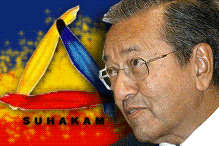 Mahathir had irked the delegates when he accused the US and United Kingdom of being hypocritical in their call for human rights in relation to the war on Iraq, the war on terrorism and the torture of prisoners.
"The US and UK took it up upon themselves to invade Iraq in order to remove an allegedly authoritarian government.
"Worse still, the power which was supposed to save the Iraqi people has broken international laws in human rights, by detaining Iraqis and others and torturing them at Guantanamo, Abu Ghraib and elsewhere," he said.
Quizzed on the incident at a press conference later, the former premier said: "As I said, as much as they have the right to criticise me, they should give me the right to criticise them. But if you don't want to hear my criticisms of them, then you are denying my right to speak out."
Abusive speech
Later Cleghorn issued a one-paragraph statement to malaysiakini explaining why he decided to leave.
"I was invited by Suhakam to attend the opening of their Human Rights Day conference. I accepted out of respect for Suhakam and for Tun Mahathir as a previous prime minister of Malaysia.
"Unfortunately I found myself listening to abuse and misrepresentation about my country. I therefore left," said the British envoy.
It was learned that Toth left the venue as he was displeased with the tone of Mahathir's speech, which went against the theme of the conference - human rights and globalisation.
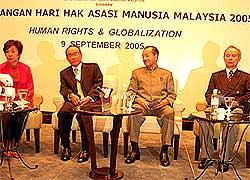 Asked to comment on the walk-out, conference organising chairperson Prof Chiam Heng Keng said that it was their right to do so.
Suhakam's decision to invite Mahathir to address the conference had proven to be controversial from the outset.
Several non-governmental organisations had boycotted the conference after the commission refused to strike the former premier of its list of speakers.
The organisations had accused Mahathir of violating numerous human rights during his 22-year tenure in office.
No excuse
Met at the sidelines of the conference, Malaysian Bar Council president Yeo Yang Poh said he was at the conference to show support for Suhakam.
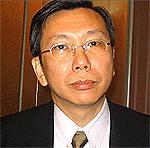 "Being present doesn't mean you have to agree with the view of the speaker," he added.
Asked if he agreed with the boycott by several NGOs, he said: "There's nothing wrong with protesting. It is their right. But there is nothing wrong with attending as well as it does not mean agreeing with the speaker."
On Mahathir's speech, Yong said human rights is universal and thus human rights advocates will never use any country as a model.
He said it is fine to compare with other countries but it should not be used as an excuse not to look into the inadequacies in your own country.
"If I commit domestic violence, can I say I'm better than my neighbour who is very abusive? He beats his wife once a week and I beat my wife three times a month?" he added.
Lawyer Edmund Bon said he arrived after Mahathir's speech as a sign of protest and wanted to quiz him during the question-and-answer session.
"He is a cause of immense human rights violation in Malaysia for the past 22 years... I am very disappointed there was no question-and-answer session," he added.
Misplaced argument
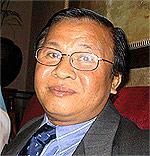 Centre for Peace Initiative chairperson Anuar Tahir (photo) said he was unaware of the boycott.
"We were not consulted about the boycott. If given the opportunity, I would have signed (the protest memorandum)," he added.
Anuar said he attended the conference to listen to the speeches of other human rights advocates.
"I am here to listen to other speakers, not to honour one man," he added.
He was also not convinced with Mahathir's argument that Western nations committed graver human rights violations.
"He said detentions under the Internal Security Act is necessary. For us it's an abuse. No matter how big or small you abuse human rights, it is (still) an abuse," he said.


Are you sure you want to delete this comment?
This action cannot be undone.