




Shad: Set ground rules for conversion
It is time to deal with a "great defect" in the judicial system by setting ground rules for religious conversion, said senior professor of law Dr Shad Saleem Faruqi.
It is time to deal with a "great defect" in the judicial system by setting ground rules for religious conversion, said senior professor of law Dr Shad Saleem Faruqi.
Noting that the contentious circumstances in the case of former army commando M Moorthy, he said the amendment of Article 121(1)(a) of the Federal Constitution in 1988 had left it unclear as whether such matters fall inside or outside the Syariah Court's jurisdiction.
"We can't continue as we have been doing. We need to have ground rules about conversion," he said when commenting on the Moorthy case.
"Justice must not only be done, but also seen to be done. If the conversion out of Islam is a matter of Islamic law, then surely the conversion out of Christianity is also a matter of Christian law and if it is out of Hinduism, then Hindu opinion should be sought."
He was speaking at an Islamic Family Law Forum organised by Sinchew Daily yesterday in Kuala Lumpur.
 Shad (
left
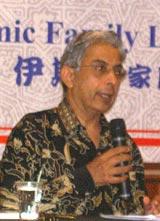
) suggested that panels set up to hear such cases must comprise judges from different faiths, and that a Syariah division be set up in high courts and civil courts to examine these matters.
Shad (
left
) suggested that panels set up to hear such cases must comprise judges from different faiths, and that a Syariah division be set up in high courts and civil courts to examine these matters.
"Judges trained in both Syariah and civil laws could examine the matter. We must be fair and respectful of all religions," he said.
"Cases such as those involving Moorthy and Nyonya Tahir should not be allowed to continue and divide our society the way these have."
The death of Everest climber Moorthy , 36, last month saw a legal tussle between his widow S Kaliammal and the Islamic authorities over the funeral rites. Kaliammal claimed that Moorthy was a practising Hindu, contradicting the claim that he had converted to Islam.
The Syariah Court ruled that he was a Muslim at the time of his death. Kaliammal's attempts to seek redress in the Kuala Lumpur High Court proved futile when judge ruled that the court had no jurisdiction over such matters.
Shad said Syariah courts had been given "expansive power" and that Syariah enactments passed at both state and federal level had violated the Federal Constitution.
"To me, the constitution is quite clear in that there should be no compulsion in religion. However, it had failed to become the sail and anchor of the nation.
"Those who are appointed to preserve, defend and protect it (the constitution) have chosen to turn a blind eye to this."
He disagreed that the jurisdiction of Syariah courts should be expanded.
"If everything that involves Muslims has to go before these courts, then we are not only politically divided in term of ethnic-based political parties, but also by different court systems."
Changes to IFL
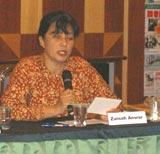 Another speaker Zainah Anwar, the executive director of Sister in Islam (SIS), spoke on the amendments to the Islamic Family Law (IFL) which were passed recently but which have
not been gazetted
as yet due to public outrage.
Another speaker Zainah Anwar, the executive director of Sister in Islam (SIS), spoke on the amendments to the Islamic Family Law (IFL) which were passed recently but which have
not been gazetted
as yet due to public outrage.
She claimed that after four years of negotiations with the government, its answer was "just pass the law, we will amend it later".
SIS, which works on the rights of Muslim women, then began lobbying law makers. All 16 women senators spoke against the Bill, but were later told to agree to it or they would be deemed to be in breach of Barisan Nasional discipline.
Zainah reiterated that the IFL discriminates against Muslim women by enabling men to freeze and claim a share of matrimonial assets from property belonging to their wives, thereby allowing men to divorce their wives and to contract polygamous marriages.
 She said that law reform in the 1990s had been geared towards gender equality for non-Muslims, but not for Muslims.
Zainah denounced the Islamic law-making process, saying it only involves a small number of experts to draft laws that have a huge impact on every Muslim.
She said the Joint Action Group on Gender Equality formed by various civil society groups has asked the government to set up an inter-agency committee and to include women's groups in the law making process, and eventually draft a new IFL that upholds gender equality.
"We are now consulting with Attorney-General's Chambers over interim amendments to the IFL, but our ultimate goal is to come up with a new IFL," she added.


