




Suhakam: No need to amend Article 121(1A)
Article 121(1A) of the Federal Constitution, recently cited as preventing civil courts from intervening in Syariah Court decisions, does not constitute a violation of human rights, the Human Rights Commission of Malaysia (Suhakam) has concluded.
Article 121(1A) of the Federal Constitution, recently cited as preventing civil courts from intervening in Syariah Court decisions, does not constitute a violation of human rights, the Human Rights Commission of Malaysia (Suhakam) has concluded.
The decision was reached after two meetings called by the commission since last month to discuss five memoranda it has received over the religious conversion issue, triggered by the death of Mount Everest hero M Moorthy.
Suhakam commissioner Prof Hamdan Adnan told malaysiakini that the commission was also of the view that the Article does not require amendment.
 "We feel that is a matter of interpretation. It's up to the judge to interpret it accordingly to assure that both Muslims and non-Muslims have justice...we believe it is the interpretation of that 'thing' that is wrong, so maybe that needs to be made clear," he said when contacted.
He said there is no necessity to amend the Article because "it is good as such" but conceded that the Article could have been interpreted by judges "in such a way that the others feel deprived".
Asked if the Article could be deemed as violating fundamental rights, as has been argued in several quarters, Hamdan replied: "When both parties have recourse, then there would not be a case of (violation of) human rights, so the judges must ensure that."
Mixed views
During its first three-hour meeting on Jan 23, the commission was not able to arrive at a stance, saying it needed more time to study the Article, especially on how it was enacted, by studying the background from the Hansard (record of parliamentary proceedings).
However, malaysiakini understands that in working towards a decision at the second meeting last week, commissioners were split in their view. A "minority" felt that Article 121(1A) was not clear and required amendment.
Clause (1A), inserted following an amendment in 1988 to stop Muslims from leaving Islam, has been interpreted as forbidding the civil court from encroaching into the jurisdiction of the Syariah Court.
As a result, the civil courts have time and again rejected a non-Muslim plaintiff's right to legal redress on jurisdictional grounds if the matter falls within the Syariah system.
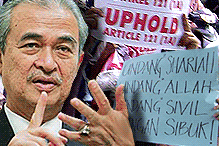 Moorthy's death rekindled discussion of the Article and elicited different responses, with Prime Minister Abdullah Ahmad Badawi ultimately deciding that the Article will
not be amended
as it has kept the civil and Syariah legal systems running parallel to each other.
Moorthy's death rekindled discussion of the Article and elicited different responses, with Prime Minister Abdullah Ahmad Badawi ultimately deciding that the Article will
not be amended
as it has kept the civil and Syariah legal systems running parallel to each other.
However, de facto law minister Mohd Nazri Abdul Aziz was of the view that the Article should be amended to clarify the power of the civil court.
Former attorney-general and current Suhakam chief Abu Talib Othman had previously urged the judges to be "bold" in interpreting provisions.
"If the plaintiff is not a Muslim, I cannot imagine why the (civil) court can say 'I don't have jurisdiction'. If the plaintiff does not profess Islam, there is no reason not to hear the case," Abu Talib was quoted as saying, maintaining that the Article does not take away non-Muslims' rights.


Are you sure you want to delete this comment?
This action cannot be undone.