




Suhakam goes soft on refugee children
The Human Rights Commission (Suhakam) has left out direct references to the issue of refugee children in a report launch yesterday in order to avoid offending the government, said critics.
The Human Rights Commission (Suhakam) has left out direct references to the issue of refugee children in a report launch yesterday in order to avoid offending the government, said critics.
According to them, the report on 'Reducing Violence, Harm and Exploitation of Children', has instead urged the government to address the problem of stateless children, which critics said is not the same as refugee children .
Suhakam officials have admitted that the omission of a recommendation to specifically address the needs of refugee children was due to "the sensitivity of the issue".
"That's a policy issue that we did not want to touch on. The government is a bit sensitive on that (one)," said a Suhakam commissioner who asked for anonymity.
It is estimated that there are 4,600 refugee children in Malaysia, who are not entitled to education and healthcare due to the non-recognition of their status.
The report, which was launched by Suhakam together with the United Nations Children's Fund (Unicef), contains 14 recommendations for the government to improve the rights of children in Malaysia.
One recommendation calls for the setting up of a 'Bureau of Population, Refugees and Migration' to address the problem of statelessness and ensure that "every child is registered at birth and is granted nationality if otherwise stateless ".
Another urges the authorities to house children separately from adults when detained in immigration detention centres, as opposed to current practice of holding everyone together.
A participant who was present at the launch of the report lamented the absence of a "clear-cut recommendation to the government on the issue, nor the recognition of refugee children".
"The children of refugees are among the most exploited children in this country," she pointed out.
She also expressed indignation that Suhakam had implicitly accepted the detention of children, albeit on the condition that they be held separately from adult inmates.
"Children should not be detained at all," she said.
Refugee vs stateless children
Stateless children are those whose their parents have either lost the necessary documents to prove their status, or have not been able to acquire these for themselves.
Many children from the Indian and Orang Asli communities in the peninsula as well as the indigenous communities in Sabah and Sarawak are affected by the problem.
However, there is another group of children - many of whom born in Malaysia - whose parents are either undocumented immigrants or refugees.
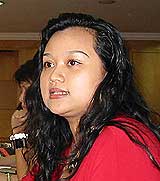 "Refugee children are slightly different from stateless children - they are not without nationality, but have sought or are seeking asylum in Malaysia," noted United Nations High Commissioner for Refugees's (UNHCR) external relations officer Yante Ismail.
"One is not necessarily the same as the other," she explained.
Because of the non-recognition of their status, most refugee children, such as those of Rohingya refugees from Burma, Acehnese from Indonesia and Moros from the Philippines, grow up on the streets of Malaysia's major cities without access to education or healthcare.
While Malaysia is signatory to the 1989 UN Convention on the Rights of the Child (CRC), it has not ratified the 1951 UN Convention Relating to the Status of Refugees.
Immigration authorities do not, therefore, distinguish between persons seeking asylum from situations of conflict or persecution and other economic migrants.
"With regards to Rohingya children, for example, a long-term solution needs to be found for their plight as they are growing up in Malaysia unable to return to their country of origin while being denied their basic right of access to healthcare and education," said Yante.
She noted that the government last year had agreed to grant work permits to Rohingya refugees and allow their children to go to school.
Although the UNHCR welcomed the decision , the estimated 11,000 Rohingya community are anxiously waiting for the decision to be implemented.
"There are 16 and 17-year olds who are growing up not knowing how to read or write," Yante added.
The UNHCR official however declined to comment on Suhakam's silence on the rights of refugee children.
Nevertheless, Yante said the UNHCR supports the proposal for a bureau of refugees be established.
She said UNHCR has suggested that the bureau "extends its purview to include all refugees, asylum-seekers and stateless persons."


Are you sure you want to delete this comment?
This action cannot be undone.