




Shahrir defends 'close one eye' MP
Parliamentarian Shahrir Abdul Samad has spoke out in defence of the Jasin MP Mohd Said Yusof whom he claimed had committed a 'shameful act', but it was not serious enough to warrant severe punishment.
Parliamentarian Shahrir Abdul Samad has spoke out in defence of the Jasin MP Mohd Said Yusof whom he claimed had committed a 'shameful act', but it was not serious enough to warrant severe punishment.
"I don't really think the Jasin MP did any real crime that can be punished by the ACA (Anti-Corruption Agency) or by criminal (prosecution). I don't think he is corrupt. I don't think he has threatened anybody.
"How did he abuse his power? He did not have power over the matter of imported timber. All he has done was display his position as MP so how do you punish somebody for doing something shameful?"
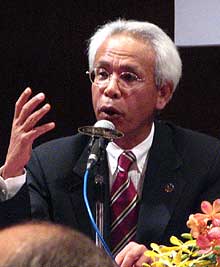 Shahrir, who recently resigned as the chairperson of the Backbenchers Club (BBC), also claimed that Said had been unfairly treated by the media who was "in cahoots" with customs to smear his reputation.
"The customs department is known for its good connections with the press. So the point is that the customs and the media are in cahoots. How do we go after them? The customs officers were told to close one eye ... and which they didn't and went to the press instead."
Shahrir quit following his support for an opposition motion in Parliament to refer a newspaper report to the parliamentary privileges committee in relation to the Jasin MP's request to customs officers to 'close one eye' over the importation of a consignment of illegal timber.
He argued that it was only through the privileges committee that action, if any, could be taken against Mohd Said.
Shahrir also said his resignation had brought positive results as it helped to push for the formation of a code of conduct for parliamentarians.
"At my meeting with the Barisan Nasional chief whip on May 5 when I submitted my resignation, he (Najib Abdul Razak) agreed to look into my suggestion to look into a code of conduct for MPs.
"It looks like I am praising myself too much if I now claim credit for spurring on work not yet done under the National Integrity Plan (NIP) for achieving parliamentary integrity, even though it requires my resignation for it to happen."
Shahrir was speaking at a forum on "Parliamentary Integrity: Challenges and Prospect" organised by Konrad-Adeneur Foundation and Institute of Political and Economic Analysis in Kuala Lumpur yesterday.
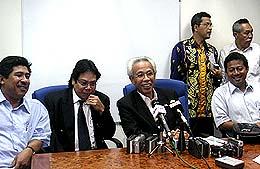 In a question-and-answer session later, Shahrir said the code of conduct would be useless if there was no mechanism to "punish" parliamentarians for breaching the code.
"There is a need for Parliament to regulate the behaviour of parliamentarians. There is no point for a code of conduct when there is no avenue for the MPs to be tried and judged by their peers."
He also expressed his confidence that the code would be eventually implemented as they have been laid down in the NIP.
"All we need to do is to remind the government who may have forgotten about them," he added.
Checks and balances
Shahrir also touched on the need for the parliamentary Public Account Committee (PAC) to be more proactive. He said instead of deliberating the prepared reports of the auditor-general, they should also look into current issues of public interest.
"PAC has asked the auditor-general to do a management auditing on current issues, for example, the controversy surrounding the Matrade building. The whole process seemed like a scam. So PAC should ask the AG to delve into how payments are made and who approved it.
"In that sense, PAC is actually looking after the public's money and how it is spent.
"This in turn would deter unnecessary circulation of rumours of alleged abuse of power and poison-pen letters."
On the need for effective parliamentary integrity via checks and balances, Shahrir said a two-party system is not necessarily the only means to act as check and balance.
"There was the BBC's desire to be the balancing force (in Parliament). I am tired when opposition members make valid points and all the majority does is shout them down."
This prompted the question as to whether MPs are responsible to their constituents or toe the party line. To this, Shahrir replied that "MPs need to win for the party in the Parliament (by exercising integrity) but also outside Parliament".
"At the end of the day, you make the judgement call yourself. The conscience is your own.
"Integrity is not when you do not have the power, but the fact you have the power to make a difference. The test is when the knife is in your hand and when you can cut it."


Are you sure you want to delete this comment?
This action cannot be undone.