




Scomi denies nuclear-linked sales
A Malaysian company sucked into a nuclear black market scandal in 2004 on today insisted it had not been involved in exporting devices that can be used to make atomic weapons.
A Malaysian company sucked into a nuclear black market scandal in 2004 on today insisted it had not been involved in exporting devices that can be used to make atomic weapons.
A Japanese manufacturer, Mitutoyo, allegedly exported two measuring devices in 2001 to a unit of Malaysian company Scomi Group without a licence, and one of the devices is believed to have ended up in Libya for its now-defunct nuclear program.
But Scomi Group's chief executive officer, Shah Hakim Zain, denied Scomi had been involved in nuclear black market activity.
"Whatever investigations have been done, we came out with a clean bill of health," he told reporters, referring to a 2004 probe by Malaysian police and the International Atomic Energy Agency (IAEA).
"Nobody has contacted us for an investigation. The case is closed," he said, when asked if Japanese police had contacted the company for details about the Mitutoyo shipment.
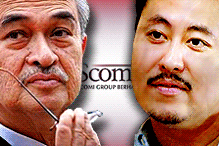 The allegations about Mitutoyo and Scomi are part of a larger nuclear scandal which embroiled Prime Minister Abdullah Ahmad Badawi's son, Kamaluddin, who owned Scomi Precision Engineering (Scope).
Scope manufactured centrifuge parts which were seized on a ship headed for Libya in 2003, but it was later cleared by a police probe.
Mislead by business partner
 The company said it had been misled about the purpose and destination of the parts by a Sri Lankan businessman, BSA Tahir (
photo
), who has been detained without trial since June 2004.
The company said it had been misled about the purpose and destination of the parts by a Sri Lankan businessman, BSA Tahir (
photo
), who has been detained without trial since June 2004.
Shah revealed that Scope, which has since closed down, had bought six machines from Mitutoyo in 2002 worth RM1 million.
"Five are still in Malaysia and one had been sent to Dubai for a customer," he said.
Shah said he was not aware what had happened to the sixth machine, a measuring device, beyond its shipment to Dubai.
"We don't know ... It went to Dubai," he said, adding that "these are standard machines. Mitutoyo manufactures these and sells it to everyone."
Tahir, 44, admitted to Malaysian police that he acted as a middleman for Pakistan's disgraced nuclear scientist Abdul Qadeer Khan.
Khan admitted passing nuclear secrets to Libya, Iran and North Korea in a televised confession in February 2004, placing him in the thick of a global atomic black market.
Tahir also gave a detailed insider's view of the proliferation scandal, according to an official report handed to the IAEA in 2004.


Are you sure you want to delete this comment?
This action cannot be undone.