




World Bank: Were not involved
exclusive The World Bank has denied any involvement in the Malaysian government's decision to use par value to calculate race-based equity ownership, a subject that has been hotly debated for months.
exclusive The World Bank has denied any involvement in the Malaysian government's decision to use par value to calculate race-based equity ownership, a subject that has been hotly debated for months.
"The methodology for computing the country's equity ownership using par value calculation was initiated by the Malaysian government," a World Bank spokesperson told malaysiakini by email in response to a query.
The bank said it has to recognise the data provided by the Malaysian government, even with use of par value calculation, as these figures are deemed to be official data.
 Said the spokesperson: "The (par value calculation) methodology has been used since the introduction on the New Economic Policy (NEP).
"The figures have also been widely published and recognised as official data on equity by international organisations, including the World Bank."
The spokesperson declined to respond to another question as to whether the par value calculation is suitable methodology in computing equity ownership.
Economists have argued that market value calculation is a more accurate yardstick of equity ownership, but the government has disputed this. In an attempt to fend off strong criticism, leaders had claimed that the government methodology is endorsed by international agencies such as the World Bank.
 On Nov 7, Deputy Finance Minister Dr Awang Adek Hussin said it would be wrong to say that the government's methodology of calculating equity ownership was unreliable,
pointing out
that it had been prepared with World Bank advice and international scholars.
On Nov 7, Deputy Finance Minister Dr Awang Adek Hussin said it would be wrong to say that the government's methodology of calculating equity ownership was unreliable,
pointing out
that it had been prepared with World Bank advice and international scholars.
The same day, Awang Adek revealed in the Parliament that the bumiputera share ownership on the Bursa Malaysia was at 36.64 percent last year (which would exceed the target of 30 percent bumiputera equity ownership set under the NEP).
 In an about-turn six days later, Minister in the Prime Minister's Department Effendi Norwawi - who oversees the Economic Planning Unit - retracted the figure, saying it was "inaccurate".
In his statement, he reiterated the official methodology has been consistently used since the introduction of NEP in 1970 and that it is recognised by international financial bodies such as the World Bank, International Monetary Fund and the Asian Development Bank.
'Not the practice'
Former World Bank economist, Dr Lim Teck Ghee cast doubt on the statement, saying it was not the official practice of the World Bank and other international development agencies to endorse any national methodology.
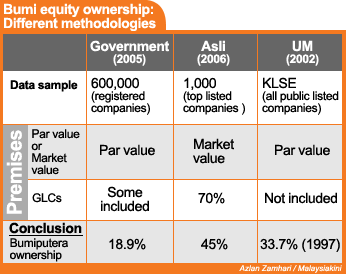
Lim sparked initial debate over the NEP when the local think-tank he worked for - the Asian Strategy and Leadership Institute (Asli) - in a report published in February said the bumiputera equity could already be as high as 45 percent.
 The findings and methodology met with fierce criticism from Umno leaders when reported in
malaysiakini
in late September.
The findings and methodology met with fierce criticism from Umno leaders when reported in
malaysiakini
in late September.
Lim - who stood by his findings - resigned from his post as director of Asli's Centre for Public Policy Studies in November after the think-tank retracted the report amidst the furore.
A separate study by Universiti Malaya researcher Dr M Fazilah Abdul Samad had found that bumiputera equity stood at 33.7 percent in 1997.
The government has insisted that the overall bumiputera equity is 18.9 percent as of last year, but critics have alleged that the government underestimates the figure to justify continuation of the NEP which gives favourable treatment to bumiputeras.
The NEP was enacted in the 1970 as part of a bold blueprint to reduce income disparity among different ethnic groups. It was given a life span of 20 years but the affirmative action policy continued after 1990 under a different name, the New Development Policy.
Under the Ninth Malaysia Plan unveiled in March, the government said that NEP measures would remain in place for another 15 years until 2020.


Report this comment
Are you sure you want to delete this comment?
This action cannot be undone.