




Did World Bank endorse NEP methodology?
Did the World Bank endorse the methodology used by Malaysia in computing the corporate equity held by its various ethnic groups?
Did the World Bank endorse the methodology used by Malaysia in computing the corporate equity held by its various ethnic groups?
That's the question asked by the man at the centre of the bumiputera equity ownership controversy.
 Dr Lim Teck Ghee, who is a former World Bank top economist, said it was not the official practice of the bank and other international development agencies to endorse any national methodology.
"The claim of the EPU (Economic Planning Unit) that its methodology of calculating equity ownership is 'best practice' is totally unfounded; as also the claim that the methodology is recognised by international financial bodies," said Lim, who was a senior social scientist in the World Bank for six years.
"If the EPU wants to make the claim of international endorsement, it should cite the full details. Otherwise, no one will believe it and its claim of so-called best practice."
The government has consistently claimed that its methodology of measuring the corporate equity ownership was given the seal of approval by a number of international financial agencies.
This was reiterated by Minister in the Prime Minister's Department Effendi Norwawi two days ago when the government made an about-turn on the bumiputera corporate equity ownership in Bursa Malaysia - it was 21.8 percent, not 36.64 percent as earlier revealed.
"The methodology used is recognised by international financial bodies, such as the World Bank, the International Monetary Fund and the Asian Development Bank," said Effendi.
Lim told malaysiakini that the confusion over the different sets of figures on bumiputera equity indicated that the government ministries are at odds over the methodology used.
According to the EPU, which is under the Prime Minister's Department, the bumiputera equity in Bursa Malaysia was 21.8 percent in 2005, while the Finance Ministry said it was 36.6 percent .
Methodology 'seriously flawed, outmoded'
Lim and a number of economists have questioned the methodology employed by the government, especially the use of par value instead of market value in estimating the corporate equity.
"In my opinion and that of numerous independent experts, the current methodology is seriously flawed and outmoded."
Effendi had defended the government's use of the companies' par value in its methodology.
"In calculating the equity ownership, par value was used as it provides a constant measurement to all companies in the corporate sector as compared to the market value, which can only be used on the listed companies."
However, economists have challenged this assertion as par value does not adequately reflected the real value of the companies surveyed.
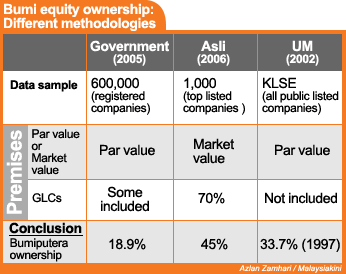 Lim sparked a debate on the 36-year-old New Economic Policy (NEP) when the think-tank he worked for - the Asian Strategy and Leadership Institute - said in a February report to the government that bumiputera equity could already be as high as 45 percent.
The research met with fierce criticism from leaders in the ruling Umno, prompting Lim - who stood by the findings - to resign from the institute two months ago.
The government has insisted that the overall bumiputera equity is 18.9 percent as of last year, and has set a 30-percent target under the NEP.
Lim's research was supported by a study done by Universiti Malaya's Dr M Fazilah , who said that bumiputera equity stood at 33.7 percent in 1997.
The NEP was enacted in the 1970 as part of a bold blueprint to reduce income disparity among different ethnic groups in Malaysia.
It was given a life span of 20 years but the racially-based affirmative action policy continued after 1990 under a different name, the New Development Policy.
The government recently announced that NEP measures will remain for another 15 years until 2020.


Report this comment
Are you sure you want to delete this comment?
This action cannot be undone.