




Q&A: Tribunal not a kangaroo court
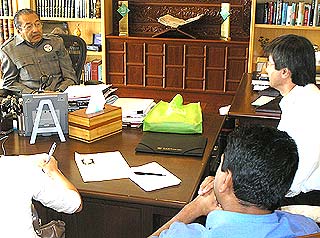
Former premier Dr Mahathir Mohamad talks about, among others, the lack of support from his friends in the corporate sector for his anti-war conference in this first of a two-part series.
Former premier Dr Mahathir Mohamad talks about, among others, the lack of support from his friends in the corporate sector for his anti-war conference in this first of a two-part series.
Malaysiakini: Are you happy with the support you're getting for the initiative to set up the War Crimes Commission?
Dr Mahathir : Not quite happy... From the government you mean? That is quite sufficient. No complains of that.
We understand that you still having problem with the lack of sponsorship.
Yes, yes...
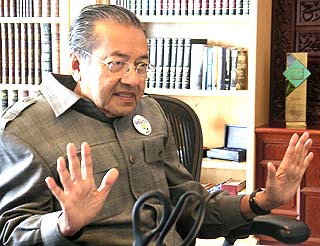 Are you disappointed with your friends in the corporate sector who are not chipping in money?
That is a kind of fatigue about this thing. I must admit I have been asking the corporate sector for donations for all kind of things because recently I sent some money to Lebanon in order to purchase winter clothing for the (people). Their prime minister told me that they needed it. I am afraid I used my money first. Now I am going to recover it (but) once you used your own money, recovery is very difficult (laughs).
Approximately how much you are talking about?
Quite substantial for me. I collected a few hundred thousand (ringgit) but I sent about RM1.5 million ringgit to purchase (clothes). Anyway, I hope those people who made their pledges will reimburse me.
Are you disappointed with the fact that initially there were quite a lot of sponsors during the first year of the (annual anti-war) conference, in 2005, but not now.
I know actually people do not like to receive letters from me because when they see my letter, (they know) I am asking for funds. People come to me and say 'please, raise funds' for them. I tried, but I think people are little bit fed up receiving letters from me. It's always about asking for money.
We understand you have had a meeting with (Hungarian born American philanthropist George) Soros and there were slight differences between you and him regarding war in general.
 He was against (US President George W) Bush (
photo
) because of the war in Iraq and I thought that he would be supportive of our efforts to criminalise war. I wrote a letter to him before I met him, asking him to join in this effort. He declined because he said there has been war for 7,000 years, this is a way to resolve problems, so he did not quite agree with my idea to make war a crime.
He was against (US President George W) Bush (
photo
) because of the war in Iraq and I thought that he would be supportive of our efforts to criminalise war. I wrote a letter to him before I met him, asking him to join in this effort. He declined because he said there has been war for 7,000 years, this is a way to resolve problems, so he did not quite agree with my idea to make war a crime.
So he somehow believes there are some wars that can be justified?
We don't see all wars are unjustified. If someone attacks you, you have the right to fight back. But to use war in order to impose your will on another country that is wrong. War is not a way to solve problem, to kill people. Just imagine in a society like ours, we said that if A has a problem with B, you two can fight it out, kill each other, if you kill it is all right, it is legal. That will be terrible.
What you are saying now is in the community of nations in this world, a world that has become very small, globalised world, it is all right for a country to smash the other country if we have a difference (of opinion). Invariably of course, it is not a question of justice, it is a question of strength. The stronger country will win even if the stronger country is in the wrong. If in our society, it doesn't matter whether he is right or wrong but because he can kill his enemy, therefore he is right, this will be terrible. It is uncivilised.
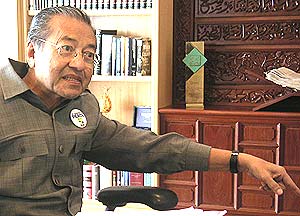 It will be a question of might is right.
Yes. In the old days, they had wars, it was between soldiers and soldiers (who fought) on the battlefield, Waterloo and all that. But today, the whole country has became a war zone and civilians are being killed. It's too rude telling us that 250 Iraqis armed with guns were killed by missiles, you mean to say it doesn't hurt anyone standing next to them? It's all nonsense. More ordinary people are being killed than soldiers. So today's war is more brutal than in the past.
Talking about Iraq, in 1990, Malaysia was part of UN Security Council and there was a debate on resolution 678 (which allowed US to take military action against Iraq). There was high expectations that Malaysia will take a stand on this, but it did not. Was that because of pressure from US? You were then the prime minister.
The perception at that time was that Iraq had done something wrong against Kuwait and we cannot be seen to be supporting a country that wants to use might in order to achieve its aim of making Kuwait part of their country. That is why we supported (the resolution). There is a reason for that.
But was there any pressure from the US?
Of course, they wanted us but we did not respond because we took a stand that Iraq has no right to invade Kuwait.
What were the problems you've faced in organising this conference? Are you happy with the commitment shown by the government to support it?
One ministry has been very supportive, I am very happy with it. Other things of course including the corporate sector, the government-linked companies (GLCs), I am quite sure they can afford it but so far they have not given us (money). I asked for what would be a very small sum, but I am not getting that.
Why is this happening? Is that because the issue is dying or is it because of who you are?
I don't like to make accusations. The last time I said it is because of me, people said 'no'. Somehow rather I feel I am kind of persona non grata to a lot of people. Some people are afraid that if they are seen to be close to me they might not, errr, well they might suffer...
So how are you financing this conference? Where did you get the money? Is it sufficient to keep it going for next year?
I must say that the support from that government ministry was substantial...
Which ministry?
The Tourism ministry. They think this has got something (that is of interest to) the rest of the people. The other people I asked for (funds), some have not responded, including the GLCs.
We note that there are no government representatives at the conference. Is that done purposely?
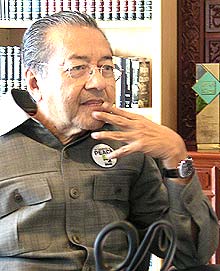 We don't want the government to be involved because this is an NGO effort. Government ministers are bound to speak in support of government's policies, we don't want them to be embarrassed by the kind of stand that we take. So it is far better if they don't get involved.
Why do you think they will be embarrassed?
They have a certain policy. What we are trying to do may not be completely in accord with their policy because we are going to say nasty things about war crimes and some countries (will) be (called) war criminals and the government may not feel that way about those countries.
Has the government indicated they want to be part of the conference?
No, but I am very glad that at least one ministry has decided (get involved).
On the war crime tribunal, someone looking from the outside will say this is a kangaroo court filled with members that you know will vote a certain way.
No, these are ex-judges. These judges decide according to their principles. Of course, they cannot be biased, they have to listen entirely on evidence. The reason why we have to set this up - what will be called an NGO court - is because these people have tried to put their case to the ICC (International Criminal Court) for example, but they were not given a hearing.
They have nowhere else to go so we have to do this and the judges who man the tribunal, they are experienced judges, they are retired, they have not given political opinion, they have not said anything about war crimes, they have a completely open mind.
We purposely invited the judges. If we want to, we can invite some people definitely against America but these judges have not expressed their opinion about America as far as I know, not from the Bench anyway.
But you have others personalities such as Ramsey Clark and Francis Boyle who have made very strong opinions on the issue before.
There are two stages, first there is the commission, the commission will receive the complaints from the people affected, the commission will study whether there is a prima facie case. If there is, the commission will put it before a tribunal, then there will be a proper trial. I do not know whether Ramsey Clark is in the tribunal or not but they of course, have very strong views, but it is important to balance those with strong views also.
For a tribunal to be credible, we would want the panelists to be seen as independent rather than having people like Clark .
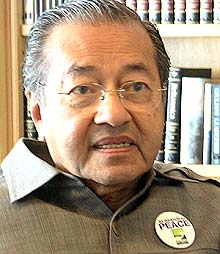 He is a person who has been on the other side, so he could see both sides. We should not pre-judge them. The main thing is will they make a decision based on evidence or will they make a decision even before they hear the evidence?
In the case of (former Iraqi president) Saddam Hussein, they already decided that he was going to be hanged. When the judges appeared to be sympathetic, they were removed. His lawyers were killed. Everything was done to make sure he would be hanged in the end - never even giving him time to appeal.
What do you think you can achieve from this tribunal? Will there be far-reaching implications? Is anyone going to implement the proposals from the tribunal or will it just be a sheet of paper lying on someone's table?
The whole idea is to change the mindset of people and to consider war a crime. Already in the US, the people who are affected, the mothers of the soldiers are beginning to think like that. They are already talking about war being a crime. Our purpose is to get them when voting for president or congress, these candidates must make a declaration that they are against war. In that way, eventually we will have pacifists as leaders.
It is already happening and there is a great deal of interest in what we are doing here. That's why these people come, these are not just anybody we picked, these are people who are known to have very strong feelings and they know coming to Malaysia is very important. If you ask them why they come to Malaysia, they will tell you it is because of this conference.
Is this initiative going against the government? We have (Prime Minister Abdullah Ahmad Badawi) as the OIC and NAM chairperson (at the same time). In this sort of situation, for us to have this conference in this place, will it be perceived as something to embarrass the government?
No. This government accepts freedom of speech and accepts criticism. It is an open government.
You seriously subscribe to that?
That is what the government claims so the government must be prepared to listen to voices of dissent but if they don't want, of course they can put a stop to this meeting. You can't do anything (about that).
What will happen if something - as during your rule - such as Apcet II, the government comes knocking down the door to say you can't do this (conference)? How would you react to that?
 During my time, there were lots of complaints and campaigns against me, even people who stood against me, I didn't put a stop to that. They campaigned, they said nasty things about me, even in papers, even
malaysiakini
, you were not very kind to me before, did I close you down? I told you don't attend my press conference, that's all.
During my time, there were lots of complaints and campaigns against me, even people who stood against me, I didn't put a stop to that. They campaigned, they said nasty things about me, even in papers, even
malaysiakini
, you were not very kind to me before, did I close you down? I told you don't attend my press conference, that's all.
But you did call us a traitor which we think was quite unwarranted.
That's my feeling. You were saying something that was not fair.
There was also the police raid.
That's my freedom of speech. As much as you can criticise me, I can criticise you.
What are the responses that you get from the government so far?
So far they have not objected, I made to understand that PWTC was asked about what is happening. PWTC reported and the government said 'okay'.
Regarding the tribunal, how is it going to be implemented? What time period you are talking about? Is it going to be in the next few months?
On the last day (of the conference), those people who came, those who have been tortured against, they will make their position through a statutory declaration and this will be handed over to the commission. The commission will study them and may call witnesses to (hear) whether they are right or wrong. If the commission decides there is a case to be heard, the commission is to inform the tribunal.
If there any suggestion now as to who are the possible candidates to be tried?
It is quite possible (these will be) the people who initiated the war against Iraq and the people who backed all the cruelties in Palestine. It is quite possible they will be named as the accused persons.
So we presume it will include Bush?
There will be. I mean Bush deserves it, it is my opinion. The way he is saying things that he has a right to do this even if Congress disagrees, I will going to send (the soldiers). I mean this man is terrible.
But you tacitly supported him when he was running for president the first time - when he was running against Al Gore (in 2000).
 Because Al Gore was nasty, he came here in front of me and he told people to overthrow me. How can I support him? But I didn't know what Bush was like. I knew the father but not the son.
We thought you should know better because Bush never been to any other country before he became the president.
Anything seemed better than Gore.
So would you regret supporting Bush?
Yes, I regret it certainly because I didn't know. This man is really terrible, he seems to enjoy killing people.
Would the foundation support war victims who want to take legal action against Bush or (British Prime Minister Tony) Blair ( photo )?
 To the extent we can support, we will support, but we must give them the opportunity to present their case to the commission and if there is a need for trial, whether they may have to appear, probably of course the accused person will not be there, but that does not matter because the trial in absentia has been accepted.
Still, for the public at large, the global audience at large, they will see the tribunal is held in Malaysia and the people who are involved, yourself, there is really not much credibility there.
No, there may not be credibility to some people but there may be credibility to some others. Today, legal principles have been breached in many ways. For example, you can make a law in Malaysia and apply it to somebody who did something wrong in some other country, that's what happened to this chap, Irving (British writer David Irving), because he wrote a book somewhere else, he was enticed to go to Austria, and then he was arrested, tried and thrown in jail.
What do you think of that? Is that justice? That is not justice. But as I said, a NGO taking this action to set up a tribunal is different from normal practice. But normal practice now are being ignored, if they can ignore, why can't we ignore? We are doing things which are much more justified than what they are doing.
How is this different from other similar initiatives before? There were other NGO-type tribunals set up previously.
 This time we have chosen the members carefully, they are judges and they are going to make judgment-based on evidence, not a kangaroo court and (there) will be an open trial. It's not like the Saddam's trial - it is closed and we don't know what happened. They already decided to hang him.
One big concern currently is the situation regarding the US and Iran. What's your view of that? How do you think we can prevent the escalation of tension?
With Bush, you can never tell because this man, he just loves killing. He might go into Iran and if he goes into Iran, the situation will be worse than their experience in Iraq. Iranians may not like their government, but if you go into their country, they fight.
That's what they did when Iraq tried to invade Iran before, they lost one million people, they fought even though at that time their army was in shambles because of the revolution but they fought. If Bush gets his soldiers into Iran, those soldiers are going to be exposed to grave danger and the Iranians will attack them with great severity.
Bush invaded Iraq on the pretext of weapons of mass destruction but so far we haven't found any. Now he is claiming that Iran is developing nuclear weapons. Do you feel that Iran has the right to build and develop nuclear weapons?
Iran and every country has the right to develop nuclear weapons, even Malaysia. I can't understand why some countries have the right to kill other people but those people who are the targets of their killings should not protect themselves. The principle is all wrong.
If the condition is that if the US wants to stop other people from developing nuclear weapons, the first thing they have to do is to reduce their arsenal of the nuclear weapons which they have not done; and they have not signed the treaty of no (nuclear) testing. They have not signed that. They break the law first and they tell others don't break the law. What kind of people are they?
Wednesday : Mahathir on free trade agreements, his boats in Langkawi, the government's private jet, toll hike, corruption, the future of Proton and many more issues.
Part 1: Dr M: Bush enjoys killing people


Report this comment
Are you sure you want to delete this comment?
This action cannot be undone.