




Kg Medan: Being victims and social outcasts
It has been six years since the Indian squatters in the Petaling Jaya Selatan area came under bloody attacks in an incident which bore the hallmarks of the May 13, 1969 race riots.
It has been six years since the Indian squatters in the Petaling Jaya Selatan area came under bloody attacks in an incident which bore the hallmarks of the May 13, 1969 race riots.
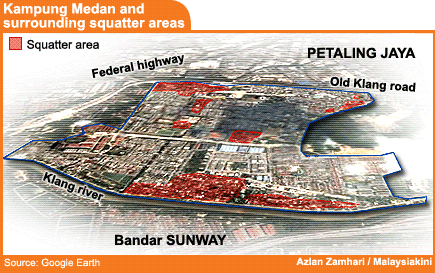
Clashes between Malays and Indians in this area, which lasted for almost 15 days, resulted in six being killed - four local Indians, one Indonesian and one Indian national. At the same time, almost 200 others - almost all Indians - suffered severe slash wounds.
In the aftermath, an analysis of the situation was quite perturbing.
It was quite evident that the victims of the incident were the Indian squatters in the area - which boasted close to 20 squatter settlements, including Kampung Medan. It is estimated that about 10,000 people live in the Petaling Jaya Selatan suburb, which the squatter areas are part of.
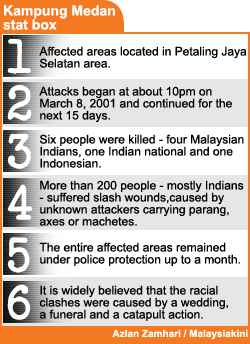 Many theories have been proposed since then as to why the attacks took place - from accusing the ruling party to a grand campaign by property developers to get rid of the squatter areas to local tiffs between the Malays and Indians getting out of hand.
To date, no conclusive reason has been found, with the government preferring to let the matter rest. Local level politicians too are only keen to forget and move on.
However for the affected victims, the wounds and fears are still fresh, despite the squatter settlements in the area having a new landscape - gone are many of the squatter houses and slums, replaced with low-cost flats and apartments.
'A lesson for us'
 "It's true that we have been taken away from the slums. However, our problems remain. Our fears are still there," said a local leader E Maran (
right
), whose settlement, Rumah Panjang KTM, was among the hotspots during the March 8 racial incident in 2001.
"It's true that we have been taken away from the slums. However, our problems remain. Our fears are still there," said a local leader E Maran (
right
), whose settlement, Rumah Panjang KTM, was among the hotspots during the March 8 racial incident in 2001.
His Indian neighbour was slashed to death by some parang-wielding Malay youths while wheelchair-bound Maran too had a narrow escape after a Molotov cocktail was hurled at him.
"I can still vividly remember those panicky moments, especially on the attacks to this settlement. Even the presence of a huge number of policemen couldn't stop the attackers from trying to come into this place," he told malaysiakini when met recently.
He added that these fears continue to remain in the minds of the people in the settlement.
"I think it was a lesson for the Indian community here. It looked as though the attacks were meant to put us in our place. And you can see that even today," he said.
 He gave examples of how the local Indian boys are denied the chance to play football at the only football field in the area, or the fact that the grassroots leaders have no say in local programmes organised for the community there.
"These boys have access to the field only during the fasting months. At community meetings, all we can do is attend and listen. Our inputs are not needed."
He added that the fact that the Indian squatters were now sharing low-cost apartments with the Malay community made things quite tensed.
"We have to be very careful now in what we do, what we say and how we behave. We just can't afford another March 8 racial incident," said the 36-year-old businessman.
Such sentiments are shared by S Nagarajan, a research director at the Malaysian Tamil Education, Research and Development Foundation.
"I don't think the resettlement of the squatters has eased ethnic tensions. On the contrary, it may exacerbate tensions as the high-density low-cost flats do not provide a conducive living environment and are potential trouble spots," he said.
A model settlement
The Rumah Panjang KTM settlement, once known for its notoriety, is now a model settlement.
 "There is no gangsterism here now. The youths are not involved in crime or drugs and the people are generally more aware of their rights and needs," said Yayasan Strategik Social's director of special projects K Barmasevam (
left
).
"There is no gangsterism here now. The youths are not involved in crime or drugs and the people are generally more aware of their rights and needs," said Yayasan Strategik Social's director of special projects K Barmasevam (
left
).
YSS is a MIC-linked non-government organisation which has been working in many squatter areas throughout Malaysia to uplift the socio-economy standards of the poor Indians.
It has also been successfully running several programmes in the Petaling Jaya Selatan squatter areas.
"Our aim to ensure that these people realise that they can have a better life. We have programmes catered for the women, for youths and for the problematic and crime-prone teenagers," he told malaysiakini .
YSS's modus operandi is to involve local participation and subsequently allow locals to lead their communities. Maran is a product of such a scheme.
"We are trying to change to mindset of the local Indian squatters here. We are happy with the local participation but we too have our limitations," said Barmasevam.
The main obstacle is the lack of funding. In fact, the financial aspect plays a major role in determining the success or failure of a grassroots programme.
And the same fear is now apparent in the YSS-run programmes in Petaling Jaya Selatan squatter areas.
Add to that is the problem created by the fact that these squatters are being relocated into nearby low-cost apartments and flats.
"The neighbourhood concept cultured here will be lost as they will be in a new surrounding with new neighbours. They will have to start looking after themselves now, with the aid of the local leaders that we have identified," added Barmasevam.
But this is where the new problems start for local leaders like Maran.
"We are simply marginalised over there. We have no say," he laments.
Talking to other residents here confirms one thing - that the political support for the Malay residents in the low-cost flats and apartments are simply too powerful when compared to the political backing for the Indians.
So powerful that even the ruling coalition Barisan Nasional senior partner MIC could not get things done using its political connection.
The crutch mentality
Former academician Prof P Ramasamy however said that these squatters shouldn't just rely on MIC to help them out. He said it was a fact that MIC was unable to do much for the community.
 "These people should accept the fact that nobody is going to assist them, they have to stand on their own feet. They have to take control of their lives, face challenges and threats," he told
malaysiakini.
"These people should accept the fact that nobody is going to assist them, they have to stand on their own feet. They have to take control of their lives, face challenges and threats," he told
malaysiakini.
"The crutch mentality has to go, if they are hit, they have to fight back," he added.
He said that in the long run, these problems which the squatters are facing now could be overcome by de-racialising the situation in the country.
He suggested that the people should start supporting the development of alternatives in the country.
"They must show their support to parties and NGOs that argue for non-racial methodology to address serious political, social and economic issues."
"Despite the MIC's intervention, the plight of the victims of the racial attacks here have not been looked into," he charged.
As Ramasamy mentioned, poverty is still an issue here at the Petaling Jaya Selatan squatter settlements. However these victims of the 2001 attacks are trying their best to move on with their lives.
"One good thing to have come out from the incident though is the fact that the Indians here are more united now," said Maran proudly.
Last night, the residents of Rumah Panjang KTM had a small prayer session in a temple in their settlement to remember the dead and to seek continued peace.
But the irony is that the temple itself is in imminent danger of being demolished with the rest of the squatter houses here as the villagers move out to the nearby low-cost flats.
Yesterday: Kg Medan: Painful memories linger on


Report this comment
Are you sure you want to delete this comment?
This action cannot be undone.