




Kg Medan: Painful memories linger on
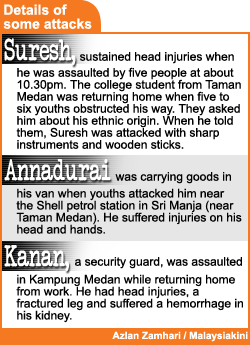
"I was riding along Taman Lindungan Jaya. My friend Murugan was pillion riding... Suddenly a large group of Malay youths chased us. They attacked Murugan. He fell down and tried to run away from the mob.
A large parang was thrown at me. This unbalanced me and I fell down. I was surrounded by the angry youngsters. Someone then hit my leg. I screamed in pain. Then the 50-odd youngsters started attacking me...".
(A victim's narration of events in Kampung Medan on March 8, 2001.)
"I was riding along Taman Lindungan Jaya. My friend Murugan was pillion riding... Suddenly a large group of Malay youths chased us. They attacked Murugan. He fell down and tried to run away from the mob.
A large parang was thrown at me. This unbalanced me and I fell down. I was surrounded by the angry youngsters. Someone then hit my leg. I screamed in pain. Then the 50-odd youngsters started attacking me...".
(A victim's narration of events in Kampung Medan on March 8, 2001.)
 The above is taken from the book
March 8
by author K Arumugam. According to Arumugam, the victim, V Mathavan, 26 then, suffered heavy blows, nothing too serious, but his friend Murugan was less fortunate.
The above is taken from the book
March 8
by author K Arumugam. According to Arumugam, the victim, V Mathavan, 26 then, suffered heavy blows, nothing too serious, but his friend Murugan was less fortunate.
Murugan suffered severe head injuries and was in coma and then admitted to the intensive care unit for further treatment.
Arumugam's book - in Tamil - gives an in-depth analysis as to what actually transpired in Kampung Medan and the surrounding areas in Petaling Jaya Selatan on March 8, 2001.
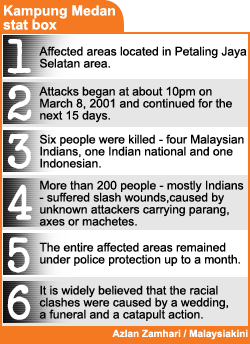
And he says that there was a political motive behind the attacks, which resulted in the death of six persons and causing injuries to more than 200 - mostly Indians.
His 98-page book was banned by the government last December.
Arumugam said his book was blacklisted because the government doesn't want public discussion on the incident.
"I have made some inferences in the book, of who might have perpetuated the attacks and for what reasons. These, I think, made the authorities uncomfortable.
Human rights violations
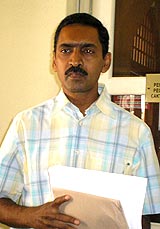 When
malaysiakini
met Arumugam (
right)
recently, he described the incident as an effort by someone in the ruling party seeking to create a rift among the Malays and the Indians.
When
malaysiakini
met Arumugam (
right)
recently, he described the incident as an effort by someone in the ruling party seeking to create a rift among the Malays and the Indians.
It has been six years today since the incident and until now no one can clearly say what actually happened in Kampung Medan.
Violence continued in the 10 square kilometre area of Kampung Medan and the surrounding squatter areas for almost 15 days, beginning March 8.
Witnesses said that the attacks on the squatters, almost all Indians, started at about 10pm that fateful day. In the aftermath, victims, politicians and non-government organisations accused the police of inaction, along with it the popular notion that the ruling party had a hand in it.
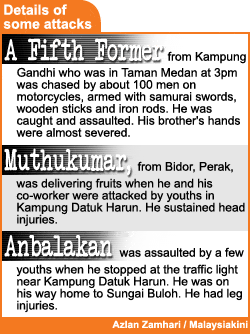 In fact, some victims claimed that the police on several occasions aided the attackers.
"This was the worst case of human rights violation in Malaysia but got the least attention from the government," said human rights lawyer P Uthayakumar.
Uthayakumar's Police Watch Committee was among the first to go to the ground to show their support for the victims. They have also been the most vocal critic of the government for its silence in the incident.
"As far as the government is concerned this is a racial clash between the Malays and the Indians from Kampung Medan. But that is not the case," he told malaysiakini.
"Talk to the victims, talk to the locals and you will know that this was not a racial clash. It was a racial attack on the Indians," he said.
"Six people died and scores were injured but to date no one has been charged with murder of the six or for causing grievous bodily harm to others.
"What we saw was some people being charged with causing riots and affray. That's all," he added.
Uthayakumar's group has been asking the government to institute a royal commission - or at least release a white paper on the incident - but without any success.
He has even gone to battle with Suhakam for their failure to take up the matter.
 "Nothing happened. The victims are still there with painful memories but no one is interested in finding out the truth," he said.
The victims too have filed at least two civil suits against the government, seeking compensations and damages for the racial attacks but the cases are still pending hearing. The cases were filed in 2003 and 2004.
'Let us move on'
Immediately after the incident, ruling politicians said that the cause for the tiff among the races was due to the squalid living conditions in the squatter area.
As such, after the incident roads were resurfaced, public phones and street lights erected and drains cleaned.
Now six years on, Kampung Medan looks different.
Gone are the squatter settlements, replaced by low-cost flats but the affected people are still here, although many new residents have moved into the many flats and apartments in the vicinity.
For these victims, the fear is also still fresh. Malaysiakini spoke to some victims who are trying to move on with their lives after the incident.
"We don't know when another incident will break out. Relations here between the races are still very fragile. We are still living in fear," said L Krishnan, 49-year-old taxi driver.
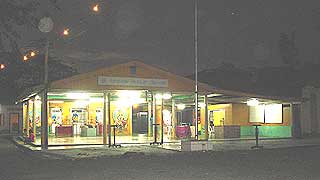 These Indian victims say that the attackers were from outside, who seem to have come into Kampung Medan with a mission.
"My Malay neighbour pleaded with the attackers to leave me alone," said one Indian shopkeeper.
"The residents in Kampung Medan know each other well. They all agree that those who attacked the Indians in March 2001 were not Malays from the neighbourhood," said Arumugam.
If that was the case, who were they then?
MIC president S Samy Vellu was quoted in local media on March 25, 2001 as saying the attacks were organised and that the attackers behaved as if "they were told by somebody to do it".
Don't dig up the past
However, local Malay residents told malaysiakini that outsiders did not start the incident.
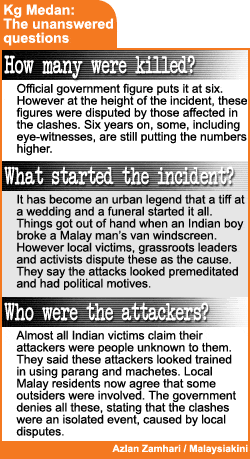 "I believe some small misunderstanding started the clash. After that it blew over and local Malay boys were then seen moving about armed with parang. They were looking for the Indian boys," said a long-time resident Aminah Hassan, 53.
But she conceded that a few days later, locals noticed the presence of many Malay youths who had come from elsewhere to protect the local Malays.
"We don't know who asked them over but they were here," said the Umno veteran member.
When malaysiakini contacted local Umno leaders to talk about the situation in Kampung Medan now, they were all reluctant to speak openly on the incident.
"It is still a sensitive matter. It is a black mark in our history here. We don't want to talk about it," said a division leader.
Most Malay residents said they would prefer to move on and forget the fateful March 8 and the days that followed.
"We are trying to get back to normalcy here with our Indian friends. Let's not dig up the past," said an elderly resident who wished to remain anonymous.
Tomorrow: Double tragedy: Being victims and social outcasts
Watch the 12-minute video here.


Report this comment
Are you sure you want to delete this comment?
This action cannot be undone.