




Ex-judge: Quit if you cant take the heat
If you can't take the heat, get out of the kitchen - that is the message from an ex-judge to his former colleagues who worry they will rule against their conscience in controversial religious cases.
If you can't take the heat, get out of the kitchen - that is the message from an ex-judge to his former colleagues who worry they will rule against their conscience in controversial religious cases.
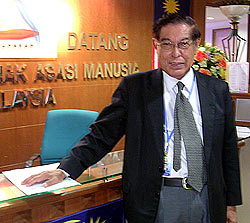
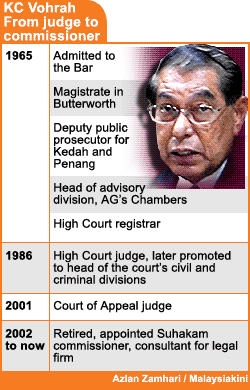
Retired court of appeal judge KC Vohrah reminded judges that they are bound to execute their duty in accordance to law and the Federal Constitution regardless of their beliefs.
"If you feel it's against your conscience to do something, then don't become a judge," Vohrah, who retired in August 2002, told malaysiakini in an interview this week.
His comments came in the wake of growing concern within the legal fraternity on the creeping Islamisation into the judiciary, which has been described by an ex-top judge as worrying .
A judgment pattern
Some legal practitioners have observed a pattern of judgments in recent cases involving apostasy and conversion.
 They noted that Muslims judges tend to rule in accordance to their faith while non-Muslim judges who sat on the same panel are likely to dissent the judgment based on one's rights under the Federal Constitution.
Asked to comment on this, Vohrah cited two cases in his response.
The first, he said, involved a highly-respected Catholic judge - whom he did not name - who was asked to hear divorce cases.
"In the Catholic faith, divorce is not permitted and when he was asked to sit in divorce cases, he pronounced the divorce because he upheld his duty when he took an oath under the constitution to execute the duty in accordance with the constitution," Vohrah noted.
In the second case, he cited the example of former Anti-Corruption Agency director-general Zulkifli Mahmood, who served the agency between 1987 and 1994 and was offered the post of judge in the 80s.
"He declined. You know the reason? He said because as a Muslim, he didn't believe in capital punishment and if he accepted the post, he would have to sit as a criminal judge then it will be against his conscience.
"That was many years ago and some friends of mine had also declined (such offer) on the same ground," Vohrah added.
Judges overlooked
On another note, Vohrah reiterated the necessity to establish an independent judicial services commission to deal with the appointment and promotion of judges.
The 12,000-strong Malaysian Bar has been pushing for the establishment of such a commission to help promote transparency in the exercise, but the proposal was shot down by the government.
Vohrah said the commission, with disinterested persons as members, can spell out the criteria in the selection and promotion of judges which are ambiguous at the moment.
 "We must measure ourselves with the best. We must have men who have intellectual depth, integrity, written judgment which have been published - there are those who have written hundreds of judgments and some not at all," he said, adding that seniority should top the consideration.
The ex-judge also joined in the fray to lament that many senior judges in the appellate and high courts who deserved to be promoted were overlooked in the recent judicial exercises.
"I honestly don't know the reason. If you ask me on some of the recent appointments - I have to quote [the exclamation] from the lawyers, "Oh my God, really?"
"You begin to wonder why do they said that. There must be something wrong," he said.
Vohrah also hoped that the camaraderie between the bench and bar could be restored to what it was like the old days and he described the relationship as "could be better" at present.
'Not easy to prosecute'
 Meanwhile, he shared the same sentiment with Attorney-General Abdul Gani Patail who has defended his chambers which came under fire after the accused in a series of high-profile cases were acquitted.
"I agree with his (Abdul Gani's) point of view that it's not easy to prosecute," said Vohrah, who had also served as a prosecutor in the AG's Chambers.
Suggesting the prosecutors could not be blamed solely, Vohrah said the prosecution of a case often depends on the investigating officers and the testimony of witnesses when they take their stand.
He said he had noticed there were a lot of young and inexperienced investigating officers even since 10 years ago.
In the first part of the interview yesterday, Vohrah said the Federal Constitution should not be read pedantically in relation to the rulers' power.
This came in the wake of the reported rejection of the government's nominee for the chief judge of Malaya by the Conference of Rulers.
What another top ex-judge said


Report this comment
Are you sure you want to delete this comment?
This action cannot be undone.