




Q&A: Why the sex tape was destroyed
Human Rights Commission (Suhakam) chairperson Abu Talib Othman is often remembered for the many controversial decisions made during his 13-year tenure as attorney-general.
In an interview with malaysiakini , Abu Talib said the decisions were relevant and correct at that point of time. One of them was the destruction of vital evidence that could have implicated a former high-profile politician of sexual offences in 1992.
Human Rights Commission (Suhakam) chairperson Abu Talib Othman is often remembered for the many controversial decisions made during his 13-year tenure as attorney-general.
In an interview with malaysiakini , Abu Talib said the decisions were relevant and correct at that point of time. One of them was the destruction of vital evidence that could have implicated a former high-profile politician of sexual offences in 1992.
He also explained the basis for drafting Article 121(1A) of the Federal Constitution (an amendment stipulating that the civil courts have no jurisdiction on matters within the jurisdiction of the syariah courts).
Malaysiakini: There have been many decisions that you made as AG that were quite controversial.
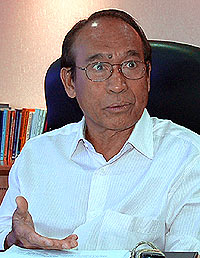 Abu Talib:
Yes. I accept that. I drafted 121(1A), I amended ISA (Internal Security Act - in which detainees no longer have the right to judicial review), which is now very controversial, I defended those cases, I defended the case in court with regards to the constitutionality of the death sentence. I went to the highest court based on the applicable law.
Abu Talib:
Yes. I accept that. I drafted 121(1A), I amended ISA (Internal Security Act - in which detainees no longer have the right to judicial review), which is now very controversial, I defended those cases, I defended the case in court with regards to the constitutionality of the death sentence. I went to the highest court based on the applicable law.
Were you doing what the government asked you to do?
No. I appeared on the basis that it was my duty to defend the law passed by Parliament. My argument is purely based on the law.
But you may personally disagree with it.
The question of whether I disagree with it or not is not relevant. I appeared for and on behalf of the government, the state. My statements today are quite different on, for example, the death sentence. (We have said that) it is inhumane, (thus) the government should reconsider it.
The ISA, as I have mentioned, does not provide sufficient safeguards, so after thorough investigation and debate, we (Suhakam) decided the government should review it - have another law, but there must be safeguards.
121(1A), well that's a matter of respect for another religion. That does not amount to legislating religion. It's a question of making it the jurisdiction very clear. How you interpret it is entirely up to you.
 It's quite clear. In the matter of religion, only the Syariah Court would be well-versed in that. You don't expect the civil court to understand. If at all, you can call the syariah people as experts to give evidence.
So for the purpose of jurisdiction, in my view, you should go to a court competent to adjudicate on the subject matter. Hence, revise that legislation. You can say it is wrong, you can modify it, it is up to you.
But don't you think there would be more confusion? If I go to a syariah court judge to apply the secular law, how can you put secular law on a matter that is purely Islamic law? There must be some separation.
Therefore, there's a clear separation. But people exploit it and confuse everything. If there are shortcomings, we can always review it. No law is cast in stone. Things change as we move forward. At that time, human rights was not on everybody's lips. Today, even the government has accepted it as a means of administration.
As a drafter of 121(1A), do you accept that the civil court judges argue that they have no jurisdiction on issues of religion?
It is a matter of interpretation. We make it clear that what is purely a matter of Islamic law, for example, divorce, inheritance... (for example) under the Quran, the son gets more than the daughter - that is the belief in religion.
What about the cases of M Moorthy, M Revathi... (disputes of jurisdiction between civil and syariah courts)
It has been argued and blown out of shape. The government advisors should sit down and think about it. The court has indicated quite clearly that it is for Parliament to resolve it. Parliament has got advisors, it is for them to sit down and decide how to review it.
Apparently the judiciary is now pushing the ball back to Parliament...
Precisely! That's why I made the statement that the judiciary should be bold enough to interpret the law before them. I'm not saying they're not (bold). It's been said that it should be for Parliament to review it. The law is initiated by Parliament. These people should sit down and look at the problem now raised.
When you draft (a law), you cannot think 20 years ahead. Can you imagine what was going to happen 20 years ahead? That was the law, and that is why the law changes. The Constitution clearly provides a procedure for amending the law.
During my time, there were a lot of (legislative) amendments - I'd like to look at that book that says there were 50 amendments to the Constitution during my time - but it was right at that time. Now, people should look at it and do what is necessary in the interests of the nation going forward.
Have you regretted the decisions you have made when you were AG?
 I have not regretted any decision I made because the decisions I made were relevant and necessary, in my view, at that time.
The decisions made, the majority were contested in court, but the courts agreed with me, so.... so what? I had a very tough time during my time. Definitely. The constitutional crisis, the political crisis, I thank God for showing me the light.
You cannot deny there was pressure on you from the government.
What pressure? Tell me. There was no pressure on me.
For instance, the destruction of the sex tapes involving a former top MIC politician.
Let me explain. Where you make a decision, you also have to think of other people. This poor girl had been exploited and humiliated. Do you want her to be further humiliated?
There is such a thing as tempering justice with mercy. It is for that reason that I believe the Constitution was drafted in such a way that it gives discretionary power to the public prosecutor to charge or not to charge.
The only thing that can be done is to order the destruction of the tape. But the police did not destroy. It went flying around. That is out of my control. The direction was in good faith and in the interest of the poor girl who had been exploited and humiliated. Is it fair to further humiliate the girl?
The police did not destroy the tape?
I don't know. My instruction clearly was, on the basis of humanitarian grounds, we won't prosecute this because the robber was detained, we would destroy this so that it would not cause further humiliation to the victim. It was a clear instruction. Whether the police did it or not, I cannot tell...
The public would argue that the person who did this had to be punished...
You punish this man, and he might go to jail. But this poor lady will live through her life subject to public contempt and humiliation. Do you want that? People only look at one side, because he was a politician - nothing more than that. I looked at it from the human point of view. Let's say, (what) if it was our sister or our daughter? Can you take it?
So you are saying that it was not a directive from the government.
I can tell you the government criticised me. I was asked to explain. It was not an easy case.
Was there pressure from MIC?
No. In fact, I was asked by the (former) prime minister (Dr Mahathir Mohamad) why I did it. Yes. Those days, you cannot escape the eyes of the prime minister. He is up to date. It's not an easy thing. No pressure. He has got his views. You have to explain.
Other people might have copies of the tape already...
I don't think so. The tape was in a safe, and the safe was thrown away... So, it was not that I was pressured. I was, in fact, asked to explain.
Do you feel that you've been hard done by?
 I wouldn't used those words. I had a difficult time during my time because of the controversial issues raised. I only had my law books at that time. I had nobody else to consult, because others had vested interests.
I can only sit down in my chambers with my law books and argue with my officers. During my time, I allowed my officers to criticise me, and we had a very good time.
When I had meetings with them, I told them they are free to say their piece. Forget that I'm your boss, we sit down as lawyers, and we argue. Not on all issues, but on critical issues on which I'm not sure, I'd sit down and let them challenge the issue before we make the final decision and before a legislation is submitted to Cabinet.
Was I under (political) pressure? No. Did I have a difficult time? Yes, because it was a change of administration. Many policies which were introduced could not be implemented because of the law.
I can tell you that when they wanted to do the North-South highway, when (parliamentary opposition leader) (Lim) Kit Siang challenged it. I went up and down the courts with five judges, and that led to a lot of controversies.
We went through with it, but on the question of toll, you go to the state, there was such (provisions). Everybody said cannot. There is nothing that the state cannot do for the sake of the public. There must be a way. After all, this country is ruled by law. I came up with that law and we moved on.
Do you think the public failed to understand?
As a government servant, it is not your duty to explain to the public. You have to do what you have to do. If you don't agree with the policy, you leave.


