




AG ticked off for 'taking risk' on prosecution
Attorney-General Abdul Gani Patail has been criticised by a former colleague for 'taking risks' in prosecuting cases where he was not 90 percent sure of obtaining a conviction.
Attorney-General Abdul Gani Patail has been criticised by a former colleague for 'taking risks' in prosecuting cases where he was not 90 percent sure of obtaining a conviction.
 Abdul Gani (
left
) reportedly said that "calculated risks" must be taken to avoid public perception that the AG's Chambers was attempting to cover up certain matters.
Abdul Gani (
left
) reportedly said that "calculated risks" must be taken to avoid public perception that the AG's Chambers was attempting to cover up certain matters.
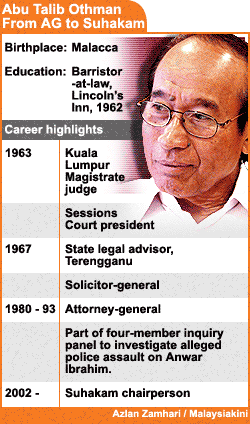
But according to Human Rights Commission (Suhakam) chairperson Abu Talib Othman, who was AG from 1980 to 1993, he had introduced the '90 percent rule' during his 13-year tenure and that cases should not be brought to court unless the criteria was met.
"It's a matter of whether you have evidence. You only prosecute a person if the person clearly committed a criminal offence. What the public perceives and wants are not relevant.
"There is public interest. There must also be the interest of the accused. It's not fair that you prosecute me just because the public thinks I"m guilty. Then what is the purpose of having a court?
"It would be a dangerous trend if the prosecution is based on what the public and politicians want. I have not done it," he told malaysiakini during an exclusive interview on Tuesday.
A case in point, said Abu Talib, was the trial and subsequent murder conviction of Umno politician and former youth and sports minister Mokhtar Hashim in 1983.
"Do you think the government was happy when I prosecuted a minister for murder? I went through with it. It was tricky and difficult so I prosecuted the case myself. I would not ask my deputies to do it," he added.
Jury still out on cyber DPPs
 Abu Talib also said that the jury was still out on the attorney-general's recent directive to deputy public prosecutors (DPPs) compelling them to publish case reports on the Internet.
Abdul Gani argued that the move would make the AG's Chambers more transparent and accountable as prosecutors would have to explain themselves should they lose a case due to prosecutorial error.
Since last month, government lawyers have been publishing the case reports online . This is part of efforts undertaken to allay fears over perceived mishandling of cases.
Commenting on this, Abu Talib said it is till too early to tell if the 'cyber DPP' directive will make an impact.
"Give him (Abdul Gani) a chance to implement his policies and let's see if that is a way of enhancing the performance in the chambers."
However, Abu Talib cautioned that similar ideas undertaken by other government departments have made little headway.
"Most government websites go 'kaput' halfway. But, let's give him a chance," he said, adding that the move might also prove to be an added burden for prosecution officers as they are expected to file web reports at 4pm on the conclusion of cases.
Fate of IPCMC?
To a question on police matters, Abu Talib said Suhakam was receiving less reports on police abuse but an increasing number of complaints were on alleged police inaction.
"We have acted on it. (For example in) custodial death (incidents), we have taken a stand where we would hold a inquiry if they don't initiate an inquest. But when they hold an inquest, there is a question of dates by the court. The court (could) postpone a case indefinitely," he said.
 Abu Talib, however, refused to be drawn into speculating why the establishment of the much-touted Independent Police Complaints and Misconduct Commission (IPCMC) was still pending.
"We have urged that the IPCMC be established. But the reply we always get is that it is still with the AG. I guess it must be very difficult to come out with it," he said with a tinge of sarcasm.
On the upcoming Ikatan RELAwan Rakyat (Rela) bill, Abu Talib said Suhakam has held dialogues with the controversial volunteer corp, who's members are often accused of being perpetrators of human rights violations.
"We can only advise them. If they accept our advise, then it's good. If they don't accept our advice, we have discharged our function in promoting the protection of human rights.
"The response was very good. But so far, there is no more (reported cases) of (beatings) by Rela (members)," he said.
The Rela bill, expected to be tabled during the next Parliamentary session which convenes on Monday, would seek to make the volunteer corp a full-fledged government department.
Q&A: We're gov't advisors, not supporters
Part 1


