




Subashini can 'submit' to Syariah Court
The Federal Court today heard that R Subashini can seek relief from the Syariah court even if she is a non-Muslim because the subject matter falls under the religious court's purview.
The Federal Court today heard that R Subashini can seek relief from the Syariah court even if she is a non-Muslim because the subject matter falls under the religious court's purview.
 Mohamed Haniff Khatri Abdullah, who is appearing for Subashini's husband T Saravanan, told the three-man bench led by Justice Nik Hashim Nik Ab Rahman that the secretary can submit to the Syariah court under constitution and legislation provisions.
He said the subject matter concerning the divorce and custody fell under Article 121(1A) which states that the civil court has no jurisdiction on matters under the purview of the Syariah court .
"It is for her to waive her immunity. She can go to the Syariah court and she can submit to the jurisdiction of the Syariah court.
"The Syariah court won't be able to stop her because the subject matter is clearly under its purview," he said.
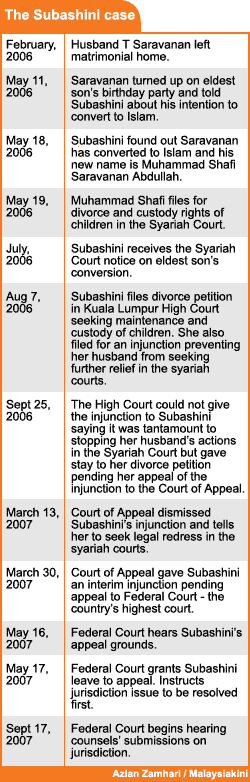
Subashini, 28, a Hindu, is trying to stop her 31-year-old husband, who has converted to Islam and assumed the name Muhammad Shafi Saravanan Abdullah, from taking matrimonial proceedings to the Syariah court.
Her husband converted in May 2006 along with their eldest son, Dharvin Joshua, 4. The husband then launched proceedings in the Syariah court for divorce and custody of their second son, Sharvin, 2.
Haniff also said Subashini can seek remedy under Section 53 of the Administration of Islamic Law (Federal Territories) Act 1993 which states that 'any party or person interested' can be given justice in the Syariah appeal court.
He argued that this act is wide enough for Subashini to be an applicant or plaintiff in any matters before the Syariah court unlike Section 51 of the Law Reform (Marriage and Divorce) Act 1976.
'Unfair and unjust'
 Yesterday, Subashini's counsel Malik Imtiaz Sarwar said the civil marriage
should be governed
by the LRA which includes all matters flowing from the marriage such as divorce and custody.
Yesterday, Subashini's counsel Malik Imtiaz Sarwar said the civil marriage
should be governed
by the LRA which includes all matters flowing from the marriage such as divorce and custody.
Haniff pointed out that Section 51 of the LRA states that only a non-Muslim spouse can become the petitioner in a divorce petition and applicant while the Muslim spouse is compelled to remain as a respondent.
"Such a provision is not only unfair and unjust but is also beyond the power of Article 8 (1) of the constitution that ensures equality before the law.
"This means the Muslim spouse can never be a petitioner and in our case, our client has no relief in the civil courts. (To use Section 51 of the LRA) is not right, that would be discrimination," he argued.
The counsel also stated that the LRA contravened Article 76(2) of the constitution which disallows Parliament to legislate on Islamic law until the government or state authorities are consulted on it.
Haniff said Section 51 of the LRA that denies a Muslim convert a right to petition for a divorce is a form of legislation on Islamic law.
"Section 51 takes Saravanan out of the jurisprudence of a competent court such as the Syariah court and into the civil court that has no say on Islamic matters, this is a clear violation of Article 76(2) and Article 8," he said before concluding his submissions.
The lawyers will submit on the appeal application on the divorce and custody matters when the hearing resumes on Monday.


Are you sure you want to delete this comment?
This action cannot be undone.