




Dr M on why we're not feeling good
The economy is doing well. Last week, the government said that Malaysia’s economy surpassed all expectations by growing 6.3 percent in 2007.
But why is there no 'feel-good' feeling on the ground?
The economy is doing well. Last week, the government said that Malaysia’s economy surpassed all expectations by growing 6.3 percent in 2007.
But why is there no 'feel-good' feeling on the ground?
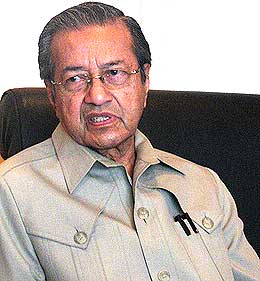 Former prime minister Dr Mahathir Mohamad has the answer. According to him, the economic growth is not translating into jobs and higher income for the people.
“If a man earns RM1 million a year - and he is among 1,000 people - the average earning of these 1,000 people is 1,000 dollars per year. Whereas actually the 999 will earn nothing at all. That is the problem with statistics and averages.
“I used to tell people in my speeches that a man can drown in a river that its average depth is two feet. So when we play with averages, we can make things look good especially when we skew things to make it look good.
“That is why although the economic growth is there but it doesn’t translate into jobs for the people or into better income for the people.”
 In an exclusive interview with
Malaysiakini
at his Perdana Leadership Foundation office in Putrajaya, Mahathir argued that while the country cannot stop inflation, it can however control it by not raising prices too rapidly.
In an exclusive interview with
Malaysiakini
at his Perdana Leadership Foundation office in Putrajaya, Mahathir argued that while the country cannot stop inflation, it can however control it by not raising prices too rapidly.
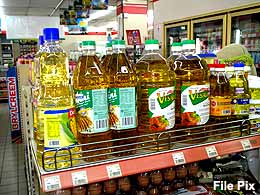
“The increase in the price of oil is real. It increased by almost 300 percent. It is impossible for the government to meet that by subsidising (it). They can subsidise, but not fully. Perhaps the government could increase the price of oil a bit more gently so people will not feel it so much.”
He said one way to put a lid on inflation is for the government to exercise control over the country’s exchange rate regime.
“Instead of controlling the exchange rate and benefit from the strengthening of the Malaysian ringgit, they (the government) allowed the Malaysian ringgit to float and when it strengthens, you get no benefit because you cannot use that to control the prices in the country.”
Re-pegged ringgit
Mahathir, who was also finance minister at the tail-end of his 22 years in power, argued that the government should not have unpegged the ringgit, a controversial policy he introduced after the Asian financial crisis in 1998.
“China pegs the ringgit. What are we ashamed about? What do we care about what the IMF (International Monetary Fund) says? We thumb our nose at the IMF and we still get away with it.”
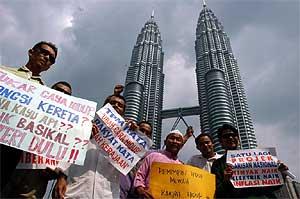
 The former premier believed that the ruling Barisan Nasional coalition will be punished by voters at the general elections tomorrow as a result of price hikes despite that the government had made a flurry of announcements on multi-billion dollar investments in five key ‘corridors’ projects.
“What is important is not so much the speeches, the media but the reality of prices going up. You see, that is something that they feel. So that will influence them more than all the speeches and all these corridors and all that.
“So (even if) there is a corridor, I am not going to get anything. What I know is that I am paying a higher price for food and fuel.”
Part 1
Mahathir: We need an opposition
Q&A: No gentleman's agreement between us
Part 2


Report this comment
Are you sure you want to delete this comment?
This action cannot be undone.