




Judicial reform - we want much more
Opposition leader Lim Kit Siang said he was “disappointed” because he had expected “more, much more” from Prime Minister Abdullah Ahmad Badawi who announced a number of reforms to the judiciary.
Meanwhile, Gerakan acting president Dr Koh Tsu Koon described the setting up of a judicial appointments commission as “a major right step in the right direction” and held out hopes that this will lead to other reforms.
Opposition leader Lim Kit Siang said he was “disappointed” because he had expected “more, much more” from Prime Minister Abdullah Ahmad Badawi who announced a number of reforms to the judiciary.
Meanwhile, Gerakan acting president Dr Koh Tsu Koon described the setting up of a judicial appointments commission as “a major right step in the right direction” and held out hopes that this will lead to other reforms.
But others ticked the PM off for not trying to exorcising the ghosts of the past.
DAP leader Lim Kit Siang
I had expected more, much more, than what was announced by Abdullah.
 The thunderous and prolonged applause which greeted Abdullah's recognition of the "contributions of these six judges to the nation, their commitment towards upholding justice" and acknowledgment of "the pain and loss they have endured" in the 1988 judicial crisis cannot hide the general disappointment that the prime minister had fallen far short of expectations to ensure a fair and just closure to the Mother of Judicial Crisis in 1988.
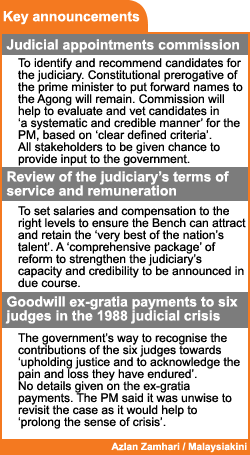 It is precisely because the "contributions, pain and loss" of the six wronged judges cannot be equated with mere currency that the ex-gratia payment is grossly inadequate. The six wronged judges deserve a full and proper recompense.
A royal commission of inquiry – a judicial ‘truth and reconciliation’ commission - into the 1988 ‘Mother of Judicial Crisis’ and two decades of judicial darkness should be set up precisely as the victims of the ravages to the justice system were not just to six wronged judges but the Malaysian people and nation which cannot be computed in monetary terms.
The objective of such a judicial ‘truth and reconciliation’ commission should not be punitive but to find out what went wrong to cause the country to be enveloped by two decades of judicial darkness – why the various national stakeholders, the judiciary, Parliament, mass media and civil society failed the test to defend the cardinal constitutional principles of the doctrine of separation of powers and an independent, impartial and competent judiciary.
It is only with such a comprehensive investigation and serious soul-searching that we can ensure that another ‘judicial darkness’ will not descend on Malaysia in future.
Gerakan acting president Dr Koh Tsu Koon
 Gerakan welcomes and describes the prime minister’s announcement to set up a judicial appointments commission as “a major right step in the right direction” towards overall judiciary reform.
We believe the government will soon take very quick and concrete measures to set up the commission which should have representatives from the legal profession and civil society.
Hopefully, this will lead to other reforms that will restore public confidence in our judiciary.
Gerakan has been calling for judiciary reform to restore the independence, integrity and image of the judiciary, which was badly damaged since the 1988 ‘assault’ on the judiciary.
Last year, Gerakan was the first Barisan Nasional component party to openly support the setting up of a royal commission on the VK Lingam video-clips.
Subsequently, Gerakan also called repeatedly for judiciary reforms, including the setting up of judicial appointments commission.
PAS president Abdul Hadi Awang
 With the reform, PAS hopes that integrity of our judiciary can be restored. We hope that other areas such as governance, the democratic system and media also receive similar reforms.
In this regard, PAS wishes to congratulate and thank former lord president Salleh Abas and the other five judges on the government’s acknowledgement of their contributions and the ex-gratia payment they are about to receive.
Their efforts will be remembered in our judicial history as an example of how truth and justice will prevail eventually.
PAS feels that the ex-gratia is a sign of the government’s guilt in the sacking and suspension of the six judges. However, PAS feels the government should also offer a public apology over the incident.
Subang MP and senior lawyer R Sivarasa
 We welcome the setting up of a judicial commission. It means the prime minister has now taken a position which we have been arguing for years - that there should be a (transparent) system of appointing judges, it’s glad that the government is now open to it.
But we must remember ultimately the effectiveness of the commission is measured by the people who are there (in the commission) and (how far it will) reflect the stakeholders. That we have to wait and see.
My main disappointment is however the PM talks about judicial reform but failed to address two critical areas of the judicial reform.
First is the amendment to Article 121 (1). De facto law minister Zaid Ibrahim has mentioned it and we would have supported it in Parliament but Prime Minister Abdullah is completely silent on that. That is way, way disappointing.
Secondly, he mentioned about corruption in his speech - which is correct - as it is part of the reality in the judiciary today, but he is absolutely silent on what he is going to do about it.
Any attempt to deal with judiciary reform must have proposal to deal with the existing corruption first.
Aliran president P Ramakrishnan
It was the Barisan Nasional that destroyed the judiciary in its desire to make it subservient to the executive. We have witnessed shocking judgments that denigrated the judiciary and bewildered litigants who had turned to the judiciary in seeking justice.
How can we reconcile ourselves to the fact that deserving litigants were robbed of their just dues because of a corrupted judiciary? Who will undo these wrongs and bring to justice the dubious judges who had betrayed their oath of office to uphold justice?
The six judges who were victims of a political plot to subjugate the judiciary in 1988 were men of integrity, representing the best traditions of the judiciary. Three of these brave and honest judges were unjustly sacked only because there were judges who were willing to do the bidding of the executive.
The executive thought that it could sully the names and tarnish the reputation of these upright judges its wicked scheme to achieve its political aim of turning the judiciary into a convenient tool to serve it. This it achieved and that is why in these last 20 years, the judiciary has lost its lustre and integrity as an institution serving the cause of justice.
It has always been Aliran’s stand that they were wrongly and falsely charged and convicted by a kangaroo court. We want this wrong to be undone and the injustice to be exorcised.
To achieve this it is necessary to revisit the past to put things right. We have to re-examine - this time through a commission of inquiry – the circumstances surrounding the crisis to verify that the charges levelled against the six judges were without merit and that the composition of the tribunals itself was a travesty of justice.
Aliran totally disagrees with the prime minister’s contention, “I do not think it wise or helpful to revisit past decisions as it would only serve to prolong the sense of crisis – something our nation can do without.”
You are wrong, Mr Prime Minister. These judges have suffered long enough. The pain and anguish that they and their family had to undergo and endure cannot be compensated by ex-gratia payments.
The burden of the false and wrong accusation must be removed formally so that they will be seen and viewed as innocent victims of a tyrannical government. We, as caring human beings with the means to rectify a terrible wrong, must act to remove this wrong and set them free.
Suaram executive director Yap Swee Seng
 Suaram welcomes with caution the judicial appointments commission announced by the prime minister as the powers and criteria of selection of the members of the commission have yet to be outlined.
We however regret that the PM wishes to retain its constitutional prerogative in naming the judges to the King. Does that mean that the judicial commission is just an advisory body which will only have the powers to submit names to the PM who will ultimately decide the names to be proposed to the King?
If this is true, then the role of the judicial commission is very limited and may be undermined by the prerogative powers of the PM. Suaram calls on the government to ensure that the judicial commission is constituted with the powers to recommend judges to the King directly.
The recognition of the government that the six judges were wrongly sacked and suspended in 1988, although short of a public apology, is a step in the right direction. While no amount of ex-gratia payment can compensate the great losses suffered by the six judges and the nation for the past 20 years, the most meaningful measures that the government can take is to establish a royal commission of inquiry to investigate the whole judicial crisis in 1988, especially on whether the then-PM Mahathir Mohamad had abused his powers.
We believe that the principle of justice must be upheld by bringing the wrongdoers to book. Impunity should not be tolerated. Suaram calls on the PM to review his decision of not reopening the investigation into the 1988 judicial crisis.
VIDEOS
Ex-lord president Salleh: A moral victory l 3 min
Sivarasa: Other issues on judiciary not addressed l 3 min
Zaid Ibrahim: Sorry can be said in many ways l 2 min
Acknowledgement comes two decades later l 4 min


Are you sure you want to delete this comment?
This action cannot be undone.