




PI case: Lawyers quizzed, Bar concerned
The Bar Council today expressed concern over the number of lawyers being called in for questioning in relation to missing private investigator P Balasubramaniam.
The Bar Council today expressed concern over the number of lawyers being summoned for questioning in relation to missing private investigator P Balasubramaniam.
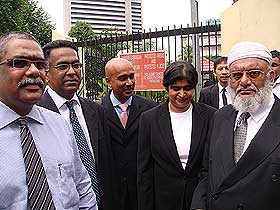 According to the council's president S Ambiga, this is an attempt by the police to intimidate lawyers into revealing confidential information.
This morning, lawyer M Puravalen ( photo, far left ) was quizzed by the Commercial Crimes Investigation Department (CCID). He is the third lawyer to be summoned over the case, besides Americk Singh Sidhu and N Surendran.
"The police are aware of the law. (They know) this is a question of privilege and that the information cannot be disclosed. So what is the reason for calling in the lawyers if it is not to intimidate?" asked Ambiga ( right ).
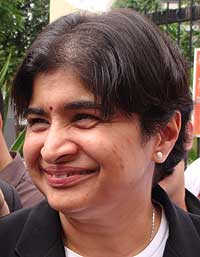 She said that the legal system would break down if a client's privilege is not respected by all parties, adding that she wrote a letter this morning to the inspector-general of police on the matter.
"We see it as an act that interferes with the independence of lawyers. We see it as an act of intimidation and an act which could amount to threatening lawyers into revealing information.
"It is an inference in the whole criminal justice system if lawyers are not free and cannot act in the interest of the client," said Ambiga, who was one of the five lawyers who accompanied Puravalen this morning.
A case of intimidation
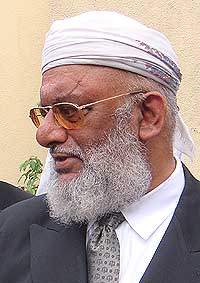 Former Bar president Sulaiman Abdullah (
right
) also voiced his dissatisfaction, saying lawyers will not tolerate any form of intimidation.
Former Bar president Sulaiman Abdullah (
right
) also voiced his dissatisfaction, saying lawyers will not tolerate any form of intimidation.
"We are here to show that the Bar Council definitely deprecates (this) and we are against any form of intimidation no matter how polite the questioning session was."
"The mere act of calling in a lawyer to take a statement is intimidation and we will not stand for it," he said.
Puravalen had represented Balasubramaniam in the Altantuya Shaariibuu murder trial.
Balasubramaniam recently rocked the nation with his explosive statutory declaration. In his first declaration dated July 1, he linked Deputy Prime Minister Najib Abdul Razak to Altantuya, including that the duo had an affair.
In his second declaration dated July 3, he claimed that the first was made under duress and stated that all allegations concerning the deputy premier were inaccurate .
Following this, he left the country with his wife and three children.
A privilege to protect clients
"The law is very clear; a lawyer cannot answer unless his client (expressly) allows him to and in this case a written consent is required. The lawyer has absolutely no other option," said Sulaiman.
"So unless the police can show a written consent from the client and until the lawyer has the opportunity to clarify with the client, he cannot say anything. No matter how important it is, even if it concerns national security, the client's interest is paramount," he added.
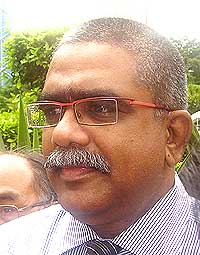 Puravalen (
right
) explained that lawyers had the right to keep mum to sustain the confidence of the client.
Puravalen (
right
) explained that lawyers had the right to keep mum to sustain the confidence of the client.
"The privilege is not to protect lawyers but it is a privilege to protect and promote the interest of the client. You cannot have a professional relationship if the client is unable to repose confidence," he said.
Sulaiman stated that the Bar Council has referred the matter to the relevant enforcement authorities but to no avail.
"I don't know why they are still calling lawyers. It is a waste of manpower as they are highly qualified police officers. They should be fighting crime."
However, Sulaiman said he was confident that police would cooperate and realise that their actions were counter productive.
"We are part of the same justice system - the police, the prosecution and the lawyers - each of us are a part of the system and we have to recognise and appreciate the system. The police cannot try and subvert the workings of the system just for an immediate advantage," he added.
Right cannot be compromised
Speaking to reporters after the 60-minute session, Puravalen said he had declined to respond to questions that were contradictory to his professional relationship with his clients.
"We were treated respectfully (by the police). But I think we ought to remind ourselves that the criminal justice system has various stakeholders. One is the law enforcement agency and the other component is the legal profession," explained Puravalen.
He added that the fundamental part of the legal profession is the right of access to counsel. The very existence of the criminal justice system in the country would be affected if this right is eroded.
"There are no two ways about it, no compromise, no half-way measures. It is a fundamental (right) that cannot be compromised."


Are you sure you want to delete this comment?
This action cannot be undone.