




Forget mega-projects, SMEs are our 'golden' goose
The playing field for our local businesses must be levelled. Malaysian business pay a much higher cost of operation compared to their counterparts in Thailand and Taiwan.
The playing field for our local businesses must be levelled.
Malaysian business pay a much higher cost of operation compared to their counterparts in Thailand and Taiwan. It is important to point out that the business community; especially the businesses owned by the locals; are paying a different and higher price for the input for their production.
Malaysian planners know well that the local businesses are the most important source of growth and jobs for the economy; given the global competition for FDI and the changing economic dynamics of the region, there has been little growth of the FDI-invested sector in this country.
In fact, foreign owned businesses have suffered a reduction in scale and number. While local businesses have been the pillar of the economy, yet they are not supported by local operating condition that helps them gain a competitive edge especially for those in the export sector.
For logistics, local businesses have to pay road tax, excise duty on cars, and toll. In Thailand, cars only pay a one-time road tax and there is no toll and no excise duty. In Malaysia, in additional to an annual road tax, businesses do not enjoy concessions in cheaper toll rates or excise duties for vehicles used for industrial uses.
By keeping the ringgit strong, it works against our manufacturers who export; local manufacturers who are exporting their products need to work extra hard to protect their margins.
The old subsidy plan on oil and current subsidy plan on essential items such as cooking oil and flour does not favour the productive sector. They have to pay an industrial price for these inputs. While the practice of getting businesses to pay the real price is good; the practice of subsidising both the rich and poor is not a good allocation of the nation’s scarce resources.
Protect the goose
If the productive sector is the "goose" that lays the golden egg, we must do all we can to nurture and protect it, the government should look into creative schemes to support them with competitive prices for their input.
The manufacturing sector produces RM152 billion out of the total GDP of RM505 billion, equivalent to 30% of the GDP. Medium-sized SMEs makes up a large proportion of this sector. Combined with the service sector, there are estimates putting the SME sector at 45% of the GDP. The Malaysian government draws 80% of its income tax from corporations and only 10% from individuals. Hence these local businesses form a critical source of tax revenue for the government.
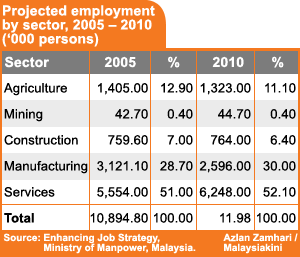 There are 600,000 enterprises (classified under Sdn Bhds) in the country and according to the SME Report of 2006, 99.2% belong to the small and medium enterprise (SME) category. These are the local businesses.
They together employed some 65% of the total working population of 11 million, around seven million people. Eighty percent of these SMEs belong to the micro-enterprises, with turnover of less than 25 million and employing less than 10 people.
In times of difficulty; they will cut back as much as they can, and only retain their family members. The SME Association warns that this sector can downsize by at least 20-30%. The SME sector must be protected to protect the jobs from disappearing.
The bigger SMEs are the ones that will be most affected by the current economic turmoil, triggered by the fuel hike. Medium and bigger SMEs employ a large number of workers; for example in the food manufacturing sector; each enterprise employs between 500 to 1,500 workers, and many export up to 40% of their total production.
The hike in gas, diesel and electricity for industrial use has increased their overall cost by eight to 15%, with net margins ranging between 3-5%; they face serious challenges of survival. In the last decade, global competition has driven down their margins; in fact the entire global business community has been operating with laser thin margins; many could not withstand the impact of further increase in cost.
The SME Association has warned that as much as 20-40% of the SMEs will be forced to closure in the next six to 18 months. Should this happen, this would push unemployment rate to go into double digits
It is critically important to protect the existing matured goose that lays the golden eggs than to spread resources out on new initiatives such as the development corridors. The policy measures must aim at helping these businesses to survive and to enhance their competitiveness; no amount of loans or delayed repayment would help. We should help these businesses increase their yield.
Give priority to protect local business
In order not to put the economy into a downward spiral, the local business community must be saved first. The local businesses are the ones employing the largest number of people. Protecting them, we protect income, and banks and government revenue. The local businesses will pose a much more potent effect on the overall downward spiral.
Protect the input, not by dishing out more loans
The correct measures should be exercised at the input end to make the businesses competitive and to protect their margins. This is not done by dishing out one time loans such as the RM1 billion announced earlier by the government to support the SMEs. Measures to aim at providing local businesses with competitively priced-energy input; and revise energy prices for industries as follows as soon as possible:
Diesel, gas and electricity used for industrial uses will not affect much of the overall savings the government plans with the June 6 fuel hike as petrol takes up the largest portion.
As mentioned earlier, industries only use up to 20% of the total gas; in terms of usage and therefore subsidy allocation. The Federation of Malaysian Manufacturers has indicated that only some 630 companies use 20% of the gas consumption in the country. However the number of people employed in the sector can be large.
Efficiency of the power sector
For electricity, the impact on Tenaga National Berhad is different; according to the economic report of 2007/2008, 60,000 of TNB’s commercial customers contribute towards 80% of its annual revenue; corporate users are the lifeline of TNB.
TNB must work to protect the profitability of these customers by giving them a package that allows them to enjoy reasonable margin. The Federation of Malaysian Manufacturers (FMM) urged the government to "strictly enforce and monitor energy efficiency in the power sector, in particular TNB," it pointed out that the US power sector which obtains energy inputs at world prices is able to supply electricity to its industry at 20sen/kWh at Henry HubNG price of RM36.92 per mmBTU (exchange rate RM3.2390 to USD1) and rates as at May 29, 2008.
It must also be noted that electricity rates for industrial uses in Thailand, Taiwan and Korea are more competitive than Malaysia.
Malaysia's energy security master plan
From this analysis, the issue is the efficiency of the power generation sector must be seriously reviewed. The government needs to review the relationship between the IPP and TNB, according to the breakdown of 2007, the electricity and industrial sector combined enjoyed a total subsidy of RM18 billion; some 41.5% of total subsidy.
What the rakyat find unacceptable is these oligopolies were subsidised by the government to make huge amounts of profits that only enrich a few. This is the hard choice facing the government; but we recommend that the economy and the millions of jobs should be given priority.
Malaysia’s planners must go back to the drawing board and review our Energy Security Plan seriously; there shouldn’t be any more abhor mega-projects whether to build dams or nuclear plants; as we have competitive advantage in many renewable energy area; chief of which is solar energy.
Technology now exit to generate electricity from photovoltaic cells; as easy as have them planted on the roofs with electricity to power the homes; and any excesses directed to the national grid and distributed for other uses.
Solar energy is the most abundant in the world, Malaysia has abundant sunshine, the infrastructure cost many many billions less than dams, and there is no ecological impact of risks of leakage of toxic nuclear materials, this avenue must be exploited before we look into dams or nuclear plants.
The revision of rates for industries should not affect the government’s plan too much, but may be looked upon as a refinement of the cutting back measures. However, the effect is tremendous. By supporting the local business sector and protecting their margin, the government saves the economy from the serious threat of a downwards spiral with critical consequences.
Public transportation
Since Malaysia can get a good price for the energy it exports; the choice between exports and domestic consumption must be made; if it is not good economics to use gas or our premium petrol to power private cars, then the government must really get serious with the public transportation exercise.
To maximise on our resources, the federal government should spare no time, set up a multi-ministry task force; with the commanding power given to one single ministry, and to decentralise the implementation to thee state government and local municipality levels to immediately work on improving the public transportation system.
The nation must go to work immediately to reduce demand for energy and migrate to fuel efficient modes of production and living. Concrete plans need to be put in to increase the number of users of public transportation from the current 20% to 50% as soon as possible, for all major cities and towns.
Reaching the 50% target in public transportation is not something desirable, but necessary, given oil and gas are finite resources. The energy used in this sector should be put to more productive use in the industrial sector. Moreover, the window of opportunity is very short for Malaysia before we become a net oil importer by 2014.
Part 1: Save businesses, protect jobs
FOONG WAI FONG is Director of Megatrends Asia and best selling authors of several books including The New Asian Way, We have to talk Mr Prime Minister and Culture Is Good Business .


