




Cop: We confiscated CPU, laptop
The police confiscated a central processing unit (CPU) and a laptop from blogger Raja Petra Kamarudin without a search warrant, a witness told the Petaling Jaya Sessions Court today on the third day of the sedition trial.
The police confiscated a central processing unit (CPU) and a laptop from blogger Raja Petra Kamarudin without a search warrant, a witness told the Petaling Jaya Sessions Court today on the third day of the sedition trial.
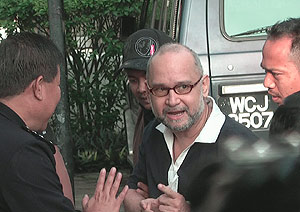 The prosecution's fourth witness, Superintendent Victor Sanjos, said he took away one CPU of a Dell desktop computer and an Asus laptop from Raja Petra on May 2 when a police team went to Raja Petra's house in Sungai Buloh.
Sanjos, who heads the cyber security division of the Commercial Crimes Investigation Department (CCID), testified that he went to the house "to inspect and to confiscate any evidence that is connected to the investigation."
According to Sanjos, he and seven other police officers had been instructed by ACP Mohd Kamarudin Md Din, the assistant director of the cyber and multimedia investigation division in the CCID, to seize "any storage devices that could store data."
The police officer then elaborated on what transpired on the day the he went to Raja Petra’s residence.
Sanjos said when the police arrived at the house on May 2, only Raja Petra and his wife Marina Lee Abdullah were in.
"I met him (Raja Petra) and introduced myself as the police officer from the CCID and showed him my identification card and told him the purpose of the visit," he added.
After thoroughly explaining further details of the visit to Raja Petra’s house, Sanjos said that he asked the latter to direct him towards the computer which is used to access the Internet.
"He (Raja Petra) brought me upstairs and showed me the computer which he uses… it was situated in what that looked like his reading room.
"I took the CPU and the white Asus notebook… (And) swiftly took a glance at the rest of that level," he said.
Moreover, Sanjos said when he found the CPU it was still attached to the monitor, the keyboard and the mouse.
Asked if any other materials besides the CPU and notebook were taken, Sanjos replied "no".
"In my view data can only be stored in a hard disk inside the CPU of a computer," he said, when quizzed why he had not considered confiscating any other materials besides the CPU.
The witness also informed the court that the objects that were seized from the house were later submitted to investigating officer DSP Mahfuz Abdul Majid.
The sedition trial is fixed for a week over Raja Petra's article entitled 'Let's send the Altantuya murderers to hell' which he posted on Malaysia Today on April 25.
Raja Petra was charged under Section 4(1) (c) of the Sedition Act. If found guilty, he could face up to three years imprisonment or not more than RM5,000 fine, or both.
Justice Rozina Ayob is presiding over the case. Hearing continues tomorrow.
Opposition Leader Anwar Ibrahim accompanied by his wife Wan Azizah Ismail also made a cameo appearance in the courtroom today and wished Raja Petra the best before leaving for his trial at the Kuala Lumpur High Court.
Is this a special case?
After a 15-minute stand down, Sanjos was cross-examined by defence counsel Gobind Singh Deo who attempted to put across that the Raja Petra's case was given special attention by the authorities.
Gobind: You (Sanjos) did not arrest Raja Petra that day?
Sanjos: No.
Gobind: Do you agree with my suggestion that you did not arrest him because you did not suspect that he would escape?
Sanjos: I do not agree.
Gobind: Then, why did you not arrest him?
Sanjos: There was no reason to make an arrest.
Gobind: Do you agree with me that a special team was set up for this case?
Sanjos:
Yes.Gobind: Is this a special case that requires a special team?
Sanjos: Just a normal case… for any case at the Bukit Aman level, a task force will be formed and every officer would have a role in it.
No search warrant
During the cross-examination it was also revealed that no search warrant was produced by Sanjos, when he had confiscated the CPU and the laptop.
Gobind: Did you receive instruction to complete the inspection quickly?
Sanjos: No.
Gobind: So there was no urgency in the investigation?
Sanjos: All cases are urgent.
Gobind: Were you pressured?
Sanjos: No, I was not pressured… to me it is normal… it's a routine.
Gobind: Tell me, you said you were not pressured, you agree there was no reason to suspect that the evidence in this case will be disposed?
Sanjos: Yes
Gobind: Did you get a search warrant?
Sanjos: I did not need a search warrant as it was investigated under the Sedition Act, and I had the power to make inspection.
At this juncture, the counsel questioned Sanjos whether he was familiar with the details of Section 8 of the Sedition Act and Sanjos said "yes".
The counsel then asked Sanjos whether he agreed that a warrant is usually needed unless there is reasonable suspicion that the evidence of the case will be disposed.
Gobind then read aloud the particular section under the Sedition Act which stated that '… reasonable cause to believe that in any premises there is concealed or deposited any seditious publication, and he has reasonable grounds for believing that, by reason of the delay which would be entailed by obtaining a search warrant, the object of the search is likely to be frustrated, he may enter and search the premises…'
However, Sanjos disagreed and reasserted it was within his power to confiscate items without the need of a warrant.


Are you sure you want to delete this comment?
This action cannot be undone.